
William E. Pabor
The most experienced town-builder ever to work near Avon Park, and the one whose town failed completely.
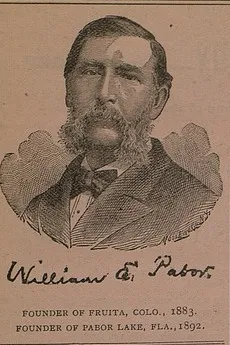
William E. Pabor, engraved for his own newspaper, with his facsimile signature and the line “Founder of Fruita, Colo., 1883. Founder of Pabor Lake, Fla., 1892.” Pabor Lake Pineapple, 15 November 1895, page 173. University of Florida Digital Collections, Florida Digital Newspaper Library, AA00020306. Public domain.[pineapple-1895-11-15]
Before Florida
Pabor was a Colorado colonizer. He had been “connected with the early history” of both Greeley and Colorado Springs — the two most famous planned temperance colonies in the American West — before moving to the Grand Valley on the Western Slope.[ocala-1911-09-14]
In the summer of 1882 Matt Arch began building the Grand River ditch, the irrigation work that “transformed this valley from a desert of alkali and sagebrush to one of the most beautiful and productive fruit gardens of the world.” Pabor became the ditch company’s secretary and it was completed under him. While doing that work he founded the town of Fruita, Colorado. Asked late in life why he had not called the place Pabor, he said he had wanted to emphasize his idea, then only a dream, that this was a great fruit country.[ocala-1911-09-14]
He also wrote. For years he was poet laureate of the Press Association of the United States, which his obituary says made him a national reputation, and for a period he was the agricultural and horticultural editor of the Jacksonville Times-Union.[ocala-1911-09-04]
His method, and where Avon Park fits
Two habits carried from Colorado to Florida.
The colony town built around a single crop. Fruita was named for fruit before there was any; Pabor Lake, founded 18 July 1892 four miles north of Avon Park, was named for its founder and advertised through a newspaper called the Pabor Lake Pineapple. In both cases the town came first and the crop was the argument for it.
Temperance written into the title. At Fruita, Pabor “anticipated by a quarter of a century the public sentiment of this county in favor of prohibiting the liquor traffic and placed in every deed the prohibitory liquor clause, copied from the deeds of Greeley and Colorado Springs.”[ocala-1911-09-14] Whether he did the same at Pabor Lake has not been checked.
Literary editor of a Jacksonville weekly, from Avon Park
In the summer of 1906 Pabor was conducting a books-and-magazines department called “Bright Literature” in The Sun of Jacksonville — Claude L’Engle’s Democratic weekly, published 1905 to 1908 — and the standing note under the column reads: “Books, Magazines and other matter for notice in this department should be addressed to Literary Editor of THE SUN, Avon Park, Fla.”[jax-sun-1906]
The department is a real literary column. The issue of 14 July 1906 opens: “Unquestionably the article of the month in the July magazines is that of Vance Thompson in Everybody’s,” and the 7 July issue carries an epigraph — “Books in the running brooks, sermons in stones and good in everything” — and the line “Our writings are so many dishes, our readers guests, our books like beauty.”[jax-sun-1906]
Two things follow. Pabor was still living at, or working from, Avon Park in 1906, nine years after the last surviving issue of the Pabor Lake Pineapple and five years before his death. His family was also tied by marriage to Avon Park’s pioneer merchant community: on 9 May 1894 his son Charles W. Pabor married Jessie L. Kinney, daughter of Avon Park postmaster Dorr D. Kinney, at her parents’ home in Avon Park, and she was still living in the community in November 1905 when O. R. Thacher reported her trip to Orlando to visit her brother Will Kinney and father D. D. Kinney.[pineapple][dsc-1905-11-17] And a state-circulation Jacksonville weekly was having its literary page edited from a village on the ridge, which is the kind of fact that says more about Pabor’s standing than any of his own advertising does.
Death
Pabor died suddenly, of apoplexy, at Denver, Colorado, on Tuesday 29 August 1911. He had been in excellent health all summer and had greatly enjoyed a visit to Florida. The Ocala paper still described him as “Mr. W. E. Pabor of Avon Park” — nineteen years after founding Pabor Lake and fourteen years after the last surviving issue of his newspaper, he was still a Florida man to Florida readers. He was survived by a wife, four sons and a daughter.[ocala-1911-09-04]
He was buried at Fruita, where he had long said he wished to rest. The funeral was held at the Methodist church at ten o’clock and drew more than two hundred and fifty of the leading residents of the Grand Valley; the Grand Junction News called it “the most remarkable tribute ever paid to the memory of any man on the Western Slope.” Rev. J. J. Lace officiated; former Senator Horace T. DeLong and former Senator James W. Bucklin gave the eulogies. Bucklin called him “a pioneer, a poet, an idealist, a builder: a builder of ditches, a builder of cities: a builder of manhood,” and said he had occupied his body “for nearly four score years,” which puts his birth about 1832.[ocala-1911-09-14] His ultimate legacy centered on Fruita and Colorado horticulture, with Pabor Lake and his Avon Park editorial career representing the final creative phase of his life.[pineapple]
References
- ocala-1911-09-04 — Ocala Evening Star. Ocala Evening Star, 4 September 1911, page 2: W. E. Pabor. 4 September 1911. https://www.loc.gov/resource/sn84027621/1911-09-04/ed-1/?sp=2
- ocala-1911-09-14 — Grand Junction News, reprinted in the Ocala Evening Star. Ocala Evening Star, 14 September 1911, page 2: W. E. Pabor, clipped from the Grand Junction (Colo.) News. 14 September 1911. https://www.loc.gov/resource/sn84027621/1911-09-14/ed-1/?sp=2
- jax-sun-1906 — The Sun (Jacksonville, Fla.), Claude L’Engle editor. Bright Literature, conducted by W. E. Pabor, The Sun (Jacksonville, Fla.), 7 and 14 July 1906. 7 July 1906. https://www.loc.gov/resource/sn95047216/1906-07-07/ed-1/
- pineapple-1895-11-15 — W. E. Pabor, Pabor Lake Pineapple. Pabor Lake Pineapple, vol. III no. 12, 15 November 1895, page 173: engraved portrait of William E. Pabor. 15 November 1895. william-e-pabor-1895-portrait-engraving.md
- pineapple — W. E. Pabor and E. A. Pabor. Pabor Lake Pineapple, October 1892 to September 1897. 15 September 1897. pabor-lake-pineapple.md
- dsc-1905-11-17 — O. R. Thacher, in The De Soto County News (Arcadia, Fla.). The De Soto County News, 17 November 1905, page 8: Department of The South Florida Sun (Mrs. C. W. Pabor visiting her brother Will Kinney and father D. D. Kinney in Orlando). 17 November 1905. https://www.loc.gov/resource/sn95026908/1905-11-17/ed-1/?sp=8
Related
- Entity: Pabor Lake Colony
- Reference: the Pabor Lake Pineapple
- Entity: Oliver Marvin Crosby
- Entity: Dorr D. Kinney
Where this comes from
- Evidence
- corroborated — More than one independent source agrees.
- Review
- unverified — Drafted from sources but not yet checked by a volunteer.
- Rights
- society
Sources
- Ocala Evening Star, Ocala Evening Star, 4 September 1911, page 2: W. E. Pabor (1911)
- Grand Junction News, reprinted in the Ocala Evening Star, Ocala Evening Star, 14 September 1911, page 2: W. E. Pabor, clipped from the Grand Junction (Colo.) News (1911)
- The Sun (Jacksonville, Fla.), Claude L'Engle editor, Bright Literature, conducted by W. E. Pabor, The Sun (Jacksonville, Fla.), 7 and 14 July 1906 (1906)
- W. E. Pabor, Pabor Lake Pineapple, Pabor Lake Pineapple, vol. III no. 12, 15 November 1895, page 173: engraved portrait of William E. Pabor (1895)
- W. E. Pabor and E. A. Pabor, Pabor Lake Pineapple, October 1892 to September 1897 (1897)
- O. R. Thacher, in The De Soto County News (Arcadia, Fla.), The De Soto County News, 17 November 1905, page 8: Department of The South Florida Sun (Mrs. C. W. Pabor visiting her brother Will Kinney and father D. D. Kinney in Orlando) (1905) · newspaper
Something here wrong, or incomplete? The Society would rather know. Tell a volunteer.
Have a question about this record?