
The Black churches of Avon Park in 1938
The record of Black Avon Park is thin almost everywhere else, but a New Deal make-work program left a rich one.
In 1938 the Works Progress Administration’s Historical Records Survey sent workers across Florida with a printed form — “WPA Form 20 HR-FLORIDA Revision, Historical Records Survey — State Archives Survey, Church Inventory Form: 1938” — and told them to fill one in for every congregation they could find, white and Black alike. Twenty-two of the Highlands County cards are for Avon Park. Nine of them are for Black congregations, and they are, by a wide margin, the richest known source on Black Avon Park’s institutions.[wpa-avonpark-cards]
The worker who did most of Avon Park was Lucy G. Crumley, and she was thorough. She asked for the church’s exact name and street, the race of its membership, its denomination and every governing body above it, the year it was organized, every building it had ever used and what happened to each, the present building’s shape, size, material and color, whether it had a bell or colored glass, the name and dates and schooling of every minister anyone could remember — and then, on further sheets, every record book the congregation kept, what was in it, who had it, and what condition it was in.[wpa-beulah][wpa-stjohn]
The nine congregations
| Church | Organized | Street | Minister in 1938 |
|---|---|---|---|
| Saint Mark Baptist | 1916 | Avenue “C” | T. L. Jenkins |
| Mt. Zion Methodist Episcopal | 1921, disbanded 1926, reorganized 1929 | Castle Avenue | G. W. Holmes |
| Saint John Baptist | 1922 | Mill Quarters | Cleve Luter |
| Beulah Baptist | 1923 | Fairfield Avenue | A. R. Robinson |
| Emanuel Tabernacle | 1927 | Carolina Street | H. Johnson |
| St. Mary Primitive Baptist | 1929 | Carolina Street | E. W. Williams |
| Church of Christ | 1932 | Carolina Street | E. C. Myers |
| Church of God by Faith | 1932 | Second Street | Frank Harris |
| Church of God in Christ | 1937 | Mill Quarters | M. B. Blackshear |
Nine. Only two of Avon Park’s Black congregations were otherwise documented — New Mount Olive A.M.E., which the congregation dates to 1919[newssun-mtolive-105] (and the Florida Black Heritage Trail to 1920),[florida-black-heritage-trail] and St. Mark Missionary Baptist, 1916. The other seven were previously unrecorded, and St. Mary Primitive Baptist was not even catalogued among the collection’s numbered items; it turned up only by checking the neighboring item numbers.[wpa-avonpark-cards] (New Mount Olive A.M.E. lacks a digitized WPA survey card in the State Archives of Florida, nor does it appear in the 1939 or 1942 indexes of the Historical Records Survey, indicating it was either not surveyed or its record did not survive.)
Three neighborhoods, and a name nobody had
The addresses cluster, and the clustering tells you how the town was laid out.
- Avenue “C” and Fairfield Avenue — Saint Mark and Beulah.
- Carolina Street — Emanuel Tabernacle, St. Mary Primitive Baptist, and the Church of Christ.
- The Mill Quarters, also written Crate Mill Quarters — Saint John Baptist and the Church of God in Christ, and the homes of officers of several other congregations.[wpa-avonpark-cards]
Fairfield Avenue, Carolina Avenue, Castle Avenue and Second Street are already known, from the 1950 census, as the streets where Black Avon Park lived.[census-1950-black-avon-park] The cards confirm that street map twelve years earlier.
But “the Mill Quarters” was not previously documented. It is not a street; it is a district, named for the crate mill — the works that made the wooden boxes the citrus went north in. A Black neighborhood named after the mill its people worked at, lying, on Saint John Baptist’s evidence, on both sides of the Seaboard Air Line track.[wpa-stjohn] No map, deed or newspaper otherwise names it. Four of the nine congregations’ officers gave their address as the Mill Quarters and nothing more, because that was address enough.
What the buildings were
Nothing here is grand, and the cards are exact about it.
Mt. Zion Methodist met under a brush arbor on Castle Street from its founding in 1921 until it disbanded in 1926 — a roof of cut branches on poles, the oldest form of open-air Southern worship. When it reorganized in 1929 it built an “unpainted, wooden building,” finished in 1930 and dedicated that year.[wpa-mtzion]
Saint Mark Baptist, the oldest, held services “in a small wooden building, located on property where present concrete block building now stands, from 1916 to 1929, when they moved into their new building.” That building, dedicated on the fourth Sunday in July 1929, is “rectangular, 40 x 50, concrete block, painted white. Has pulpit platform with stand in west end.” It had a bell, also art glass windows — the only Black congregation in the town recorded as having colored glass.[wpa-stmark]
Beulah Baptist built at the back of its lot in 1923, then put up a stucco building, gray, forty feet by sixty, in 1928, dedicated 1929, with a bell, and added a parsonage in 1934-35.[wpa-beulah]
And Saint John Baptist is the one to read twice:
Met in old frame building on west side of road just across the Seaboard Railroad Track from 1922 to 1930, when the building was moved on the east side of Seaboard Railroad Track. They continued to hold services in this building until the early part of 1938, when the building was torn down, they (the church), purchased the lumber in this building and erected the present church on adjoining property which was donated to them for a church.[wpa-stjohn]
A congregation that moved its own church across the railroad, worshipped in it for eight more years, pulled it down, bought the second-hand lumber of its own building, and rebuilt with it on donated ground. First service in the new church: 26 June 1938, ten weeks before the survey worker knocked. The card describes the result without ornament: “A small frame building, rectangular, not painted.”[wpa-stjohn]
The storms are in the record too. Beulah’s papers before 1928 were “destroyed in the storm of that year,” and several congregations date their surviving books from after 1928 or after 1938 for the same reason.[wpa-beulah]
The ministers, and what schooling they had
The form asked for each clergyman’s education, and the answers are a measurement of what segregation cost.
- T. L. Jenkins of Saint Mark, pastor from 1930: “Finished High School and attended Morehouse College, Atlanta, Georgia, and Florida Seminary for ministers, Orlando, Fla.” He lived at Davenport, and traveled to preach.[wpa-stmark]
- A. R. Robinson of Beulah, from 1936: “Finished Seventh Grade; Two years in Jones Training Class, Orlando, Florida.” Address: General Delivery, Avon Park.[wpa-beulah]
- Cleve Luter of Saint John, from 1937: “Completed eighth grade, and attended Lakeland Seminary for ministers, Lakeland, Florida, for two years.” He lived at Sebring.[wpa-stjohn]
- Reuben Foreman, Saint John’s first pastor, 1922-1934: education, “Second Grade.”[wpa-stjohn] In the April 1930 federal census of the unincorporated Mill Quarters (ED 28-3, Sheet 6A/6B, Dwelling 138, Family 141), Foreman appears with his wife Lizzie J. and three sons in a $4-a-month rented house, working weekdays as a
Sawyer, Crate Millwhile pastoring Saint John Baptist ([black-ministers-of-avon-park-1920-1950](../findings/black-ministers-of-avon-park-1920-1950.md)).[census-1930-avon-park][wpa-stjohn] - Elder Harry Johnson (
H. Johnson), founder and pastor of Emanuel Tabernacle (Emanuel Tabernacle Baptist Church Apostolic Faith (Holiness), later called the Apostolic Church of Jesus at 914 South Carolina Avenue) from 5 June 1927: “Completed Fifth Grade.”[wpa-emanuel][maxwell-1976] He first gathered the congregation in a small building made of “canary boards (sides [of] orange crates)” in Hatchell’s Subdivision before building the 30×40-foot white frame sanctuary on Carolina Street with his own hands in 1928–1929; he is recorded in both the April 1930 census (ED 28-2, Sheet 4A, age 39,Preacher, Holiness) and the April 1950 census (ED 28-8, age 57,Rev. Harry Johnson).[census-1930-avon-park][wpa-emanuel][census-1950-black-avon-park] - James (“Ned”) Huggins, Mt. Zion’s first pastor (1921–1926, 1930–1931): “Common school education.”[wpa-mtzion][maxwell-1976]
Although New Mount Olive A.M.E. Church (818/900 South Delaney Avenue, organized 1919/1920 under first pastor Rev. A. M. Wadell) lacked a 1938 WPA survey card, the April 1930 census of ED 28-2 (Sheet 1A, row 25) records its minister: thirty-five-year-old Rev. H. McNeal Harris (Preacher, Methodist), living with his wife Rosetta (38) and daughter Helen (19).[census-1930-avon-park][maxwell-1976][bethel-stpete-history] Twenty-six years later, while serving as pastor of Bethel A.M.E. Church in Tallahassee, Harris became a frontline leader of the 1956 Tallahassee Bus Boycott alongside Rev. C. K. Steele ([black-ministers-of-avon-park-1920-1950](../findings/black-ministers-of-avon-park-1920-1950.md)).[fm-34855-harris][bethel-stpete-history]
Against that, the white congregations’ cards in the same batch record ministers holding degrees from Stetson, the Southern Baptist Theological Seminary, Vanderbilt and Sewanee.[wpa-avonpark-cards] The same survey, the same town, the same year.
Two other lines of descent are recorded and worth keeping. Saint John Baptist was a daughter of Saint Mark — its card names “Saint Mark Baptist (Colored), Avenue ‘C,’ Avon Park, Florida” as the parent church.[wpa-stjohn] And Mt. Zion Methodist was sponsored at its founding in 1921 by a white Methodist Episcopal Church, South congregation, almost certainly Avon Park’s own First Methodist; the worker wrote “(see entry )” and never filled in the cross-reference.[wpa-mtzion]
The people
This is the part that matters most, because before this the project had scarcely a Black name at Avon Park earlier than the census of 1950.
Beulah Baptist alone yields, in 1938: Willie Childs, deacon; Estelle Dickson, church clerk, of Fairfield Avenue, who kept the ledger; Willie Mae Williams, financial secretary, also of Fairfield Avenue; Jerelene Tillman, secretary of the Sunday School and of the B.Y.P.U.; Clara Foster, secretary of the Woman’s Missionary Society; and the pastor, A. R. Robinson.[wpa-beulah]
Saint John Baptist yields Perry Sharp, church clerk, of the Mill Quarters; Gertrude Hicks, Sunday School secretary, of Fairfield Avenue; Thelma Bryant, B.Y.P.U. secretary, Mill Quarters; and Grace Fletcher, of the Woman’s Home Missionary Society, Mill Quarters.[wpa-stjohn]
Saint Mark yields Daisy Seasor, church clerk, P.O. Box 955; Isaac Smith, financial secretary, P.O. Box 938; and Hannah Burney, Sunday School secretary.[wpa-stmark] Mt. Zion yields B. Moody, recording steward, of the Crate Mill Quarters; Rosetta Adams, missionary society secretary, Crate Mill Quarters; and Francis White, Sunday School secretary, of Carolina Avenue.[wpa-mtzion]
Most of them are women, and most of them are the people holding the books. In a town whose Black residents appear in almost no other document of the 1930s, these are named officeholders with addresses and responsibilities.
The church record books
The survey’s real purpose was to locate records, and the cards say, church by church, what books existed in 1938 and who had them: Beulah’s “D. E. Ledger Record,” two volumes from 1928, with Estelle Dickson on Fairfield Avenue; Saint Mark’s “National Baptist Church Record, Roll, and Minute Book,” three volumes from 1931, and its Sunday School roll running back to 1916 in ten volumes; its Woman’s Home Missionary Society book, twelve volumes from 1916; a Starlight Band ledger from 1918 where children were taught Bible stories, and a Girls’ Auxiliary record from the same year.[wpa-stmark][wpa-beulah]
Item 25 on every card asks whether the records have been transferred to any depository. On every Black congregation’s card the answer is no. So in 1938 these books were in private houses on Fairfield Avenue and in the Mill Quarters, named volume by volume, with the name of whoever held each one. Some of them may still exist, in a church safe or a family’s keeping.
The visual record
No pre-World War II photograph of any of the nine 1938 church buildings has surfaced in the State Archives of Florida, the Library of Congress Farm Security Administration file, the National Archives, or the Florida A&M University Black Archives. The earliest published photograph of a Black sanctuary in Avon Park appears on page 109 of Leoma Bradshaw Maxwell’s The First Hundred Years of Avon Park, Florida (1976), showing the masonry sanctuary erected by Saint Mark Missionary Baptist Church in 1970 at 251 East Green Street during the pastorate of Rev. J. R. Daughtry:[maxwell-1976]
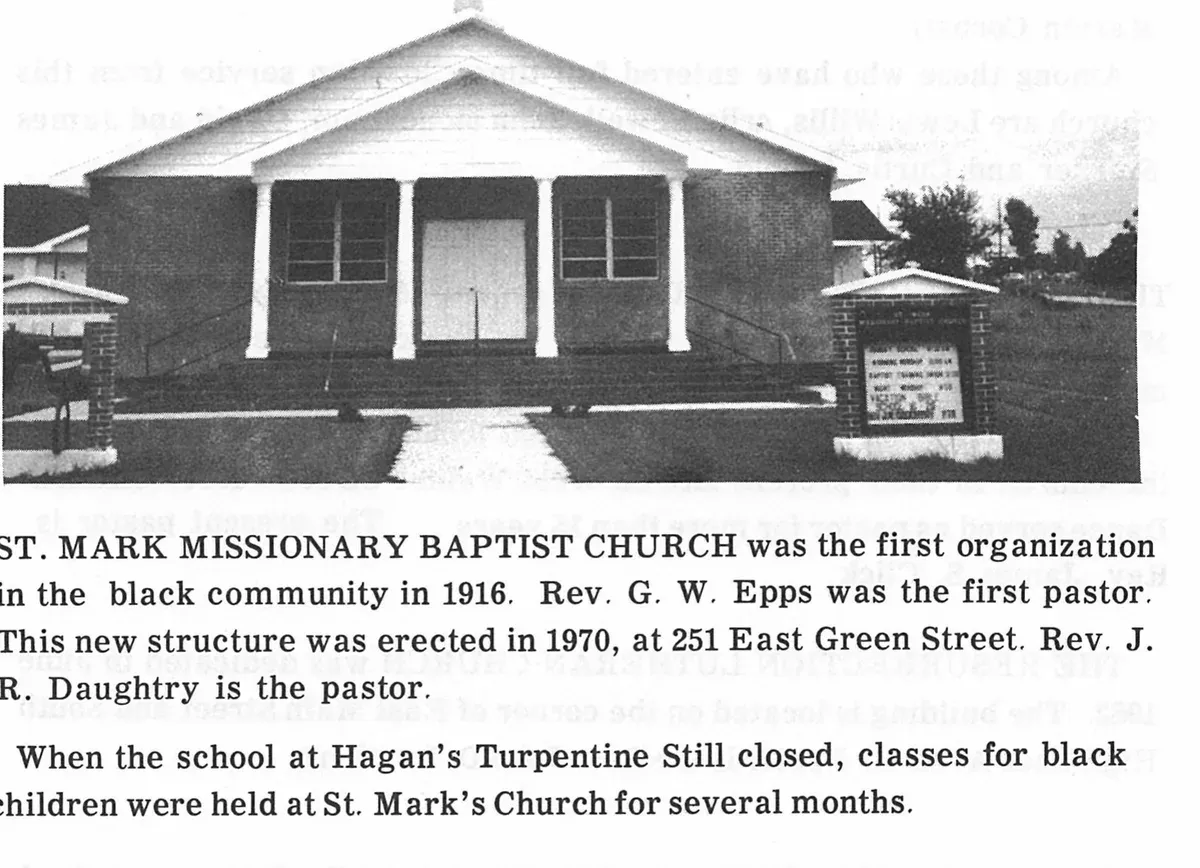
St. Mark Missionary Baptist Church, erected in 1970 at 251 East Green Street, Avon Park. The First Hundred Years of Avon Park, Florida (1976), page 109. Avon Park Historical Society.[maxwell-1976]
For the nine wood-frame, canary-board, stucco, and concrete-block sanctuaries of the 1920s and 1930s, the written descriptions made by federal relief worker Lucy G. Crumley in September 1938 remain the primary architectural and institutional record.[wpa-avonpark-cards]
References
- florida-black-heritage-trail — Florida Department of State, Division of Historical Resources. Florida Black Heritage Trail. https://dos.fl.gov/historical/preservation/heritage-trails/black-heritage-trail/
- newssun-mtolive-105 — Highlands Sun / Highlands News-Sun. New Mt. Olive AME Church celebrates 105th anniversary. 1 June 2024. https://www.midfloridanewspapers.com/highlands_sun/new-mt-olive-ame-church-celebrates-105th-anniversary/article_b2a6ab78-27d3-11ef-a58b-0fef34a36945.html
- wpa-stmark — Works Progress Administration, Historical Records Survey; State Archives of Florida. Historical Records Survey, Church Inventory Form 1938: Saint Mark Baptist Church, Avon Park. 7 September 1938. https://www.floridamemory.com/items/show/248624
- wpa-beulah — Works Progress Administration, Historical Records Survey; State Archives of Florida. Historical Records Survey, Church Inventory Form 1938: Beulah Baptist Church, Avon Park. 7 September 1938. https://www.floridamemory.com/items/show/248578
- wpa-stjohn — Works Progress Administration, Historical Records Survey; State Archives of Florida. Historical Records Survey, Church Inventory Form 1938: Saint John Baptist, Avon Park. 21 September 1938. https://www.floridamemory.com/items/show/248623
- wpa-mtzion — Works Progress Administration, Historical Records Survey; State Archives of Florida. Historical Records Survey, Church Inventory Form 1938: Mt. Zion Methodist Church, Avon Park. 1938. https://www.floridamemory.com/items/show/248615
- wpa-avonpark-cards — Works Progress Administration, Historical Records Survey; State Archives of Florida. Historical Records Survey, Church Inventory Forms 1938: the Avon Park cards, Highlands County. 1938. https://www.floridamemory.com/items/show/248581
- census-1950-black-avon-park — United States Bureau of the Census. Seventeenth Census of the United States, 1950, Population Schedules, Florida, Highlands County, EDs 28-7 and 28-8. 27 April 1950. where-black-avon-park-lived-1950.md
- census-1930-avon-park — United States Bureau of the Census. Fifteenth Census of the United States, 1930, population schedules, Florida, Highlands County, enumeration districts 28-1, 28-2 and 28-3 (Avon Park), NARA microfilm T626 roll 318. 24 April 1930. https://archive.org/details/15thcensus318unit
- wpa-emanuel — Works Progress Administration, Historical Records Survey; State Archives of Florida. Historical Records Survey, Church Inventory Form 1938: Emanuel Tabernacle, Avon Park. 31 August 1938. https://www.floridamemory.com/items/show/248598
- maxwell-1976 — Leoma Bradshaw Maxwell. The First Hundred Years of Avon Park, Florida, pages 109–111. 1976. references/the-first-hundred-years-of-avon-park_leoma-bradshaw-maxwell_1976.md
- fm-34855-harris — State Archives of Florida, Florida Memory. Reverend C. K. Steele (on left), and Reverend H. McNeal Harris protesting segregated bus seating in Tallahassee (24 December 1956), item 34855. 24 December 1956. https://www.floridamemory.com/items/show/34855
- bethel-stpete-history — Historic Bethel African Methodist Episcopal Church. Our History — Historic Bethel A.M.E. Church, St. Petersburg, Florida. 1 September 2026. https://historicbethelstpete.org/our-history/
Related
- Report: the churches of Avon Park
- Finding: Black Ministers and Church Founders of Avon Park, 1920–1950
- Finding: where Black Avon Park lived in 1950
- Finding: the record of Black Avon Park is almost entirely missing
- Entity: Hopewell School
- Report: The Avon Park election of 1951
Where this comes from
- Evidence
- corroborated — More than one independent source agrees.
- Review
- unverified — Drafted from sources but not yet checked by a volunteer.
- Rights
- society
Sources
- Florida Department of State, Division of Historical Resources, Florida Black Heritage Trail
- Highlands Sun / Highlands News-Sun, New Mt. Olive AME Church celebrates 105th anniversary (2024)
- Works Progress Administration, Historical Records Survey; State Archives of Florida, Historical Records Survey, Church Inventory Form 1938: Saint Mark Baptist Church, Avon Park (1938)
- Works Progress Administration, Historical Records Survey; State Archives of Florida, Historical Records Survey, Church Inventory Form 1938: Beulah Baptist Church, Avon Park (1938)
- Works Progress Administration, Historical Records Survey; State Archives of Florida, Historical Records Survey, Church Inventory Form 1938: Saint John Baptist, Avon Park (1938)
- Works Progress Administration, Historical Records Survey; State Archives of Florida, Historical Records Survey, Church Inventory Form 1938: Mt. Zion Methodist Church, Avon Park (1938)
- Works Progress Administration, Historical Records Survey; State Archives of Florida, Historical Records Survey, Church Inventory Forms 1938: the Avon Park cards, Highlands County (1938)
- United States Bureau of the Census, Seventeenth Census of the United States, 1950, Population Schedules, Florida, Highlands County, EDs 28-7 and 28-8 (1950)
- United States Bureau of the Census, Fifteenth Census of the United States, 1930, population schedules, Florida, Highlands County, enumeration districts 28-1, 28-2 and 28-3 (Avon Park), NARA microfilm T626 roll 318 (1930) · official
- Works Progress Administration, Historical Records Survey; State Archives of Florida, Historical Records Survey, Church Inventory Form 1938: Emanuel Tabernacle, Avon Park (1938) · archival
- Leoma Bradshaw Maxwell, The First Hundred Years of Avon Park, Florida, pages 109–111 (references/the-first-hundred-years-of-avon-park_leoma-bradshaw-maxwell_1976.md) (1976) · book
- State Archives of Florida, Florida Memory, Reverend C. K. Steele (on left), and Reverend H. McNeal Harris protesting segregated bus seating in Tallahassee (24 December 1956), item 34855 (1956) · archival
- Historic Bethel African Methodist Episcopal Church, Our History — Historic Bethel A.M.E. Church, St. Petersburg, Florida (2026) · secondary
Something here wrong, or incomplete? The Society would rather know. Tell a volunteer.
Have a question about this record?