The land boom and the bust at Avon Park
Avon Park’s land boom can be told entirely from statutes, and it is worth telling that way, because the statutes are where the optimism is written down and then, a few years later, quietly unwritten.
The scale of it
Between September 1921 and February 1926, forty-one subdivisions were platted at Avon Park. Twenty-one of them were created in 1925 alone. Lakeside Heights was subdivided and re-platted inside a single year. One lot at the west end of the business section sold for $75,000; the buyer defaulted, and in the Depression the same lot sold for $400. Between 1920 and 1926, in one twelve-block area, about forty buildings went up, including a large high school complex, a Coca-Cola bottling plant, the Avon Park Sash and Door Company building and some twenty-five houses.[nrhp-90000486]
Population had gone from 285 in 1910 to 890 in 1920. The town was building for a number far larger than either.
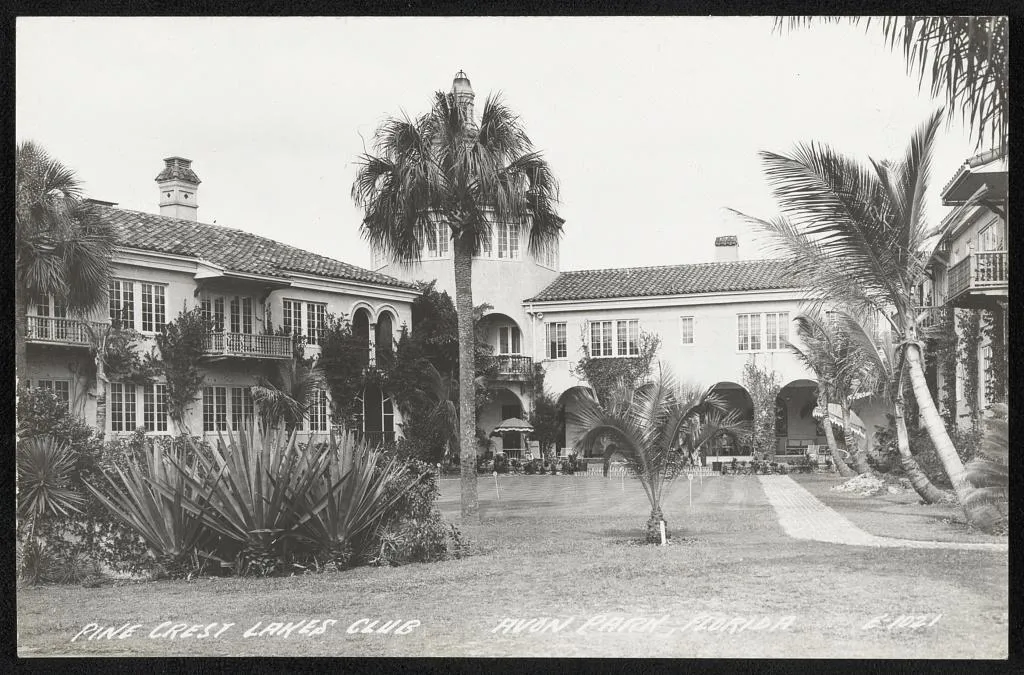 Pine crest Lakes Club, Avon Park, Florida. Library of Congress, Prints and Photographs Division [loc-2024687069]
Three statutes that measure the optimism
A whole township, June 1925. Chapter 10320 abolished the Town of Avon Park and created the City of Avon Park with limits covering all thirty-six sections of Township 33 South, Range 28 East — thirty-six square miles, against the 1913 town’s two and a quarter.[lof-1925-10320] The 1927 successor charter makes clear that this took effect on 1 January 1926.[lof-1927-12514]
A tax district for advertising, 1925. Chapter 10624 created a Special Tax District for Publicity Purposes covering the Avon Park end of the county, empowered to levy up to three mills, forbidden to spend a penny on salaries, and required to spend the whole levy “exclusively for the purchase of publicity matter and advertising the district.”[lof-1925-10624]
Fifty thousand dollars to beautify a road, 1927. Chapter 12839 authorized Highlands County to issue up to $50,000 of Highway Beautification Bonds for “the beautification and ornamentation of State Highway No. 8” as it ran through Avon Park, Sebring, DeSoto City, Lake Placid, Lake Annie and Brighton to the Kissimmee River, and created a five-member Highway Beautification Board named in the act: C. E. Lanier of Avon Park — the town’s first tax collector, back in 1913 — M. O. Sebring of Sebring, F. N. K. Ridey of DeSoto City, W. F. Coachman of Lake Placid, and J. H. Bright of Brighton.[lof-1927-12839]
What the town borrowed
The borrowing is the clearest measure of all, because it survived the boom and had to be paid.
| Date | What was voted or authorized | Amount |
|---|---|---|
| 22 December 1924 | Ordinance No. 85, street improvement bonds, sold 12 January 1925 | $18,000 |
| 3 April 1925 | Special bond election: improvement bonds and refunding bonds | $240,000 + $40,000 |
| 9-10 June 1926, voted 20 July 1926 | Ordinance No. 110: sanitary and storm sewerage and a disposal plant ($210,000), a City Hall ($30,000), and buying and improving parks ($115,000) | $355,000 |
The April 1925 election was itself validated after the fact by the legislature, in Chapter 10321 of 1925 — the same device the state would use again in 1927 and 1929, and a sign of how fast the city was borrowing relative to the formalities.[lof-1925-10321]
Ordinance No. 110 was passed by the city council on 9 June 1926 and approved by the mayor the next day; the electors ratified it at a special election on 20 July 1926. The legislature validated the whole thing in 1927, curing “all defects or irregularities” in the proceedings.[lof-1927-12513]
In nineteen months a town of under a thousand people in 1920 committed itself to well over half a million dollars. And note what the largest item was: $115,000 for parks — a third of the July 1926 issue — which is the Mile Long Mall and its plantings. The town borrowed nearly four times as much to beautify itself as to build its own city hall.
The turn
The break came from outside. In the autumn of 1925 the railways, overwhelmed by building materials moving into Florida, declared a freight embargo, and the embargo weakened the foundations of the boom. A hurricane struck south-east Florida in September 1926 and finished it.[nrhp-90000486]
The railways themselves did not believe it was over. In the year to February 1926 the Atlantic Coast Line was building 160 miles of new line and 53 miles of double track in Florida and buying 1,250 steel cars and 113 locomotives; the Seaboard was extending from West Palm Beach to Florida City and out to Fort Myers, Naples and LaBelle, and buying fifty locomotives.[frc-29]
At Avon Park the Hotel Jacaranda was finished for the spring 1926 season, having been begun in late 1923. Its backers, John Raab and Harry Winter of Chicago, “lost heavily during the economic depression and were forced to give up their interests.”[nrhp-90000486]
The bust written into a statute
The most eloquent document of the bust is Section 3 of the 1927 city charter. It re-created the City of Avon Park yet again, kept every debt alive — and then added this:
“Provided, however, that the payment of all bonds issued by the municipality of the Town of Avon Park prior to January 1, A. D. 1926, shall be restricted to the property lying within the original limits of said municipality, and the property lying beyond said limits and now included within the limits of the municipality hereby created shall not be taxed for or required to pay any portion of said bonds.”[lof-1927-12514]
In 1925 the city had swallowed thirty-six square miles on the expectation that all of it would soon be town. By 1927 the owners of the annexed land had gone to the legislature and got themselves exempted from the old town’s debts. The boundary was still there; the shared fate was not.
The City Hall shows the same story in brick. The $30,000 was voted in July 1926, but the city was already carrying, as the National Register nomination puts it, a “large indebtedness as a result of infrastructural improvements made during the boom.” The C. W. Pabor Construction Company won the contract at $28,600. Construction was slowed by the Depression, terra cotta was dropped from the exterior in favor of cheaper art stone, the building was finished late in 1928, and the city government moved in during March 1929.[nrhp-90000486]
The last building in the historic district’s period of development is the Park Theater of 1935. It took seven years after the City Hall for anything else to be built worth recording.[nrhp-90000486]
Refunding, December 1928
By the end of 1928 the city could not carry what it had voted. On 18 December 1928 Avon Park held a city election authorizing $175,000 of General Refunding Bonds, dated 1 January 1929. The 1929 legislature validated the election and confirmed the issue of $145,000 of them, “or so much of said amount as may be necessary for the purpose of paying indebtedness of said City.”[lof-1929-13910]
Refunding is borrowing to pay borrowing. Two and a half years after voting $355,000 for sewers, a city hall and parks, Avon Park was going back to its electors to refinance the debt rather than retire it.
The banks close, February and May 1929
Then the banks went. The dates are fixed exactly by a 1929 relief act for D. F. Canfield, tax collector of Highlands County — the same man the Governor had appointed to that office when the county was created in 1921 — who had public money on deposit in all three:[lof-1929-13787]
| Bank | Closed | Public money lost |
|---|---|---|
| Highlands Bank & Trust Company, Sebring | 11 February 1929, by order of the State Comptroller | $811.43 |
| State Bank of Avon Park | 16 February 1929, by order of the State Comptroller | $708.72 |
| First National Bank of Sebring | 3 May 1929, by order of the national banking authorities | $8,202.54 |
Canfield’s official bond made him personally liable for the $9,722.69 of state and county money that went down with them; the legislature relieved, exonerated and discharged him on 8 June 1929, on condition he assigned his claims against the banks to the Comptroller and the county commissioners.[lof-1929-13787]
The dates matter. The three banks holding Highlands County’s public money — two at Sebring and one at Avon Park — all failed between February and May 1929, five months before the Wall Street crash of October 1929 and four years before the national banking crisis of March 1933. Whether these were literally the only banks in the two towns is not established; they are the ones a county officer’s relief act happens to name. The Depression did not cause this. The land boom did, and the county was already in it while the rest of the country was still in the twenties.
Giving the township back, 1933
The boom’s last act is the reversal of its first.
In 1925 Avon Park had annexed all thirty-six sections of its township. The owners of the annexed land, having already got themselves exempted in 1927 from the old town’s debts, went to court to get out of the city altogether. The case was a quo warranto proceeding brought by the Attorney General of Florida on the relation of landowners: State ex rel. Fred H. Davis, Attorney General, Avon Florida Citrus Corporation et al., co-relators, v. City of Avon Park. It reached the Supreme Court of Florida five times between 1932 and 1934.[courtlistener-avonpark]
| Decision | Citation |
|---|---|
| 2 March 1932 | 104 Fla. 389, 139 So. 899 |
| 10 November 1932 | 108 Fla. 640, 144 So. 306 |
| 10 March 1933 | 108 Fla. 641, 149 So. 409 |
| 22 December 1933 | 117 Fla. 556, 151 So. 701 |
| 11 December 1934 | 117 Fla. 565, 158 So. 159 |
While the litigation was still pending the legislature settled it politically. Chapter 16316, Laws of Florida 1933, repealed Section 5 of the 1927 charter and replaced the township-wide boundary with a new one described lot by lot and block by block — a tight line drawn around the built-up town across Sections 14, 15, 16, 21, 23, 24, 25, 27 and 28. Everything outside it was excluded.[lof-1933-16316]
Three details of that act say everything about the position the city was in.
- Only registered freeholders could vote on whether to approve it. Property owners had made the city and property owners unmade it.
- The tax liens survived the exclusion. Land could leave the city, but not its arrears: “the exclusion of any of said property from the said city limits shall not relieve the same of the liens for the said taxes, assessments, and/or other public charges and demands,” and Avon Park kept the same right to enforce them.
- Section 7 is a hedge against losing in court. If the Supreme Court decided against the city, the lien-preservation and exclusion-date provisions would be void and the franchise on the referendum would narrow to freeholders living inside the new line.
The excluded territory left the city on 1 January 1934 — eight years, almost to the day, after it had joined it.
The Depression, in two tax acts of 1939
The bust’s long tail is written into two Avon Park acts, both filed on 12 June 1939 and both allowed to become law without the Governor’s approval.
Chapter 19692 empowered the City Council, by ordinance, to let ratepayers pay “current or delinquent taxes due or assessed against real or personal property in the said City of Avon Park by installment payments,” over a period not longer than a year, with default returning the property to its previous status.
Chapter 19693 amended section 34 of the 1927 charter to sharpen the other end of the same problem. If taxes on real estate were unpaid by the first of April, the Tax Collector was to make a certified delinquent roll from the assessment roll, which would stand as prima facie evidence in any suit to enforce the lien — and “the City Council may at any time after delinquency order or direct any properties on said delinquent roll referred to or delivered to the City Attorney for collection or foreclosure.”[lof-1939-19692]
Read together they are a portrait of a town thirteen years after the boom: enough property in arrears that the city needed both a way to let people pay slowly and a faster route to taking the land off those who could not. The lot that sold for $75,000 during the boom and $400 in the Depression is the same story told from the tax collector’s desk.
References
- nrhp-90000486 — United States Department of the Interior, National Park Service. National Register of Historic Places Registration Form: Avon Park Historic District. 22 March 1990. https://npgallery.nps.gov/NRHP/GetAsset/NRHP/90000486_text
- lof-1925-10320 — Legislature of the State of Florida. Chapter 10320 (No. 298), Laws of Florida 1925: the charter of the City of Avon Park. 8 June 1925. laws-of-florida-chapter-10320-1925.md
- lof-1925-10321 — Legislature of the State of Florida. Chapter 10321 (No. 299), Laws of Florida 1925: validating the Avon Park bond election of 3 April 1925. 1925. http://edocs.dlis.state.fl.us/fldocs/leg/actsflorida/1925/LOF1925V2Pt1title-ch10461.pdf
- lof-1925-10624 — Legislature of the State of Florida. Chapter 10624 (No. 602), Laws of Florida 1925: Special Tax District for Publicity Purposes in Highlands County. 1925. http://edocs.dlis.state.fl.us/fldocs/leg/actsflorida/1925/LOF1925V2pt2ch10462-10636.pdf
- lof-1927-12513 — Legislature of the State of Florida. Chapter 12513 (No. 708), Laws of Florida 1927: validating Ordinance No. 110 and the Avon Park bond election of 20 July 1926. 23 May 1927. http://edocs.dlis.state.fl.us/fldocs/leg/actsflorida/1927/1927V2Pt1SpecLawsPt1.pdf
- lof-1927-12514 — Legislature of the State of Florida. Chapter 12514 (No. 709), Laws of Florida 1927: abolishing and re-establishing the City of Avon Park. 1927. http://edocs.dlis.state.fl.us/fldocs/leg/actsflorida/1927/1927V2Pt1SpecLawsPt1.pdf
- lof-1927-12839 — Legislature of the State of Florida. Chapter 12839 (No. 1034), Laws of Florida 1927: Highlands County Highway Beautification Bonds. 1927. http://edocs.dlis.state.fl.us/fldocs/leg/actsflorida/1927/1927V2Pt2SpecLawsPt2.pdf
- lof-1929-13910 — Legislature of the State of Florida. Chapter 13910 (No. 346), Laws of Florida 1929: validating the Avon Park refunding bond election of 18 December 1928. 20 May 1929. http://edocs.dlis.state.fl.us/fldocs/leg/actsflorida/1929/LOF1929V2Pt1%20SpecialActs(Pt1).pdf
- lof-1929-13787 — Legislature of the State of Florida. Chapter 13787 (No. 223), Laws of Florida 1929: An Act for the Relief of D. F. Canfield, Tax Collector of Highlands County. 8 June 1929. http://edocs.dlis.state.fl.us/fldocs/leg/actsflorida/1929/LOF1929V1Pt1%20GeneralLaws%20(Pt1).pdf
- lof-1933-16316 — Legislature of the State of Florida. Chapter 16316 (No. 459), Laws of Florida 1933: An Act to Repeal and Re-enact Section 5 of Chapter 12514, Laws of Florida, 1927, Creating the City of Avon Park; to Define and Establish the Corporate Limits of Said City and to Exclude Certain Territory Therefrom. 1933. http://edocs.dlis.state.fl.us/fldocs/leg/actsflorida/1933/LOF1933V2Pt1%20SpecialActs%20(Pt1).pdf
- courtlistener-avonpark — Supreme Court of Florida, via CourtListener. State ex rel. Davis v. City of Avon Park, Supreme Court of Florida, five reported decisions 1932-1934. 11 December 1934. https://www.courtlistener.com/?q=%22Avon+Park%22&court=fla
- lof-1939-19692 — Legislature of the State of Florida. Chapters 19692 and 19693, Laws of Florida 1939: Avon Park tax instalments, and collection or foreclosure of delinquent taxes. 12 June 1939. http://edocs.dlis.state.fl.us/fldocs/leg/actsflorida/1939/LOF1939V2Pt1%20SpecialActs%20(Pt1).pdf
- frc-29 — Railroad Commission of the State of Florida. Twenty-ninth Annual Report of the Railroad Commission of the State of Florida, for the year ending 28 February 1926. 28 February 1926. https://archive.org/details/Twenty-ninthAnnualReportOfTheRailroadCommissionOfTheStateOfFlorida
- loc-2024687069 — Library of Congress. Pine crest Lakes Club, Avon Park, Florida. 1940. https://www.loc.gov/item/2024687069/
Related
- Entity: Hotel Jacaranda
- Entity: William J. Heim
- Entity: Mile Long Mall
- Finding: Avon Park became a city in 1925
- Finding: boom subdivisions and real estate speculation, 1912–1926
- Finding: unbuilt boom subdivisions, paper plats, and land liquidations in Avon Park (1921–1943)
- Finding: the Highlands County publicity tax district of 1925
- Finding: the original Avon Park city ordinance book is missing
- Reference: Chapter 10320, Laws of Florida 1925
Where this comes from
- Evidence
- single-source — One source. Treat as reported, not established.
- Review
- unverified — Drafted from sources but not yet checked by a volunteer.
- Rights
- society
Sources
- United States Department of the Interior, National Park Service, National Register of Historic Places Registration Form: Avon Park Historic District (1990)
- Legislature of the State of Florida, Chapter 10320 (No. 298), Laws of Florida 1925: the charter of the City of Avon Park (1925)
- Legislature of the State of Florida, Chapter 10321 (No. 299), Laws of Florida 1925: validating the Avon Park bond election of 3 April 1925 (1925)
- Legislature of the State of Florida, Chapter 10624 (No. 602), Laws of Florida 1925: Special Tax District for Publicity Purposes in Highlands County (1925)
- Legislature of the State of Florida, Chapter 12513 (No. 708), Laws of Florida 1927: validating Ordinance No. 110 and the Avon Park bond election of 20 July 1926 (1927)
- Legislature of the State of Florida, Chapter 12514 (No. 709), Laws of Florida 1927: abolishing and re-establishing the City of Avon Park (1927)
- Legislature of the State of Florida, Chapter 12839 (No. 1034), Laws of Florida 1927: Highlands County Highway Beautification Bonds (1927)
- Legislature of the State of Florida, Chapter 13910 (No. 346), Laws of Florida 1929: validating the Avon Park refunding bond election of 18 December 1928 (1929)
- Legislature of the State of Florida, Chapter 13787 (No. 223), Laws of Florida 1929: An Act for the Relief of D. F. Canfield, Tax Collector of Highlands County (1929)
- Legislature of the State of Florida, Chapter 16316 (No. 459), Laws of Florida 1933: An Act to Repeal and Re-enact Section 5 of Chapter 12514, Laws of Florida, 1927, Creating the City of Avon Park; to Define and Establish the Corporate Limits of Said City and to Exclude Certain Territory Therefrom (1933)
- Supreme Court of Florida, via CourtListener, State ex rel. Davis v. City of Avon Park, Supreme Court of Florida, five reported decisions 1932-1934 (1934)
- Legislature of the State of Florida, Chapters 19692 and 19693, Laws of Florida 1939: Avon Park tax instalments, and collection or foreclosure of delinquent taxes (1939)
- Railroad Commission of the State of Florida, Twenty-ninth Annual Report of the Railroad Commission of the State of Florida, for the year ending 28 February 1926 (1926)
- Library of Congress, Pine crest Lakes Club, Avon Park, Florida (1940)
Something here wrong, or incomplete? The Society would rather know. Tell a volunteer.
Have a question about this record?