
The Highlands County Prison Camp in 1940, and its twenty-one prisoners named
The federal census enumerated institutions the same way it enumerated households, and on 30 April 1940 the enumerator Ellon L. Perry walked the Highlands County Prison Camp, in the Avon Park precinct outside the city limits, and wrote down everybody in it. The sheet is marked “Here begins Prison Camp” at line 10 and “Here ends Prison Camp” beneath line 30.[census-1940-ed-28-4]
It is the first roster of incarcerated people in this county to be recovered.
Where it stood
On Bonnett Lake. Chapter 20297 of the Laws of Florida 1941, which designated Highlands County’s state roads, describes each road by the landmarks at its ends, and one of them runs to “the Highlands County Prison Camp on Bonnett Lake” from State Road 8, about a mile north of the Seaboard Air Line crossing.[laws-20297-1941] The camp was therefore still operating in 1941, a year after this census was taken, and was substantial enough for the Legislature to run a state road to it.
The statute’s “Bonnett Lake” and the modern Lake Bonnet, north of Avon Park, are the same water; the difference is one of historical spelling, confirmed by the Avon Park Historical Society. When the shorter form displaced the older one, and which spelling the county’s plats and deeds used at each date, is not established.
It should not be confused with the federal prison camp that occupied the Avon Park bombing range cantonment until 1953, nor with the state’s Avon Park Correctional Institution from 1957. This was the county’s own camp, and it predates both.
Who ran it
A. H. Skinner, 43, born in Georgia, warden, living on the site with his wife and daughter; and George Collier, 21, born in Florida, a guard, living on the site with his own family.[census-1940-ed-28-4]
Who was held in it
Twenty-one prisoners, each entered as “Prisoner” or “Inmate” with an institutional code in place of an occupation. Seventeen were recorded “Neg” and four “W.” In a county whose population was about 21 per cent Black in 1940, four in five of the men in its prison camp were Black.[census-1940-ed-28-4]
The Black prisoners: Roy Newman, 40, Georgia; Arthur Harris, 20, Florida; Frank McPherson, 45, Georgia; Jack Baily, 32, Alabama; James Landers, 25, Alabama; Jason Taylor, 38, Georgia; John Davis, 26, North Carolina; Richard Ellis, 31, South Carolina; Artis Police, 35, Georgia; James Mitchell, 30, Tennessee; Kellis Franklin, 24, Georgia; Mike Williams, 25, Tennessee; John Georgeo, 35, Georgia; Henry Brown, 53, Florida; Ben Eason, 20, South Carolina; Jimmie Coleman, 30, Georgia; and Anna Johnson, 30, Florida — the camp’s only woman prisoner.[census-1940-ed-28-4]
The white prisoners: Charles Jones, 25, Florida; H. Hambuckle, 37, Florida; Robert Sullivan, 21, New York; and Jack Smith, 35, Georgia.[census-1940-ed-28-4]
Their birthplaces — Georgia, Florida, Alabama, the Carolinas, Tennessee — are the same catchment as Avon Park’s free Black population, drawn from the same migration into the Florida citrus belt.
Why a county prison camp existed at all
Florida counties maintained prison camps under statutory authority authorizing boards of county commissioners to employ county prisoners upon the public roads, bridges, and public works of the county (Compiled General Laws of Florida 1927, §§ 8612–8622). While Chapter 9126, Laws of Florida 1923, abolished the leasing of state convicts to private corporations, the statute preserved county-operated road forces.
The practice had deep roots in the territory: in August 1913 the DeSoto County commissioners voted to apply to the state for the hire of ten convicts to work the county’s public roads.[dsc-1913-08-hagan] Following the creation of Highlands County in 1921, the new county established its own camp on the northern shore of Lake Bonnet to maintain the arterial road network connecting Avon Park with rural citrus groves and surrounding districts. The twenty-one individuals held at the Lake Bonnet camp in 1940 provided the uncompensated labor force maintaining these rural rights-of-way under county supervision.
No connection to turpentine labor
Because the Highlands County Prison Camp at Lake Bonnet was operated directly by the county commissioners for public road maintenance, it was distinct from the turpentine and sawmill labor camps elsewhere in the region.
The state prison camp located in Hicoria, in southern Highlands County, was the facility associated with the local turpentine and timber industries (such as the Sherman Lumber Company). That Hicoria camp gained notoriety following a 1940 incident in which a state prison guard was charged with murder for beating a convict. The 1940 federal census roster for Avon Park (ED 28-4) naming warden A. H. Skinner and guard George Collier is the specific record of the county road camp, wholly separate from the state turpentine camp at Hicoria. The Avon Park record therefore demonstrates county road maintenance labor, not turpentine extraction.
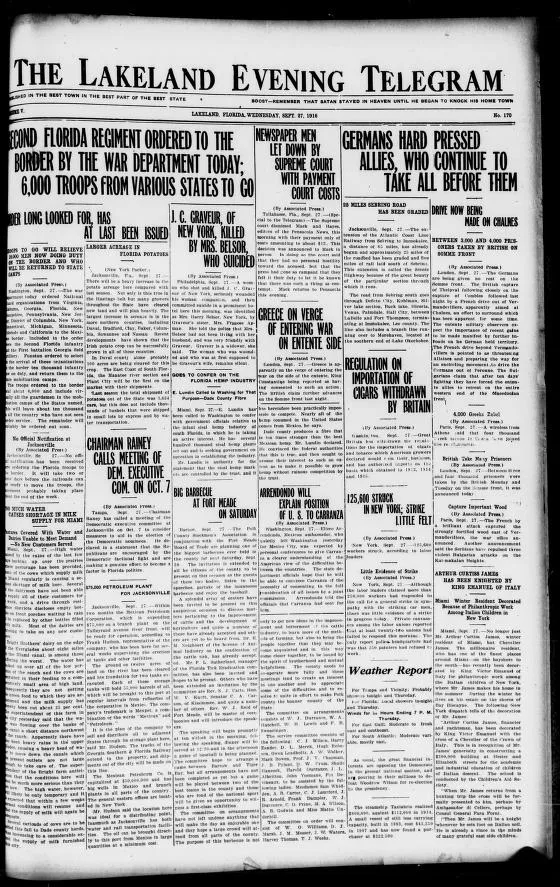 Regional news coverage from 1916 detailing the general Hicoria area prior to the 1940 state prison camp incident. Courtesy of the Library of Congress, Chronicling America. [sn95047222-1916]
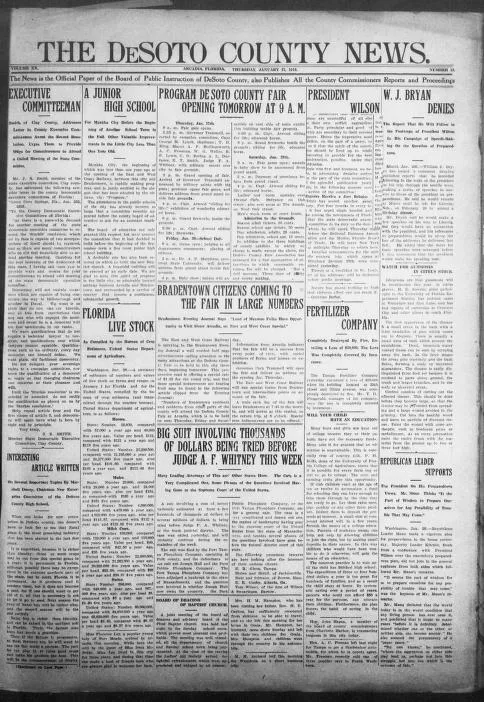 Arcadia press coverage documenting the region. Courtesy of the Library of Congress, Chronicling America. [sn95026908-1916]
References
- census-1940-ed-28-4 — United States Bureau of the Census. 1940 Census population schedules, Florida, Highlands County, enumeration district 28-4, Avon Park precinct outside the city, including the Highlands County Prison Camp. 30 April 1940. https://catalog.archives.gov/id/126246148
- dsc-1913-08-hagan — The De Soto County News (Arcadia, Fla.). DeSoto County Board of County Commissioners, August 1913: application to the state for the hire of ten convicts for road work, reported in the Arcadia press. 1 August 1913. de-soto-county-news-avon-park-department.md
- laws-20297-1941 — State of Florida. Chapter 20297, Laws of Florida 1941, designating state roads in Highlands County. 1941. avon-park-countryside-in-1941.md
Related
-
Report: Prisoners and patients — the state institutions around Avon Park, 1940-1978
-
Finding: where Black Avon Park lived, and who its people were, 1940-1950
-
Finding: the record of Black Avon Park is almost entirely missing
Where this comes from
- Evidence
- corroborated — More than one independent source agrees.
- Review
- unverified — Drafted from sources but not yet checked by a volunteer.
- Rights
- society
Sources
- United States Bureau of the Census, 1940 Census population schedules, Florida, Highlands County, enumeration district 28-4, Avon Park precinct outside the city, including the Highlands County Prison Camp (1940)
- The De Soto County News (Arcadia, Fla.), DeSoto County Board of County Commissioners, August 1913: application to the state for the hire of ten convicts for road work, reported in the Arcadia press (1913)
- State of Florida, Chapter 20297, Laws of Florida 1941, designating state roads in Highlands County (1941)
Something here wrong, or incomplete? The Society would rather know. Tell a volunteer.
Have a question about this record?