
Avon Park Air Force Range
Ten and a half miles east of Avon Park, across the Kissimmee River valley. It is the largest single thing in Highlands County and the least visible.
Establishment and growth
| Date | Event |
|---|---|
| March 1942 | The Avon Park General Bombing and Gunnery Range opens on 107,059 acres, described at the time as the largest bombing range in the world[mfh-airfield] |
| September 1942 | The Army Air Forces take over the pre-war civil airport at Avon Park as Avon Park Army Air Field, a sub-base of MacDill Field under III Bomber Command, Third Air Force |
| February 1943 | A further 111,165 acres acquired in Okeechobee County, bringing the range to about 218,000 acres — roughly 341 square miles (the figure of 352 square miles that circulates does not match the two acreages)[mfh-airfield] |
| November 1943 | Avon Park Army Airfield becomes a fully integrated air base, giving transition training in combat aircraft, bombing and gunnery[wiki-apafr] |
| September 1945 | The airfield goes inactive; the installation becomes Avon Park Air Force Range[wiki-apafr] |
| 1942-1977 | The United States acquires 218,883.88 acres in total for the range |
The war years
Crews trained on B-17 Flying Fortress and B-26 Marauder bombers against purpose-built targets: a mock town covering 555 acres on Lake Arbuckle, a floating water target on Lake Kissimmee, and an eight-mile railroad bombardment target.[mfh-airfield]
At its peak the base held about 10,000 military personnel. Avon Park’s civilian population in 1942 was about 3,000. The town could not house the difference; military families were put up in resort hotels and spilled out as far as Lake Wales and Wauchula.[mfh-airfield] For a town that had never recovered from the collapse of the land boom, this was the largest thing that had happened to it since the railway. The state’s own account adds two details that are easy to leave out: servicemen were sometimes charged higher prices in Avon Park than locals paid, and base commanders responded by restricting military traffic into town to put economic pressure on the shopkeepers.[mfh-airfield] Later in the war the School of Applied Tactics at Orlando built a special incendiary target on the range.[mfh-airfield]
The units are now identified. Two combat groups were stationed here: the 397th Bombardment Group (Medium), with its 596th, 597th, 598th and 599th squadrons, for three weeks in October 1943 on its way from MacDill to England; and the 88th Bombardment Group (Heavy), with its 316th, 317th, 318th and 399th squadrons, from November 1943 until it was inactivated here on 1 May 1944 — a B-17 replacement training unit that never went overseas. See Finding: the units stationed at Avon Park Army Airfield.
And the airfield was not the town’s only flying school. From October 1941 to November 1944 the Lodwick Aviation Military Academy ran Army primary flight training at the Avon Park Municipal Airport, inside the town, quartering its cadets in the converted Highlands Lakes Hotel and graduating 3,413 pilots. See Entity: Lodwick Aviation Military Academy, Avon Park.
Cold War, Survival Training, and UXO (1949–present)
The range contains Formerly Used Defense Sites (FUDS) divided into five areas across Okeechobee, Highlands, and Polk Counties. Between 1946 and 1983, a total of 112,771.61 acres were excessed, including various bombing targets. Area 5 included a land skip bombing target and a formation bombing target. The presence of unexploded ordnance (UXO) remains a significant challenge; tragically, on May 25, 1946, a three-year-old boy was killed by a fuze found in Arbuckle Creek in Area 1.[uxo-site-data]
A 2013 Cold War-era historic property survey (tDAR id: 391320) documented the historic milestones, development of facilities, and Cold War missions at the range.[tdar-cold-war]
Following the cessation of World War II hostilities in September 1945, the installation transitioned to auxiliary range status. In August 1949, federal defense retrenchment under Secretary of Defense Louis A. Johnson resulted in a reduction of 694 civilian employees out of 706 at Avon Park Field, leaving a maintenance skeleton of 12 workers.[miami-times-19490827]
With the outbreak of the Korean War, Strategic Air Command (SAC) reactivated the installation as a primary bombing range and wilderness survival training center for B-29, B-50, and B-47 flight crews stationed at MacDill Air Force Base.[inrmp-2004] Under range commander Captain John Kelley and instructors such as Technical Sergeant Josh Henson, aircrews completed intensive six-day survival courses subsisting on native palmetto hearts, wild citrus, and game, using parachute teepees and improvised fishing lines.[milford-chronicle-19520404] The exercises were documented by radio commentator W. W. Chaplin in Coronet and filmed for national television broadcast in spring 1952.[milford-chronicle-19520404]
The census of April 1950 found nobody living on the range. The Bureau of the Census gave the base two enumeration districts of its own, one for the part in the county’s first commissioner’s district and one for the part in the second, and the enumerator returned each with a single sheet stamped “No Population”; the twenty-nine sheets of the district named for the base but “excluding Avon Park Air Force Base” are the farms around its perimeter.[census-1950-base]
The prison inside the range
A federal emergency detention camp was designated on the cantonment area in late 1951 under Title II of the Internal Security Act of 1950, maintained on standby by the Federal Bureau of Prisons with a small caretaker crew until Congress discontinued appropriations in 1953. The Bureau of Prisons kept the lease, and in April 1957 the State of Florida subleased the property and opened the Avon Park Correctional Institution. From 1957 to 1978 it held more than seven hundred minimum-custody inmates in eighteen dormitories that had been wartime barracks; a close-custody unit for 542 was built in 1977 and the old buildings came down about 1992. In the early 1970s the leased land was declared surplus, the federal Department of Health, Education and Welfare gave Florida 143 acres, and the state bought a further 455 acres.[chrg-2001] See Finding: The Federal Emergency Detention Camp at Avon Park (1951–1953) and Entity: Avon Park Correctional Institution.
Type locality of the Avon Park Formation
During the wartime construction of base cantonments and air operations infrastructure, deep water supply wells were drilled into the Floridan aquifer. Well cuttings recovered from a borehole drilled in Section 31, Township 32 South, Range 30 East (in the Polk County quadrant of the military reservation) penetrated dense Middle Eocene limestones and dolostones between depths of 600 and 930 feet.[applin-1944-stratigraphy]
Geologists Paul L. Applin and Esther R. Applin used these cuttings to formally name and define the Avon Park Limestone (now the Avon Park Formation) in December 1944.[applin-1944-stratigraphy] Subsequent paleontological study of the well samples in 1945 described three new microfossil foraminifera named after Avon Park: Valvulina avonparkensis, Flintina avonparkensis, and Rotalia avonparkensis. See Finding: The Avon Park Formation, its Bombing Range type well, and named microfossils.
What the range holds
The range’s own management plan lists its cultural resources:
- id: uxo-site-data resource: http://uxoinfo.com/blogcfc/client/includes/uxopages/sitedata1.cfm?uxoinfo_id=05FL0025 title: “UXO Site-Specific Data (Avon Park Air Force Range, FL)” author: UXOInfo.com last_modified: 2026-09-18T00:00:00Z
- id: tdar-cold-war resource: https://core.tdar.org/document/391321/avon-park-air-force-range-cold-war-summary title: “Avon Park Air Force Range: Cold War Summary” author: Geo-Marine, Inc. / The Digital Archaeological Record last_modified: 2013-07-30T00:00:00Z
“The resource types include World War II structures and target complexes, historic homestead sites, artifact scatters, shell and earth middens, turpentine distillery sites, Seminole War forts, prehistoric earthworks and dugout canoes.”[inrmp-2004]
By about 2004, 29,710.5 acres — 28 per cent of the range — had been inventoried, recording 136 archaeological sites and 30 structures, with evidence running from the late Paleo-Indian and Early Archaic period, some twelve thousand years ago, through the Second World War. Coverage had grown from 3.5 per cent in 1995. A historic building survey of 1996, revised in 1999, placed every structure on the base dating to the war on the list of potentially significant resources.[inrmp-2004]
The plan is candid about why this matters: the range “is located in an area of Florida in which little archeological research has been conducted. There is much confusion and debate over what occurred in this area during prehistory, but it has already been demonstrated that archeological sites located on APAFR have a rich potential to answer some of those questions.”[inrmp-2004]
The range is therefore the largest and least-known archaeological landscape in Highlands County, and it contains the county’s Seminole War forts, including Fort Kissimmee, and the physical remains of its turpentine industry.
Industrial Extraction
Prior to federal acquisition for military use, the land encompassing the modern range was subjected to intensive industrial extraction. Starting around 1918, large commercial entities, most notably the Consolidated Naval Stores Company, purchased vast tracts of the area to conduct extensive logging and turpentine harvesting. The physical ruins of these turpentine camps, abandoned when the industry declined, constitute a significant portion of the base’s surviving cultural resources.
Forestry and grazing on the range, 1972
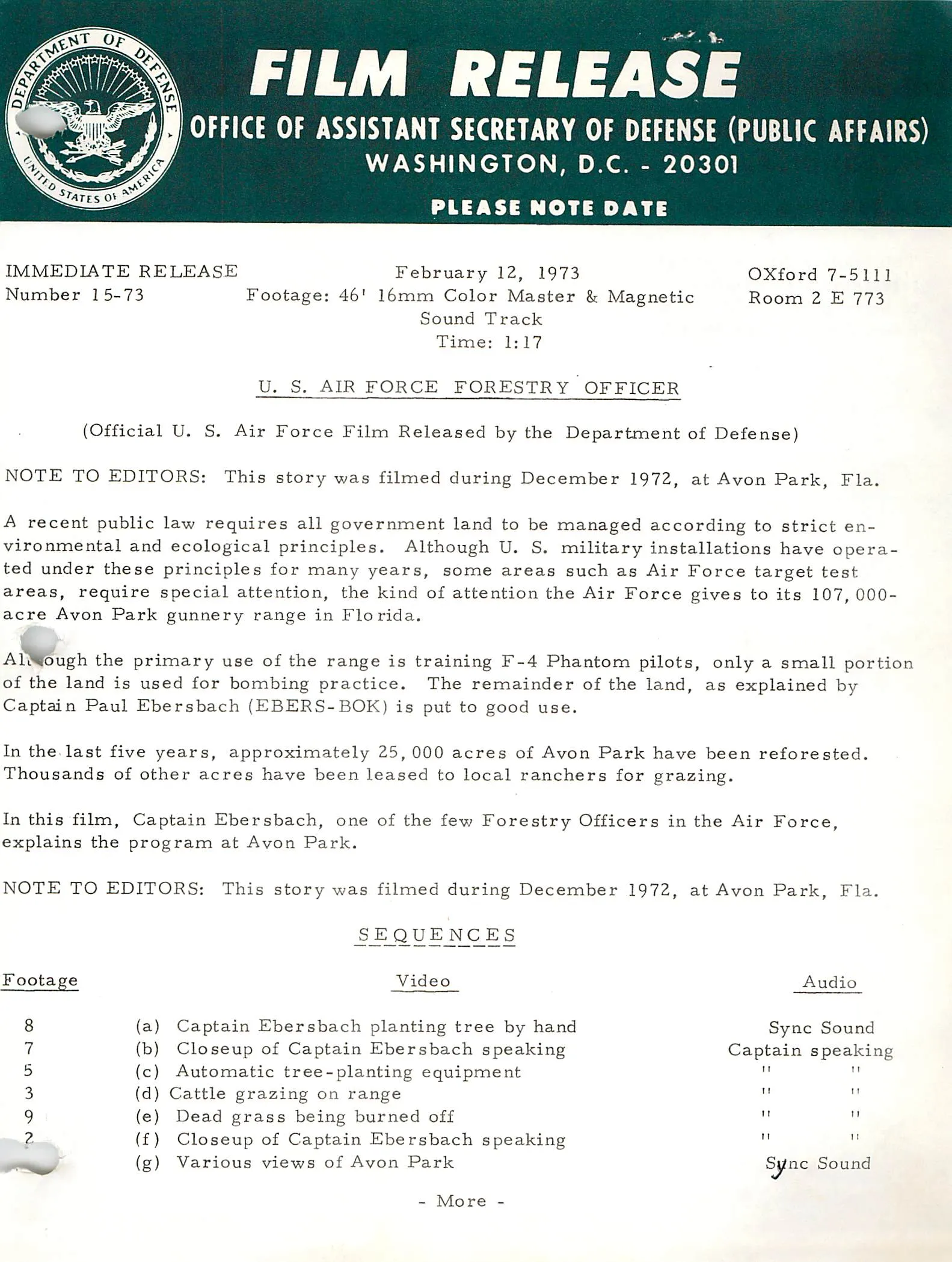
Film release 15-73, Office of the Assistant Secretary of Defense (Public Affairs), 12 February 1973. National Archives, RG 111, Filmed News Releases, 111-DD-15-73, NAID 102047601. Public domain.[nara-film-release-1973]
By the early 1970s most of the range was not a target at all. In December 1972 an Air Force film crew came to Avon Park to record Captain Paul Ebersbach, one of the few forestry officers in the Air Force, explaining how the “107,000-acre Avon Park gunnery range” was managed under the new federal requirement that government land be run on environmental principles. The film, released to newsreel editors by the Department of Defense on 12 February 1973, stated that the range’s primary use was training F-4 Phantom pilots but that only a small portion of the land was used for bombing practice; that approximately 25,000 acres had been reforested in the previous five years; and that thousands of other acres were leased to local ranchers for grazing. Its seventy-seven seconds showed the captain planting a tree by hand, automatic tree-planting equipment, cattle grazing on the range, dead grass being burned off, and “various views of Avon Park.”[nara-film-release-1973]
The range and the county now
The House Committee on Government Reform held a hearing at Avon Park on 4 August 2001 — “Sustaining Critical Military Training Facilities: Avon Park Air Force Range” — which is the fullest published record of the modern relationship.[chrg-2001] About 106,000 acres remain in the range proper, of which roughly 56,000 are impact area. The State of Florida has bought conservation land on the range’s flanks to hold off encroachment. Unexploded ordnance is a permanent problem: in fiscal 2001 Air Combat Command budgeted $230,000 to recycle training submunitions, and the range was working to remove between 1.5 and 1.8 million pounds of range residue, largely out of its own operations and training budget.
A three-blade propeller memorial to those who served at the field was erected in 1993.[mfh-airfield] (The airfield site itself is not listed on the National Register of Historic Places, despite claims to the contrary by the Museum of Florida History.)
References
- uxo-site-data — UXOInfo.com. UXO Site-Specific Data (Avon Park Air Force Range, FL). 18 September 2026. http://uxoinfo.com/blogcfc/client/includes/uxopages/sitedata1.cfm?uxoinfo_id=05FL0025
- tdar-cold-war — Geo-Marine, Inc. / The Digital Archaeological Record. Avon Park Air Force Range: Cold War Summary. 30 July 2013. https://core.tdar.org/document/391321/avon-park-air-force-range-cold-war-summary
- census-1950-base — United States Bureau of the Census. 1950 Census of Population and Housing, Florida, Highlands County, Enumeration Districts 28-10 and 28-20 (Avon Park Air Force Base, Commissioner’s Districts 1 and 2), single sheets marked No Population. 1 April 1950. https://1950census.archives.gov/search/?county=Highlands&state=FL
- nara-film-release-1973 — Office of the Assistant Secretary of Defense (Public Affairs); Records of the Office of the Chief Signal Officer (Record Group 111), National Archives. Film Release 15-73, U.S. Air Force Forestry Officer, 12 February 1973 (Filmed News Releases, 111-DD-15-73). 12 February 1973. https://catalog.archives.gov/id/102047601
- mfh-airfield — Museum of Florida History. Avon Park Army Airfield, in Florida in World War II historical sites. 31 August 2026. https://museumoffloridahistory.com/explore/exhibits/permanent-exhibits/world-war-ii/historical-sites/central-listing/avon-park-army-airfield/
- wiki-apafr — Wikipedia. Avon Park Air Force Range. 19 July 2026. https://en.wikipedia.org/wiki/Avon_Park_Air_Force_Range
- inrmp-2004 — United States Air Force. Final Environmental Assessment: Implementation of the Integrated Natural Resources Management Plan, Avon Park Air Force Range. 2004. https://archive.org/details/DTIC_ADA638923
- chrg-2001 — United States House of Representatives, 107th Congress. Sustaining Critical Military Training Facilities: Avon Park Air Force Range. Hearing before the Subcommittee on National Security, Veterans Affairs and International Relations, Committee on Government Reform, House of Representatives, 4 August 2001. 4 August 2001. https://archive.org/details/gov.gpo.fdsys.CHRG-107hhrg81854
- milford-chronicle-19520404 — Elaine Townsend Dickerson. In The Air Force: Avon Park Survival. 4 April 1952. https://www.loc.gov/resource/sn87062224/1952-04-04/ed-1/?sp=6
- miami-times-19490827 — The Miami Times. Military Jobs: Defense Department Civilian Reductions. 27 August 1949. https://www.loc.gov/resource/sn83004231/1949-08-27/ed-1/?sp=4
- applin-1944-stratigraphy — Paul L. Applin and Esther R. Applin. Regional Subsurface Stratigraphy and Structure of Florida and Southern Georgia. 1 December 1944. https://doi.org/10.1306/3D9336CD-16B1-11D7-8645000102C1865D
Related
- Entity: Avon Park Correctional Institution
- Finding: The Federal Emergency Detention Camp at Avon Park (1951–1953)
- Report: Prisons and the State Institution at Avon Park
- Entity: Avon Park Executive Airport
- Finding: The Avon Park Formation, its Bombing Range type well, and named microfossils
- Finding: Avon Park survival training and postwar military operations, 1949–1952
- Finding: The Avon Park Air Force Range is outside the Avon Park city limits
- Finding: Avon Park Army Airfield is not listed on the National Register
- Entity: Lodwick Aviation Military Academy, Avon Park
- Finding: the units stationed at Avon Park Army Airfield
- Finding: Black servicemen at Avon Park Army Airfield
- Finding: the Fort Kissimmee community was condemned and removed in 1942
- Entity: Fort Kissimmee
- Report: Seminole occupation and the Seminole Wars in Highlands County
- Finding: barriers to Highlands County archaeology
Where this comes from
- Evidence
- single-source — One source. Treat as reported, not established.
- Review
- unverified — Drafted from sources but not yet checked by a volunteer.
- Rights
- society
Sources
- UXOInfo.com, UXO Site-Specific Data (Avon Park Air Force Range, FL) (2026)
- Geo-Marine, Inc. / The Digital Archaeological Record, Avon Park Air Force Range: Cold War Summary (2013)
- United States Bureau of the Census, 1950 Census of Population and Housing, Florida, Highlands County, Enumeration Districts 28-10 and 28-20 (Avon Park Air Force Base, Commissioner's Districts 1 and 2), single sheets marked No Population (1950) · official
- Office of the Assistant Secretary of Defense (Public Affairs); Records of the Office of the Chief Signal Officer (Record Group 111), National Archives, Film Release 15-73, U.S. Air Force Forestry Officer, 12 February 1973 (Filmed News Releases, 111-DD-15-73) (1973) · official
- Museum of Florida History, Avon Park Army Airfield, in Florida in World War II historical sites (2026)
- Wikipedia, Avon Park Air Force Range (2026)
- United States Air Force, Final Environmental Assessment: Implementation of the Integrated Natural Resources Management Plan, Avon Park Air Force Range (2004)
- United States House of Representatives, 107th Congress, Sustaining Critical Military Training Facilities: Avon Park Air Force Range. Hearing before the Subcommittee on National Security, Veterans Affairs and International Relations, Committee on Government Reform, House of Representatives, 4 August 2001 (2001)
- Elaine Townsend Dickerson, In The Air Force: Avon Park Survival (1952)
- The Miami Times, Military Jobs: Defense Department Civilian Reductions (1949)
- Paul L. Applin and Esther R. Applin, Regional Subsurface Stratigraphy and Structure of Florida and Southern Georgia (1944)
Something here wrong, or incomplete? The Society would rather know. Tell a volunteer.
Have a question about this record?