
Avon Park at war, 1941-1945 — the flying school, the airfield, and the families moved off the range
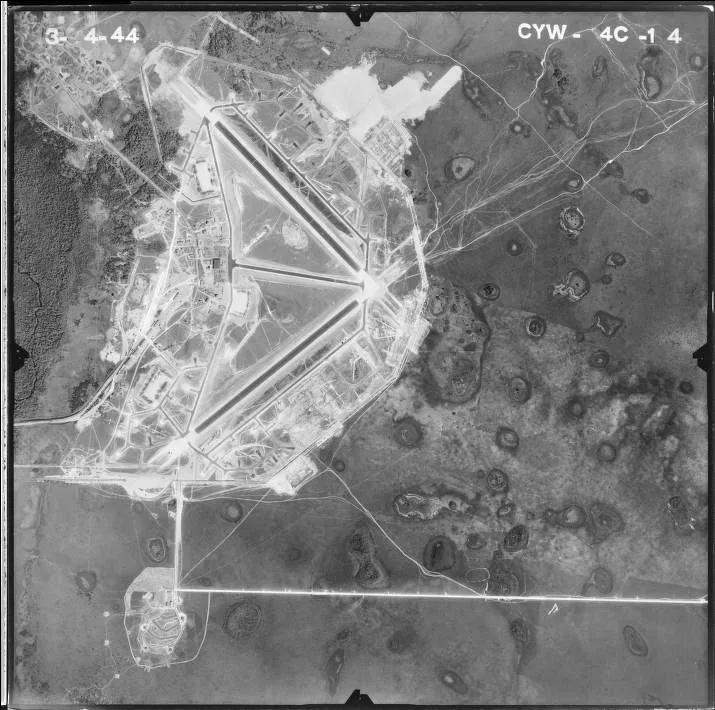
Avon Park Army Airfield, 4 March 1944: three runways in a triangle, the cantonment to the west, a target circle to the south-west, and the range to the east pocked with bomb craters. United States Army Air Forces aerial survey frame CYW-4C-14, via Wikimedia Commons. Public domain.[wm-apaaf-1944]
Avon Park had two air forces in the war, and they should not be confused. In the town, at the municipal airport and a hotel on Lake Lillian, Albert Lodwick’s civilian contract school taught Army cadets to fly a Stearman biplane. Ten miles east, on land the Army had condemned, Avon Park Army Air Field taught bomber crews to bomb. A third story belongs beside those two: the war emptied a settlement that had been on the Kissimmee River since the 1850s.
The Lodwick school in town
The city signed its contract with Lodwick in July 1941 and the first cadets arrived in October. The school ran, by the Army’s own history of its 61st Flight Training Detachment, “from October 1941 through June 1944” and graduated “more than 2,800 cadets” — against the state’s figure of 3,413 and a closing order of 6 November 1944; the two counts have not been reconciled.[sage-gagne-1989] Its barracks were the former Highlands Lakes Hotel, 120 rooms and 234 cadets, on Lake Lillian, later converted into Walker Memorial Hospital.[sage-gagne-1989]
The cadets published their own annual, and it survives. The Lakeland Public Library holds the “1941 LAMA,” produced by classes 42-D and 42-E with the hotel on its cover and a roll of both classes, and a “1943 LAMA” with class photographs.[lpl-cadet-publications] The same library’s Lodwick photograph collection names a flight instructor, Richard G. Beeler, and an auxiliary landing ground nobody else records, Ace Wright Field.
Two of its cadets died. The Army’s accident files carry a PT-17 crash twelve miles north-west of Avon Park on 3 July 1943 that killed Ralph R. Thompson Jr., and another on 30 May 1944, home station “CPS(P), Avon Park AAF” — Contract Pilot School (Primary), the Army’s name for Lodwick’s — that killed Ralph L. Riely.[aair-avon-park]
The Army’s airfield on the range
The base was commanded through most of its life by Lt. Col., later Col., Clint T. Johnson; Col. Guy L. McNeil took over from him on 11 June 1943 and Johnson resumed command on 5 October 1943.[afhra-index] A syndicated feature datelined from the field on 16 May 1944 describes what Johnson commanded: a Third Air Force training base for B-17 Flying Fortress combat crews on “220,000 acres pock-marked with thousands of bomb craters,” with an eight-mile circular railway called the “No Place to Nowhere Railroad”, run by remote control to imitate an enemy supply line; a mock enemy city on Lake Arbuckle “laid out to represent streets, buildings and even docks with ships at anchor”; a full-size Japanese submarine; silhouettes of Messerschmitts and Zeros for the gunners; and three towers at the corners of a triangle round each target to triangulate every hit.[waterbury-1944-05-16]
The 88th Bombardment Group was inactivated on 1 May 1944; the Army’s own history of the group records “GROUP WAS INACTIVATED 1 MAY 44 AND NAME CHANGED TO AVON PARK REPLACEMENT TRAINING UNIT,” and every accident thereafter is filed under the 325th Army Air Forces Base Unit — which trained B-17 crews at Avon Park until at least August 1945.[afhra-index][aair-avon-park]
The dead
The Army Air Forces’ accident reports, indexed by home station, give Avon Park 373 accidents between 27 October 1941 and 6 August 1945, twenty-four of them fatal. The aircraft in them are the base’s own roll: B-17F and B-17G, B-26B and B-26C, P-40N, P-47D and P-47G, a single P-51C, the light L-3 and L-4, and the school’s PT-17s and BT-13s.[aair-avon-park]
The worst was the last but one. On the night of 26-27 January 1945 a B-17G, serial 43-37680, of the 325th Combat Crew Training Squadron crashed six miles south-east of Sebring and killed all ten aboard. Col. Johnson announced it; the Associated Press named two of the dead for their home-state readers, Second Lieutenant Frank L. Young of Due West, South Carolina, the pilot, and Flight Officer Nearle L. Edelen of Raleigh.[wilmington-1945-01-29][aair-avon-park] The other eight names are in the accident report and have not been read.
Seven of the nine fatal crashes of 1943 were B-26 Marauders, and all of them came before the 397th Bombardment Group’s documented weeks at Avon Park that autumn — Charles A. Cox on 2 February, Ramon G. Buela and Frank L. Wassell Jr. in a mid-air collision over the range on 28 February, Stanton W. Johnston and Robert L. Floyd in April, Norman A. Nauer, William R. Norman, James W. Alexander ditched in Lake George, Henry P. Willis, William J. Bevington, Leonard W. Shirey and Gordon L. Shand.[aair-avon-park] Which Marauder unit was training here in early 1943 is not recorded in the sources read so far.
The families moved off the range
The land the bombs fell on had people on it. Kissimmee Island — the ground between Lake Kissimmee, the river, Lake Istokpoga and Lake Arbuckle — was settled from 1858, and the settlement at Fort Kissimmee by Dock Boney, Joseph McClelland, Lewis Thomas, Finley Collier, the Huckabys, the Rhymes and the Tomlinsons.[pioneer-families-1976] In 1942 the government paid them a settlement and required them to go; they went south down the valley to Fort Basinger, Lorida and Okeechobee, and the same surnames turn up among Lorida’s later settlers. The formal legal mechanism executed was a “Judgment on Declaration of Taking” under the Declaration of Taking Act (DTA) in 1942. The condemnation case files naming every landowner and award have not been found in any digitized database or published report; they reside physically in Record Group 21 (Records of District Courts of the United States) and Record Group 77 (Office of the Chief of Engineers) at the National Archives.
What stayed was the cemetery. Fort Kissimmee Cemetery holds 110 marked graves: twenty-nine Boneys, thirteen Thomases, ten Rhymeses, seven McClellands; Lewis Henry Thomas (1864-1935), who gave the land for the church, the school and the cemetery and ran the barge ferry, with his wife Spicey Ann Underhill Thomas and five of their children; Dock Boney himself (1850-1910); and the unmarked stones of Sheffield and Shaw, the two men of the duel of about 1890 that tradition makes the first burials.[findagrave-ftk] One stone is the war’s own: PFC James H. Thomas of the 507th Parachute Infantry, 17th Airborne Division, killed 12 January 1945 — a Fort Kissimmee boy whose family had been put off their land three years before he died in Belgium.[findagrave-ftk] The cemetery is reached by calling the range; its association dedicated a monument there on 29 May 1994.
Home front and memorials
Florida’s German prisoner-of-war branch camps working in citrus were situated in nearby counties including Winter Haven, Leesburg, Dade City, and Belle Glade, with no POW branch camp stationed in Avon Park itself.[mfh-pow]
At the close of the war, American Legion Highlands Post No. 69 erected the community’s World War II Honor Roll on the Mile Long Mall near the municipal flagpole. Designed without charge by local architect William J. Heim, the monument was crafted as an eight-foot star of white marble bearing the names of district service members.
References
- aair-avon-park — Aviation Archaeological Investigation and Research. USAAF accident report database (Aviation Archaeological Investigation and Research), 373 records with home station Avon Park, 27 October 1941 to 6 August 1945, retrieved by search. 2 September 2026. https://www.aviationarchaeology.com/dbSearchAF55.asp
- waterbury-1944-05-16 — The Waterbury Democrat (Waterbury, Conn.). Max B. Cook (NEA), feature datelined Avon Park Army Air Field, 16 May 1944 — The Waterbury Democrat, 16 May 1944, page 14. 16 May 1944. https://www.loc.gov/collections/chronicling-america/
- wilmington-1945-01-29 — The Wilmington Morning Star (Wilmington, N.C.). Two Carolina Men Die In Crash Of Bomber (Associated Press, Avon Park, 28 January) — The Wilmington Morning Star, 29 January 1945, page 8. 29 January 1945. https://www.loc.gov/collections/chronicling-america/
- afhra-index — Air Force Historical Research Agency. Air Force History Index: Avon Park Army Air Field history vol. 1 (1943), the 88th Bombardment Group history (April 1944), the 61st Flight Training Detachment history, and Air Force Safety Agency accident reels. 2 September 2026. https://airforcehistoryindex.org/search.php?q=Avon+Park
- sage-gagne-1989 — Waneta Sage-Gagne. Training Army Pilots in Lakeland and Avon Park during World War II: A Photographic Essay — Tampa Bay History 11(2), 1989. 1 December 1989. lodwick-aviation-military-academy.md
- lpl-cadet-publications — Lakeland Public Library Digital Special Collections. Lodwick School of Aeronautics Cadet Publications: the 1941 LAMA and 1943 LAMA annuals of the Avon Park school. 2 September 2026. https://lakelandpubliclibrary.contentdm.oclc.org/digital/collection/p15809coll53
- findagrave-ftk — Find a Grave contributors. Find a Grave: Fort Kissimmee Cemetery, cemetery id 72000, 110 memorials. 2 September 2026. fort-kissimmee-community-removed-1942.md
- pioneer-families-1976 — Kissimmee River valley pioneer families compilation. Pioneer Families of the Kissimmee River Valley (1976 compilation). 1976. https://www.lamartin.com/history/pioneer_families_kissimmee_river_valley.htm
- mfh-pow — Museum of Florida History. Museum of Florida History, World War II historical sites: German prisoners of war in Florida. 2 September 2026. https://www.museumoffloridahistory.com/
- wm-apaaf-1944 — United States Army Air Forces, via Wikimedia Commons. Avon Park Army Airfield - 1944 - Florida: aerial survey frame CYW-4C-14, 4 March 1944. 4 March 1944. avon-park-army-airfield-1944-aerial-photograph.md
Related
- Entity: Avon Park Executive Airport
- Entity: Lodwick Aviation Military Academy
- Entity: Highlands Lakes Hotel and Casino
- Finding: Founding of Walker Memorial Hospital and Charles H. Walker
- Entity: Avon Park Air Force Range
- Entity: Fort Kissimmee
- Finding: the Fort Kissimmee community was removed in 1942
- Entity: Avon Park Correctional Institution
- Finding: Avon Park ran its own municipal bus line to the bombing range
Where this comes from
- Evidence
- single-source — One source. Treat as reported, not established.
- Review
- unverified — Drafted from sources but not yet checked by a volunteer.
- Rights
- society
Sources
- Aviation Archaeological Investigation and Research, USAAF accident report database (Aviation Archaeological Investigation and Research), 373 records with home station Avon Park, 27 October 1941 to 6 August 1945, retrieved by search (2026)
- The Waterbury Democrat (Waterbury, Conn.), Max B. Cook (NEA), feature datelined Avon Park Army Air Field, 16 May 1944 — The Waterbury Democrat, 16 May 1944, page 14 (1944)
- The Wilmington Morning Star (Wilmington, N.C.), Two Carolina Men Die In Crash Of Bomber (Associated Press, Avon Park, 28 January) — The Wilmington Morning Star, 29 January 1945, page 8 (1945)
- Air Force Historical Research Agency, Air Force History Index: Avon Park Army Air Field history vol. 1 (1943), the 88th Bombardment Group history (April 1944), the 61st Flight Training Detachment history, and Air Force Safety Agency accident reels (2026)
- Waneta Sage-Gagne, Training Army Pilots in Lakeland and Avon Park during World War II: A Photographic Essay — Tampa Bay History 11(2), 1989 (1989)
- Lakeland Public Library Digital Special Collections, Lodwick School of Aeronautics Cadet Publications: the 1941 LAMA and 1943 LAMA annuals of the Avon Park school (2026)
- Find a Grave contributors, Find a Grave: Fort Kissimmee Cemetery, cemetery id 72000, 110 memorials (2026)
- Kissimmee River valley pioneer families compilation, Pioneer Families of the Kissimmee River Valley (1976 compilation) (1976)
- Museum of Florida History, Museum of Florida History, World War II historical sites: German prisoners of war in Florida (2026)
- United States Army Air Forces, via Wikimedia Commons, Avon Park Army Airfield - 1944 - Florida: aerial survey frame CYW-4C-14, 4 March 1944 (1944)
Something here wrong, or incomplete? The Society would rather know. Tell a volunteer.
Have a question about this record?