John C. Burleigh’s Steam Engine and the Avon Park Wooden Railroad
Summary
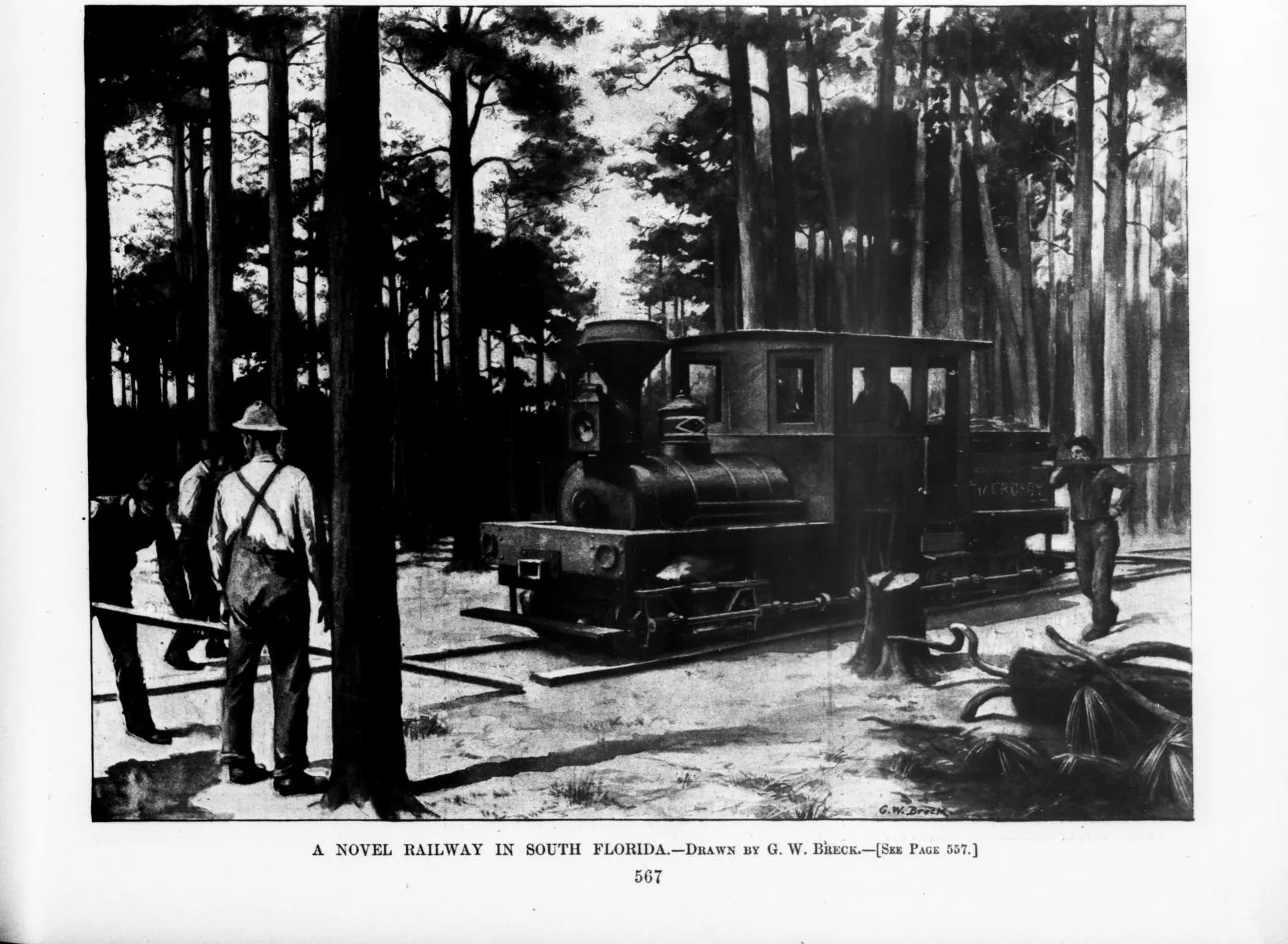
“A Novel Railway in South Florida,” drawn by G. W. Breck. Harper’s Weekly, 15 June 1895, page 567. Via Internet Archive. Public domain.[harpers-1895-novelty]
John C. Burleigh’s steam engine was not a mill engine. It was a twelve-ton Shay geared locomotive, built by the Lima Locomotive Works of Ohio and delivered to Florida late in 1894. Because no railroad yet reached Avon Park, Burleigh moved it the last twenty-three miles from the railhead at Bowling Green by laying short lengths of timber in front of it, running the engine forward onto them, then pulling up the timber behind and carrying it to the front again. With twelve men and a cook, he covered the distance in nine days.[harpers-1895-novelty]
The improvisation became the idea. The Avon Park Transportation Company, which had spent years failing to persuade investors to extend a conventional steel railroad to the town, was formed in January 1895 to build a railroad of wooden rails on Burleigh’s pattern, with Burleigh as superintendent of construction. It aimed at Haines City, forty miles north, on $25,000 of capital stock.[harpers-1895-novelty]
The town turned out to build it. A Savannah paper reported the first day’s work: “Avon Park people are building a tram railroad to Haines City. On Jan. 12 over 200 stalwart, earnest men, with axes and shovels, cleared up about three miles of the right of way through pine and palmetto for the road. The first spike was, that day, driven by Mrs. O. M. Crosby.”[savannah-1895-01-20]
When the line reached Pabor Lake on Saturday 7 September 1895, the company ran an excursion for the people of Avon Park and the neighboring colony gave them lunch and speeches at the Twin Oak picnic ground. The Pabor Lake Pineapple gave its whole front page to the day, under the heading “It Has Come”: two trains, “nearly a hundred people prepared for picnicing” on the first, President Knapp of the transportation company in the chair, Edgar A. Pabor welcoming them for the colony, the Reverend G. C. Lincoln telling them that “our only salvation was a way out — not, as some of the people might fancy, to get out — but out to a touch with the outside world”, W. E. Pabor reading rhymes on “The Building of the Tram”, and Burleigh, the superintendent of construction, calling on the people to “touch the financial button” of the concern and his sawmill would do the rest. Crosby, back from New York, told them what the Plant System’s people had said: that the wooden tramway would eventually give place to rails.[plp-1895-09]
It never got there. Steel rail did not reach Avon Park until 1912, seventeen years later — the date is fixed by the Florida Railroad Commission’s own annual station tables, and the popular “1911” is wrong.[frc-15][frc-16]
The engine itself does not survive. A locomotive construction roster records Lima shop number 469, built 17 November 1894, sold to the Florida Development Company, moved overland to Avon Park, later owned in West Virginia, and eventually scrapped.[shay-roster-469]
The core facts of the locomotive, the overland haul, the wooden railway, and the opening of the line to Pabor Lake on 7 September 1895 rest on contemporary sources: a national magazine account published within six months of the events and the local newspaper’s own front-page reporting, both of which name Burleigh directly. Burleigh’s subsequent career and the final scrapping of the engine are corroborated through subsequent business directories, local news accounts, and locomotive rosters.
Who John C. Burleigh was
The contemporary account describes him as “Mr. J. C. Burleigh, a Connecticut Yankee transplanted to Florida,” who in the autumn of 1894 was “manager of a steam saw-mill in Avon Park.”[harpers-1895-novelty]
The local newspaper adds three fixed points.[pineapple] In November 1892 he appears as an incorporator of a proposed railroad called the “Frost-Proof Line,” described as “J. C. Burleigh, of Midland,” alongside Crosby of Avon Park, Pabor and W. J. Hill of Pabor Lake, W. W. Davis of Midland, Harrison Jones of Haines City, and C. H. Smith of Jacksonville — so he was promoting railroads two years before the locomotive arrived. By the summer of 1895 the paper calls him “one of the founders of Midland but now residing at Avon Park,” which confirms from a contemporary source a move that had rested only on an uncited modern account. And in September 1895 it reports him promising that if the public would “touch the financial button” of the enterprise, “his sawmill would do the rest.”
That last phrase matters. Harper’s Weekly calls him the mill’s manager; his neighbors called it his sawmill. He was also one of four named principals of the railroad — “Messrs. Crosby, Knapp, Burleigh and Chollar” — not simply its hired superintendent.[pineapple]
A modern local-history account, which cites no sources of its own, fills in a fuller life: born in Connecticut, arrived in Florida in 1886, co-founded the settlement of Midland between Fort Meade and Frostproof with his sister Gertrude Burleigh Simmons, served as Midland’s first postmaster and ran its store and sawmill, then sold out to his brother-in-law around 1890 and moved to Avon Park, then a town of roughly two hundred people.[byrne-wooden-railroad] None of this is confirmed by any known record, and it should be treated as tradition rather than fact. What can be said is that the Connecticut origin, which appeared in that account, is independently corroborated by the 1895 magazine article.[harpers-1895-novelty]
The Midland connection also has partial independent support. The State Archives of Florida holds a photograph captioned “John Burleigh hauling supplies to the store – Midland, Florida,” dated around 1900, catalogued under Polk County and the extinct community of Midland.[fl-memory-midland-photo]
Separately, a John C. Burleigh appears repeatedly in Polk County newspapers between 1900 and 1920: a birth notice in the Bartow Courier-Informant in January 1900, land transfers recorded in the Lakeland Evening Telegram in May 1914, a notary public listing in the Lakeland Star in October 1919, and an estate administration notice running in the Polk County Record from August 1920. None of these items mentions Avon Park or a steam engine.[ufdc-polk-burleigh] A “J.C. Burleigh” also appears in Florida’s early automobile registrations under the date 1 February 1910.[fl-memory-auto-reg]
He was still at Avon Park in 1906. The Avon Park column of The De Soto County News for 18 May 1906 reports that “J. C. Burleigh is having a lot of work done in the upper story of his home, taking out the ceiling and substituting lath and paper, and will raise the roof of the front part to the same height as the new rear part.”[dsc-1906-05-18] That is a man who owns a two-story house in the town eleven years after the railway scheme collapsed, and it disposes of the assumption that he left when the freezes ruined the enterprise.
And he kept a store there for at least sixteen years. The state business directories list him at Avon Park in 1895 as “Burleigh J C, gen’l mdse & carp & builder,” in 1907 as “Burleigh John C, general store,” and in 1911 again as “Burleigh John C, general store.” He is absent from the 1918 list, but a January 1915 advertisement in the county paper still places a hardware and furniture business “in old Burleigh Store.” The directories never once call him a miller.
The most economical reading of all this is that these are one man: a Connecticut native who worked at Midland, ran a mill and then a railroad at Avon Park from the middle 1890s, kept a general store in the town until some point between 1911 and 1918, and afterwards, perhaps, returned to the Polk County side of the ridge, where a John C. Burleigh’s estate was being administered in 1920. That last step is a hypothesis; the Polk County items name no connection to Avon Park, and none of it has been tested against a census schedule, a deed, or a probate file.
Two further traces are worth recording without over-reading them. A recurring advertisement carrying the name “Burleigh,” with the legible initials “J C,” runs through The De Soto County News of Arcadia in 1905 and 1906, alongside merchandise listings for sash, doors, furniture and stoves; the scan quality is too poor to confirm the identification.[loc-chronam-desoto] And Bougainvillea Cemetery in Avon Park holds the burial of Ralph C. Burleigh, 1900–1988, the only Burleigh interment recorded in Highlands County — a plausible relative, but nothing in the record connects him.[findagrave-ralph-burleigh]
The engine
Harper’s Weekly is explicit: Burleigh “sent an order to the Lima Locomotive Machine Works for one of their twelve-ton Shay locomotives.”[harpers-1895-novelty] A Shay is a geared locomotive, designed for logging railroads — slow, powerful, and tolerant of rough, uneven, lightly built track. It was exactly the right machine for a sawmill in unimproved country, and exactly the wrong machine for speed.
The Lima construction roster records shop number 469, the 423rd Shay the works built, completed 17 November 1894, class A 10-2, built for the Florida Development Company. The same entry notes that it was “shipped to Bowling Green FL and over nine days, moved 23 miles cross country to Avon Park, over wood rail beams relaid in front as the loco advanced.”[shay-roster-469] The construction date sits about four weeks before the December delivery, which is what one would expect.
Two details do not line up cleanly.
The roster names the engine “ANNA,” recorded as Florida Development Company number 5. Harper’s Weekly, writing in 1895, names it Crosby — almost certainly for Oliver Marvin Crosby, who founded Avon Park.[harpers-1895-novelty][shay-roster-469] The likeliest explanations are a renaming at some point in its life, or a builder’s-record name distinct from the name it carried locally. Neither is established.
The roster also gives an as-built empty weight of 16,000 pounds, or eight tons, against the “twelve-ton” of the magazine.[shay-roster-469][harpers-1895-novelty] This is a familiar ambiguity in nineteenth-century locomotive description: an engine’s nominal class rating, its empty weight, and its weight in working order with water and fuel aboard are three different figures. The discrepancy does not indicate that either source is wrong about which machine is meant.
The buyer of record is no longer a puzzle. The roster names the Florida Development Company as the purchaser.[shay-roster-469] That was Oliver M. Crosby’s own company: the Pineapple names him “president of the Florida Development company,” and the National Register nomination for the town’s historic district describes it as his vehicle, lost to debt after the freezes ruined him.[pineapple] So the founder of Avon Park bought the locomotive, and the company named it after its president — which is why Harper’s Weekly calls it the Crosby.[harpers-1895-novelty][shay-roster-469]
The overland haul, December 1894
The railhead nearest Avon Park was Bowling Green, twenty-three miles away, and there was no road between them capable of carrying twelve tons. Burleigh went to Bowling Green with twelve men, a cook, a camping outfit, and a stock of 4x6 and 2x6 timbers. The crew laid the timbers as a short track, turned the locomotive to face east, ran it forward onto them on its eight-inch wheel treads, then lifted the timbers from behind and carried them to the front to be laid again. Over creeks, through marshes and through swamp, the engine reached Avon Park in nine days — under three miles a day.[harpers-1895-novelty]
The modern retelling dates the journey precisely, from 13 December to 22 December 1894.[byrne-wooden-railroad] Harper’s gives only the duration, so those calendar dates remain uncorroborated, though they are consistent with the locomotive’s November construction date and with a nine-day trip.[harpers-1895-novelty][shay-roster-469]
From improvisation to railroad
The town was impressed enough that the method outlived the errand. In January 1895 the Avon Park Transportation Company was formed with $25,000 in capital stock to build north from Avon Park, in DeSoto County, to Haines City in Polk County — about forty miles — where it would meet the Plant System for Jacksonville and the North. Burleigh was elected superintendent.[harpers-1895-novelty]
The track was wooden throughout. Rails were 4x8 beams laid directly in the sand without cross-ties, their ends joined by wooden fish-plates, the whole held together by wooden pins eighteen inches long.[harpers-1895-novelty] This was cheap, and it was not absurd. Wooden-railed logging tramways and “pole roads” were a recognized Southern technology; the Smoak Tramway in South Carolina ran a seven-ton locomotive over roughly six miles of wooden rail between 1884 and 1890.[smoak-tramway] What distinguished the Avon Park line was ambition: it was chartered as a common carrier aiming at a connection with a trunk system, not merely as a mill tramway.
The line was never finished. The forty miles to Haines City were never built, and steel rail reached Avon Park only in 1912, seventeen years later. The modern account that gives 1911 is a year out: the Railroad Commission’s station table for the year to February 1912 still ends the Haines City branch at Frostproof, ten miles short, and the table for the year to February 1913 runs it through Avon Park to Sebring.[frc-15][frc-16] A published history of Florida railroads also records the company’s forty-mile wooden-tramway proposal.[turner-fl-railroads]
The line did open to Pabor Lake, on Saturday 7 September 1895. The Pabor Lake Pineapple led its September 1895 front page with the headline “IT HAS COME. / The Tramway Reaches Pabor Lake, / On Its Way From Avon Park to Bartow / First Excursion Over the Line,” and began: “The tramway reached Pabor Lake on Saturday, September 7, this being the first station from Avon Park on the way north.”[pineapple]
The report also shows the company’s ambitions shifting. In June the destination was Haines City; by September it was Bartow, and hedged — “a connection at (probably) Bartow with the great railway system of the country.”[harpers-1895-novelty][pineapple] The account closes: “The ‘toot, toot’ of the engine was heard, and ‘all aboard’ was the cry… But the ‘toot’ has finally come and come to stay.” It did not stay. The claim that about 150 people rode the first train is from the modern uncited account and does not appear in the newspaper report.[byrne-wooden-railroad]
What became of the engine
It was scrapped. The construction roster records the locomotive passing from the Florida Development Company to A. V. Miller of Nida (Cass), West Virginia, with a final disposition of “scrapped.”[shay-roster-469] No date is given for either the sale or the scrapping. Geared locomotives were routinely resold into Appalachian logging after Southern operations wound up, so the trajectory is unremarkable, but no record fixes when the engine left Florida.
No physical artifact or component of the locomotive survives in local museum collections, and no Florida Memory photograph of the engine in service is known.
The one known image of the machine is the G. W. Breck illustration, “A Novel Railway in South Florida,” published with the 1895 article.[harpers-1895-novelty] It is in the public domain and freely available in a digitized scan.
What the popular account gets wrong
The engine’s name is disputed. The contemporary source says Crosby; the modern roster says Anna. Both cannot describe the same moment. For historical interpretation, Crosby is the documented choice for the Florida period, because it is what a writer recorded on the spot in 1895, with Anna noted as the name in the builder’s roster.[harpers-1895-novelty][shay-roster-469]
Burleigh’s role is often inflated. Harper’s calls him the mill’s manager and the railroad’s superintendent, and credits him with originating the wooden-rail idea. It does not call him the mill’s owner, and it does not call him the company’s founder.[harpers-1895-novelty]
Contemporary documentation from the Pabor Lake Pineapple places him firmly at Avon Park in 1895, confirming his transition from Midland to Avon Park and his active mercantile and civic presence alongside town founder O. M. Crosby and colony promoter W. E. Pabor.[pineapple]
The Pabor Lake Pineapple, digitized by the University of Florida and covering the years 1892 to 1897, provides the decisive contemporary record for the colony, the wooden tramway opening to Pabor Lake on 7 September 1895, and the civic leadership of the period.[pineapple]
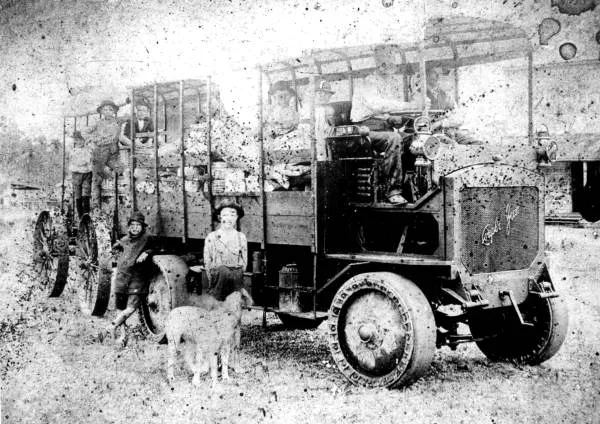
John Burleigh hauling supplies to the store, Midland, Florida. State Archives of Florida, Florida Memory, image RC09877. Public domain. The archive dates it circa 1900; the truck suggests the late 1910s or 1920s.[fl-memory-midland-photo]
References
- plp-1895-09 — W. E. Pabor, editor and publisher. The Pabor Lake Pineapple, September 1895, front page: ‘It Has Come — The Tramway Reaches Pabor Lake’. 15 September 1895. pabor-lake-pineapple.md
- savannah-1895-01-20 — The Morning News (Savannah, Ga.). The Morning News, Savannah, Georgia, 20 January 1895, page 16, Georgia and Florida column: the first day’s work on the Avon Park tram railroad. 20 January 1895. https://www.loc.gov/resource/sn86063034/1895-01-20/ed-1/?sp=16
- harpers-1895-novelty — Harper’s Weekly, Vol. 39, No. 2008. A Novelty Among Railroads (with illustration “A Novel Railway in South Florida,” drawn by G. W. Breck). 15 June 1895. harpers-weekly-1895-novelty-among-railroads.md
- frc-15 — Railroad Commission of the State of Florida. Fifteenth Annual Report of the Railroad Commission of the State of Florida, for the year ending 29 February 1912. 29 February 1912. https://archive.org/details/FifteenthAnnualReportOfTheRailroadCommissionOfTheStateOfFlorida
- frc-16 — Railroad Commission of the State of Florida. Sixteenth Annual Report of the Railroad Commission of the State of Florida, for the year ending 28 February 1913. 28 February 1913. https://archive.org/details/SixteenthAnnualReportOfTheRailroadCommissionOfTheStateOfFlorida
- dsc-1906-05-18 — O. R. Thacher (department editor), The De Soto County News, Arcadia, Fla. The De Soto County News, 18 May 1906, page 8: Department of The South Florida Sun, Avon Park Locals. 18 May 1906. de-soto-county-news-avon-park-department.md
- shay-roster-469 — shaylocomotives.com (enthusiast-compiled construction roster). Lima Shay Shop Number 469 factsheet. 22 February 2020. https://www.shaylocomotives.com/data/factsheet/sn-469.htm
- fl-memory-midland-photo — State Archives of Florida, Florida Memory. John Burleigh hauling supplies to the store – Midland, Florida (image RC09877). 1900. https://www.floridamemory.com/items/show/32637
- ufdc-polk-burleigh — University of Florida Digital Collections / Florida Digital Newspaper Library. Polk County newspaper items naming John C. Burleigh, 1900-1920 (Courier-Informant, Lakeland Evening Telegram, Lakeland Star, Polk County Record). 30 August 2026. https://ufdc.ufl.edu
- pineapple — W. E. Pabor and E. A. Pabor, editors and publishers. Pabor Lake Pineapple, October 1892 to September 1897; especially vol. 3 no. 10, September 1895, p. 145. 15 September 1897. pabor-lake-pineapple.md
- loc-chronam-desoto — Library of Congress. Chronicling America digitisation coverage for DeSoto and Highlands counties, Florida. 30 August 2026. https://www.loc.gov/collections/chronicling-america/
- byrne-wooden-railroad — Jason Byrne, Florida History Blog. The Marvelous Wooden Railroad. 29 June 2024. https://floridahistoryblog.com/the-marvelous-wooden-railroad/
- findagrave-ralph-burleigh — Find a Grave. Ralph C. Burleigh (1900-1988), Bougainvillea Cemetery, Avon Park. 30 August 2026. https://www.findagrave.com/memorial/37244881/ralph-c-burleigh
- fl-memory-auto-reg — State Archives of Florida, Florida Memory. “J.C. Burleigh,” Early Auto Registrations 1905-1917, dated 1910-02-01. 1 February 1910. https://www.floridamemory.com/items/show/300699
- smoak-tramway — Wikipedia. Smoak Tramway. 30 August 2026. https://en.wikipedia.org/wiki/Smoak_Tramway
- turner-fl-railroads — Gregg M. Turner (Arcadia Publishing, 2003). A Short History of Florida Railroads. 2003. https://books.google.com/books/about/A_Short_History_of_Florida_Railroads.html?id=fCYM5WaJH3UC
Related
- John C. Burleigh
- The “Crosby” Shay locomotive
- Avon Park Transportation Company
- Finding: The 1895 wooden railroad route and extent of track
- Finding: Burleigh’s locomotive was scrapped and does not survive
- Finding: the railroad reached Avon Park in 1912
- Finding: pre-1930 Highlands County newspapers are largely undigitized
- Finding: John C. Burleigh was still living at Avon Park in 1906
- Reference: Harper’s Weekly, 15 June 1895
- Reference: Pabor Lake Pineapple
- Florida Development Company
- Pabor Lake colony
- Avon Park in the Outside Press, 1886–1900
Where this comes from
- Evidence
- single-source — One source. Treat as reported, not established.
- Review
- unverified — Drafted from sources but not yet checked by a volunteer.
- Rights
- society
Sources
- W. E. Pabor, editor and publisher, The Pabor Lake Pineapple, September 1895, front page: 'It Has Come — The Tramway Reaches Pabor Lake' (references/pabor-lake-pineapple.md) (1895) · newspaper
- The Morning News (Savannah, Ga.), The Morning News, Savannah, Georgia, 20 January 1895, page 16, Georgia and Florida column: the first day's work on the Avon Park tram railroad (1895) · newspaper
- Harper's Weekly, Vol. 39, No. 2008, A Novelty Among Railroads (with illustration "A Novel Railway in South Florida," drawn by G. W. Breck) (1895)
- Railroad Commission of the State of Florida, Fifteenth Annual Report of the Railroad Commission of the State of Florida, for the year ending 29 February 1912 (1912)
- Railroad Commission of the State of Florida, Sixteenth Annual Report of the Railroad Commission of the State of Florida, for the year ending 28 February 1913 (1913)
- O. R. Thacher (department editor), The De Soto County News, Arcadia, Fla., The De Soto County News, 18 May 1906, page 8: Department of The South Florida Sun, Avon Park Locals (1906)
- shaylocomotives.com (enthusiast-compiled construction roster), Lima Shay Shop Number 469 factsheet (2020)
- State Archives of Florida, Florida Memory, John Burleigh hauling supplies to the store – Midland, Florida (image RC09877) (1900)
- University of Florida Digital Collections / Florida Digital Newspaper Library, Polk County newspaper items naming John C. Burleigh, 1900-1920 (Courier-Informant, Lakeland Evening Telegram, Lakeland Star, Polk County Record) (2026)
- W. E. Pabor and E. A. Pabor, editors and publishers, Pabor Lake Pineapple, October 1892 to September 1897; especially vol. 3 no. 10, September 1895, p. 145 (1897)
- Library of Congress, Chronicling America digitisation coverage for DeSoto and Highlands counties, Florida (2026)
- Jason Byrne, Florida History Blog, The Marvelous Wooden Railroad (2024)
- Find a Grave, Ralph C. Burleigh (1900-1988), Bougainvillea Cemetery, Avon Park (2026)
- State Archives of Florida, Florida Memory, "J.C. Burleigh," Early Auto Registrations 1905-1917, dated 1910-02-01 (1910)
- Wikipedia, Smoak Tramway (2026)
- Gregg M. Turner (Arcadia Publishing, 2003), A Short History of Florida Railroads (2003)
Something here wrong, or incomplete? The Society would rather know. Tell a volunteer.
Have a question about this record?