
The Great Freezes of 1894–1895 and Economic Recovery
According to Leoma Bradshaw Maxwell’s historical documentation in The First Hundred Years of Avon Park, Florida [maxwell-1976], the catastrophic back-to-back freezes of December 1894 and February 1895 brought sudden devastation to the thriving agricultural colony of Avon Park, plunging the town into a decade of severe economic hardship before a resilient core of pioneer families rebuilt the community.
The Boom Before the Disaster
In late 1894, Avon Park was celebrated across Florida as a model community [maxwell-1976]. The town counted an estimated 500 residents, 95 finished homes, 600 cultivated acres of citrus and pineapple plantations, a 60-room hotel, a thriving post office, a printing press, a 13-piece brass concert band, and active churches and schools [maxwell-1976].
However, the broader financial foundation was precarious. The Panic of 1893—precipitated by the failure of Baring Brothers bank in London, runs on gold reserves, and currency instability—had severely restricted capital markets. Oliver M. Crosby’s Florida Development Company had incurred heavy debts, including $10,000 for a new sawmill outfit and obligations to northern partners, making the venture vulnerable to any agricultural setback [maxwell-1976].
The Freezes of December 1894 and February 1895
Crosby provided a first-hand chronicle of the catastrophe in his personal records:
“Christmas Day 1894 the air was balmy as June. All was happiness at the Hotel. . . . December 27th it was growing cold fast, a gale blowing from the northwest, temperature going down fast. A bitter cold night for Florida followed.
Water was frozen in the bedroom pitchers; and next morning the mercury was 17 degrees below freezing [15°F]. Deep Lake Verona steamed like a teakettle. . . . The young orange and lemon trees were all killed; also the 500,000 pineapple plants. It was a dreadful blow, but the larger trees showed life the following month when the mild beautiful weather continued, so we felt that all was not lost.” [maxwell-1976]
The fatal blow arrived six weeks later on February 8, 1895:
“Came another blast, even worse than the first because the trees were full of sap. The sun rose the next morning bright on the frozen trees and the bark split on the East side of the trees from top to root, often with a big bang. The 600 acres of groves were killed to the ground. Plantations of pineapples, grape vineyards and gardens were all lost.” [maxwell-1976]
The Exodus and Aftermath
The disaster triggered immediate panic and a mass exodus [maxwell-1976]:
- Population Collapse: The town’s population dropped from approximately 500 in early 1895 to 241 by 1896 [maxwell-1976].
- Deserted Properties: Many families withdrew whatever money remained in the bank and left on foot or by ox-wagon for Fort Meade, leaving houses fully furnished. Wildfires subsequently consumed many abandoned timber homes [maxwell-1976].
- Financial Insolvency: With property buyers defaulting on land notes, Crosby could not meet the Development Company’s obligations. On January 6, 1896, Crosby resigned as president. Creditors foreclosed: the Avonian Block was claimed by bank cashier C. C. Chollar for $3,000, the Verona Hotel was foreclosed under a $5,000 note, and Mrs. A. R. Dodge purchased the company’s remaining assets at a sheriff’s sale [maxwell-1976].
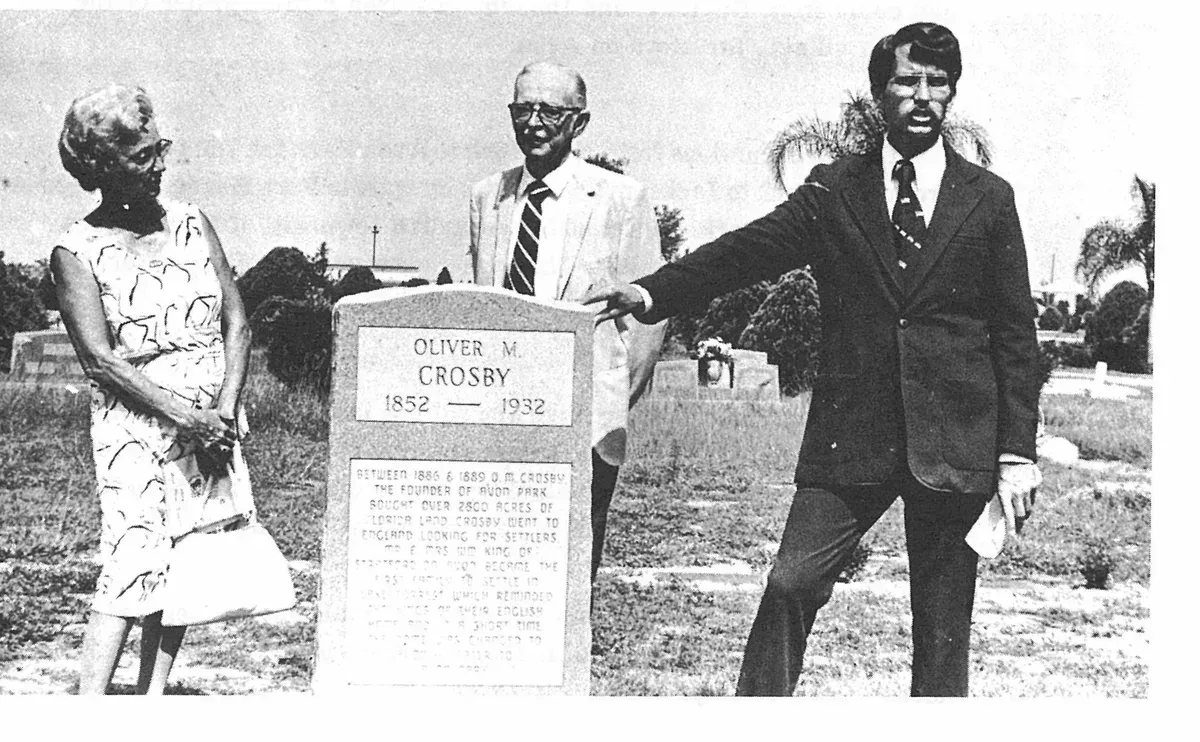
The monument erected on Oliver M. Crosby’s grave in Bougainvillea Cemetery on July 4, 1976.[maxwell-1976]
In late 1896, Crosby departed Avon Park for New York with only $10 in his pocket, working in insurance for the next decade [maxwell-1976]. He spent his retirement years in Largo, Florida, and upon his death in 1932, his body was returned to Avon Park for burial in Bougainvillea Cemetery, on land he had deeded to the town. On July 4, 1976, the Avon Park Bicentennial Committee erected a monument over his grave honoring him as the founder of Avon Park [maxwell-1976].
Rebuilding and Economic Recovery
Despite predictions that Avon Park would become a ghost town, a determined core of settlers led by William A. King, B. F. West, the Dilleys, Grays, Wrays, and Bennetts remained [maxwell-1976]. Pioneer families replanted citrus rootstocks, cultivated cold-hardy varieties, and established local sawmills and crate mills [maxwell-1976].
The town incorporated in the first week of January 1897, electing Clark D. Knapp mayor and a council of five.[savannah-1897-01-15] By then, The Florida Homeseeker reported that Avon Park was the third largest town in DeSoto County, boasting seven miles of plank sidewalks, a sawmill, drug store, barber shop, bakery, livery stable, and active commercial trades [maxwell-1976]. The recovery laid the groundwork for the arrival of the Atlantic Coast Line Railroad in 1912 and the major expansion of the 1920s.
References
- savannah-1897-01-15 — The Morning News (Savannah, Ga.). The Morning News, Savannah, Georgia, 15 January 1897, page 6, Florida column: the incorporation of Avon Park and the election of its officers. 15 January 1897. https://www.loc.gov/resource/sn86063034/1897-01-15/ed-1/?sp=6
- maxwell-1976 — Leoma Bradshaw Maxwell. The First Hundred Years of Avon Park, Florida. 1976. the-first-hundred-years-of-avon-park_leoma-bradshaw-maxwell_1976.md
Where this comes from
- Evidence
- single-source — One source. Treat as reported, not established.
- Review
- unverified — Drafted from sources but not yet checked by a volunteer.
- Rights
- society
Sources
- The Morning News (Savannah, Ga.), The Morning News, Savannah, Georgia, 15 January 1897, page 6, Florida column: the incorporation of Avon Park and the election of its officers (1897) · newspaper
- Leoma Bradshaw Maxwell, The First Hundred Years of Avon Park, Florida (Held at the Avon Park Historical Society Depot Museum, Avon Park, Florida) (1976) · book
Something here wrong, or incomplete? The Society would rather know. Tell a volunteer.
Have a question about this record?