
Oliver Marvin Crosby and the Founding of Avon Park (1884–1896)
According to Leoma Bradshaw Maxwell’s foundational history The First Hundred Years of Avon Park, Florida [maxwell-1976], the settlement of Avon Park was the visionary creation of Oliver Marvin Crosby, a Danbury, Connecticut seedsman, florist, and writer who entered the Florida land development market in the early 1880s.
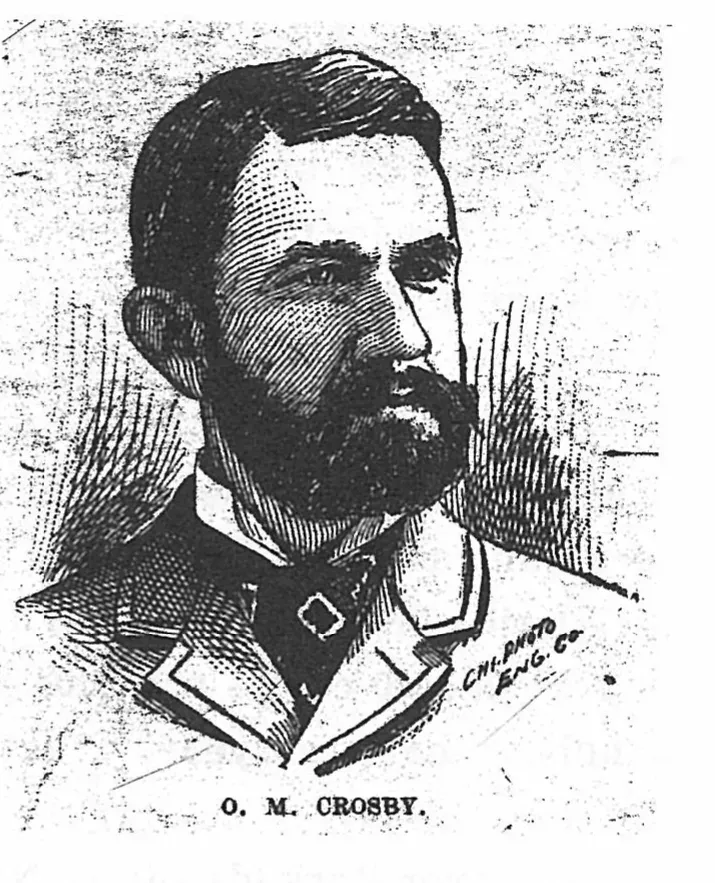
Oliver Marvin Crosby (1849–1932), founder of Avon Park, Florida.[maxwell-1976]
Early Background and the Search for Frost-Free Lands
In the early 1880s, Oliver Marvin Crosby worked under a five-year contract with Obadiah A. Clough of New York City as the Florida editor of The South, an illustrated national publication promoting Southern resort hotels, steamboats, rail routes, and agricultural settlements [maxwell-1976]. Crosby held a one-fourth interest in Clough’s development at Belleview in Marion County, where they had planted orange groves and invested in phosphate properties.
During the winter of 1884–1885, a severe freeze destroyed citrus groves as far south as Belleview. Investors grew discouraged and began abandoning the colony [maxwell-1976]. Recalling earlier exploratory travels into Manatee County in 1883, Crosby resolved to find an area roughly 100 miles south of Belleview that would be protected from northern cold snaps.
The Disston Survey and Discovery of Township 33
In Jacksonville, Crosby visited the office of the Hamilton Disston Land Company, which had acquired 4,000,000 acres of Florida public lands from Governor William D. Bloxham in 1881 for one million dollars in cash [maxwell-1976]. Crosby asked Captain C. F. Adams, the company’s chief surveyor in South Florida:
“What is the best township site you have found in your surveying South Florida?” Adams replied: “If you want to see the prettiest township in the state, go and see Township 33, Range 28 East.” [maxwell-1976]
On May 25, 1885, Crosby set out from Jacksonville by train to Kissimmee, then continued by rail to Bartow, the southern terminus of the narrow-gauge Florida Southern Railroad. Accompanied by a guide, Crosby drove a two-horse livery rig to Fort Meade, camped overnight in an abandoned log cabin at the frontier trail’s end, and on the morning of May 26, 1885, mounted horseback following a compass southeast into the wilderness [maxwell-1976].
Crosby recorded his first sighting of the region in his 1919 historical memoir:
“Passing Red Hill, as we left the flat woods, we rode into the highlands, or the backbone ridge, where your West Main Street now must be, and suddenly we were looking over your Lake Tulane, then known as Tiger Lake. We made coffee and had our lunch. Taking out the map that was furnished us by Capt. Adams, I said ‘if this is Tiger Lake then there is a much larger lake over yonder.’ We rode on and found Carter Lake, which is now Lake Lotela, and we knew that we were not lost.” [maxwell-1976]
They explored Lake Lelia, Lake Glenada, Lake Pioneer, Lake Viola, and Lake Pythias. Although Crosby did not see Lake Verona on this initial excursion (it did not intersect a section line on Adams’ survey map), he fell in love with the pristine, high-banked lakes and rolling pine forests [maxwell-1976].
The Disston Land Contract of 1886
Returning north, Crosby persuaded Clough to purchase the township. On January 14, 1886, at the Disston Company’s Philadelphia headquarters, Crosby executed a contract in Clough’s name for 20,000 acres at a price of $50,000 [maxwell-1976]. The purchase covered the entire township, excluding a few reserved parcels and Section 16 (the school section).
When Clough subsequently defaulted on his financial obligations, Crosby assumed Clough’s liabilities in 1887 to secure a direct contract in his own name. To finance the venture, Crosby sold his 18-acre nursery in Connecticut and established the Bureau of Florida Information at 99 Franklin Street in New York City, which he maintained for seven years [maxwell-1976].
Early promotional map of Avon Park showing the grid layout and surrounding lakes.[maxwell-1976]
Town Planning and Promotion
Crosby originally advertised the colony under the name Lake Forest. In May 1886, Mrs. Mary Chinn King, arriving from England with her husband William A. King, remarked that the tranquil lakes and stately pines reminded her of her native Stratford-on-Avon; at her suggestion, Crosby adopted the name Avon Park [maxwell-1976].
Crosby launched an extensive national advertising campaign, spending an estimated $25,000 across magazines such as Century, Cosmopolitan, and the New York Sunday World. He published Florida Facts, Lake Forest and Avon Park (1887), Florida Facts, Both Bright and Blue (1887), and began issuing the monthly newspaper The Florida Homeseeker (1886–1893), which reached a circulation of 10,000 subscribers throughout North America and the British Isles [maxwell-1976].
Crosby organized package excursion tours from New York City for $75 round-trip, bringing prospective settlers by steamship to Jacksonville, train to Fort Meade, and stagecoach or buckboard into Avon Park [maxwell-1976]. Land was sold on accessible installment terms ($100 down and $1 per month for one-acre lots, or $50 down and $10 per month for ten-acre tracts). All deeds issued by Crosby contained a strict clause prohibiting the manufacture or sale of intoxicating liquors [maxwell-1976].
By 1894, the colony had expanded to 95 homes, 600 cultivated acres of citrus and pineapples, a 60-room hotel, three general stores, a post office with daily mail, a printing office, a sawmill, a public school, and the Union Evangelical Church [maxwell-1976].
References
- maxwell-1976 — Leoma Bradshaw Maxwell. The First Hundred Years of Avon Park, Florida. 1976. the-first-hundred-years-of-avon-park_leoma-bradshaw-maxwell_1976.md
Related
Where this comes from
- Evidence
- single-source — One source. Treat as reported, not established.
- Review
- unverified — Drafted from sources but not yet checked by a volunteer.
- Rights
- society
Sources
- Leoma Bradshaw Maxwell, The First Hundred Years of Avon Park, Florida (Held at the Avon Park Historical Society Depot Museum, Avon Park, Florida) (1976) · book
Something here wrong, or incomplete? The Society would rather know. Tell a volunteer.
Have a question about this record?