The schools of Avon Park, 1886-1975
Fragments survive from the town’s first decades — a schoolhouse that burned in 1895, twenty-eight pupils in 1905, a library of sixty volumes, a building used as a polling place in 1915, a new building finished by Contractor Parker in February 1915 and waiting for its furniture[dsc-1915-02-11] — but the fuller picture comes from a different kind of source. Florida’s Superintendent of Public Instruction published a report every two years gathering a narrative from every county superintendent in the state, followed by several hundred pages of tables, and the run from 1904 to 1936 is free online. It names Avon Park’s buildings, its bond issues, its principals and its pupils, and because Florida counted its schools by race it also measures, year by year, what the town’s Black children were denied. See Reference: the biennial reports of Florida’s Superintendent of Public Instruction.
This report sets out what that series, the county’s own property records, the session laws and the recollections of Hopewell School’s last pupils together make of ninety years of schooling in one small town.
The first traces, 1886-1912
The town was founded in 1886. An initial one-room frame schoolhouse, the “Little Blue School House” on Midway Street near West Bell Street, was closed in 1893 when residential and business growth shifted toward the Hotel Verona commercial core[maxwell-1976]. It was replaced by a two-story frame schoolhouse at the corner of South Forest Avenue and West Walnut Street (adjacent to Block 36), which burned to the ground in a major fire on 4 December 1895[maxwell-1976]. Classes met temporarily in Sargent’s Hall on North Lake Avenue until a replacement two-story frame school opened on 4 October 1897 on the same South Forest Avenue site under principal Prof. Erving Leander Richardson (1849–1911), a Dartmouth College alumnus (Class of 1873) from Columbia and Liberty Hill, Connecticut, whom The Willimantic Journal placed at Avon Park on 6 May 1898[maxwell-1976][willimantic-1898-05-06][dartmouth-alumni-1912-03].
Throughout the 1900s, this South Forest Avenue building was Avon Park’s sole operating public schoolhouse. On 13 October 1905, the DeSoto County Board of Public Instruction granted applications from Avon Park (Special Tax School District No. 3) and neighboring Oak Hill (District 20, at Bunker) to establish matching-fund school libraries[dsc-1905-10-13-schools]. Four weeks later, on 10 November 1905, the town correspondent reported that “the new school library of sixty volumes is here and every book is covered with a neat and durable heavy manila cover.”[dsc-1905-11-10] A community entertainment program held the following February netted an additional four dollars for the collection[dsc-1906-02-09]. In the two years 1904-1906, DeSoto County’s apportionment of the state school fund gave “Avon Park” $80.00 — the same one-teacher figure as Silver Palm, Holzendorf, Prospect, Lemon Grove and Sweetwater, and a long way below the $300.00 that went to Bowling Green, the district’s real town.[dpi-1904-1906] The official biennial report corroborated twenty-eight pupils and the sixty-volume library in the Forest Avenue schoolhouse[dpi-1904-1906]. In 1906, growing enrollments required erecting an annex on the property nicknamed “The Coop,” which served alongside the 1897 frame building until the district voted bonds to build in brick on Block 43A[maxwell-1976].
The state’s teacher-certificate roll, an alphabetical list of everyone licensed to teach in Florida with a post-office address, recovers the earliest names. E. L. Richardson gave an Avon Park address in the rolls of 1904-1906, 1908-1910 and 1910-1912, and Elizabeth Bangs and Sarah E. Bangs appear the same way in the last two.[dpi-1904-1906] By 1912-1914 the roll also carries A. J. Gross, certified in geometry, trigonometry, rhetoric and psychology — a subject teacher, which means secondary work was being done at Avon Park by then.[dpi-1912-1914] See Finding: The 1905 School Library Grant and the South Forest Avenue Schoolhouse and Finding: Early teachers and principals of Avon Park, 1904-1935.
The brick school and the bond, 1913-1920
In 1913 Avon Park taxed itself and built in brick. DeSoto County’s superintendent, Jas. O. Bickley, reported it to Tallahassee in two sentences that between them give the date, the money and the mechanism:
“Avon Park Special Tax School District No. 3 voted bonds to the amount of $25,000; $20,000 of which is to be used for erecting and equipping a Junior High School at Avon Park, the building to be completed for this term of school; the remaining $5,000 is to be used for constructing rural schools in the District.”[dpi-1912-1914]
The district matters as much as the building. A special tax school district was a local taxing body that levied three mills on its own property owners; DeSoto County had forty of them by 1916, each electing three trustees and voting its own millage.[dpi-1914-1916] Every such bond issue in Florida ran under one general statute, Chapter 6542, Laws of Florida 1913, approved 13 June 1913, which required a petition of a quarter of the electors, a county board resolution fixing amount, interest and maturity, four weeks’ published notice, and then an election in which only freeholders could vote.[laws-6542-1913] Avon Park’s school was built by Avon Park’s own property owners, and by a franchise that excluded most of the town.
The bonds were being serviced within three years. In October 1916 the county board set the district’s assessment for 1917 at two mills for interest and three mills for a sinking fund, and made the First National Bank of Avon Park, which had bought bond No. 21 of the issue for $1,000, the depository for the district’s bond and sinking fund.[dsc-1916-10-19] The bond levy was still being carried in July 1916, when the county board’s request to the tax assessor listed Avon Park No. 3 among the special tax districts to bear an additional five mills “for the purpose of paying” bond obligations and creating a sinking fund, on top of the seven mills levied for general school purposes county-wide.[dsc-1916-07-27-p7]
Avon Park votes for compulsory attendance, 1916. Florida’s 1915 school law let each county decide by referendum whether to compel attendance for children between eight and fourteen. DeSoto County voted on 1 January 1916 and Superintendent Bickley’s returns, printed the following week, show Avon Park voting 17 for and 1 against — among the most lopsided margins in the county, alongside Arcadia’s 134 to 1, Punta Gorda’s 34 to 1 and Zolfo’s 21 to 1.[dsc-1916-01-06-p10]
The schoolyard, 1916. The grounds were improved as the brick building settled into use: in April 1916 Contractor Brazier was grading the school yard and preparing to build an iron fence around the school grounds.[dsc-1916-04-06]
The district’s number is confirmed twice over. Besides Bickley’s report, The De Soto County News of 4 March 1915 printed the county board’s notice of an election on 13 March “in Special Tax School Districts Numbered one to fourteen and sixteen to thirty-six inclusive, for the purpose of electing three trustees and voting the number of mills to be levied,” and listed “Avon Park District No. 3, polling place Avon Park High School,” staffed by inspectors S. F. Tucker, W. E. Dougherty and O. T. Kellogg with G. F. Smith as clerk — the same handful of men who had been running the town since its 1913 charter.[dsc-1915-03-04] At a mass citizens’ meeting on 6 March, the town unanimously nominated Hiram Dilley, W. O. Skipper, and J. P. Canfield as trustees and proposed a three-mill tax.[dsc-1915-03-11] Because no opposing slate emerged, the inspectors opened no poll on 13 March; the county paper recorded that “there was no election held in the Park for school trustees Saturday,”[dsc-1915-03-18] and the three nominees served as the recognized trustees under Florida’s statutory and constitutional holdover doctrine.
The new building was a junior high, not a senior one, and the state was careful about the difference. The 1914-1916 report lists “Avon Park High School” among the county’s new buildings, but in the same volume rates only “the intermediate school at Avon Park” as meeting the state’s requirements, a rung below the senior high schools at Arcadia, Wauchula and Punta Gorda.[dpi-1914-1916] Its secondary enrollment on 1 December was 21 pupils, the smallest of the eight schools in the county then permitted to teach high-school subjects, against Arcadia’s 170.[dpi-1914-1916]
It was outgrown within five years:
“Avon Park, on account of the rapid increase of the school population, was forced to erect a four-room frame building at a cost of $4,000. This was temporary, as a modern high school building will be erected as soon as conditions become normal.”[dpi-1918-1920]
The November 1920 Sanborn fire insurance sheets show an “Avon Park High School” and an “Avon Park Graded School” standing together on block 43A, the block bounded by Lake Avenue on the west, Verona Avenue on the east, Camphor Street on the north and Canfield Street on the south. The high school is drawn in the pink of brick: a two-story cross-plan building at the west end of the block, with an auditorium wing, heated by stoves and lit by electricity. The graded school is a one-story frame building in the block’s northeast corner, on Verona Avenue at Camphor, likewise heated by stoves and lit by electricity. They are in all likelihood the 1913-14 brick building and its 1918 four-room frame stopgap side by side; the map itself gives no dates.[sanborn-1920]
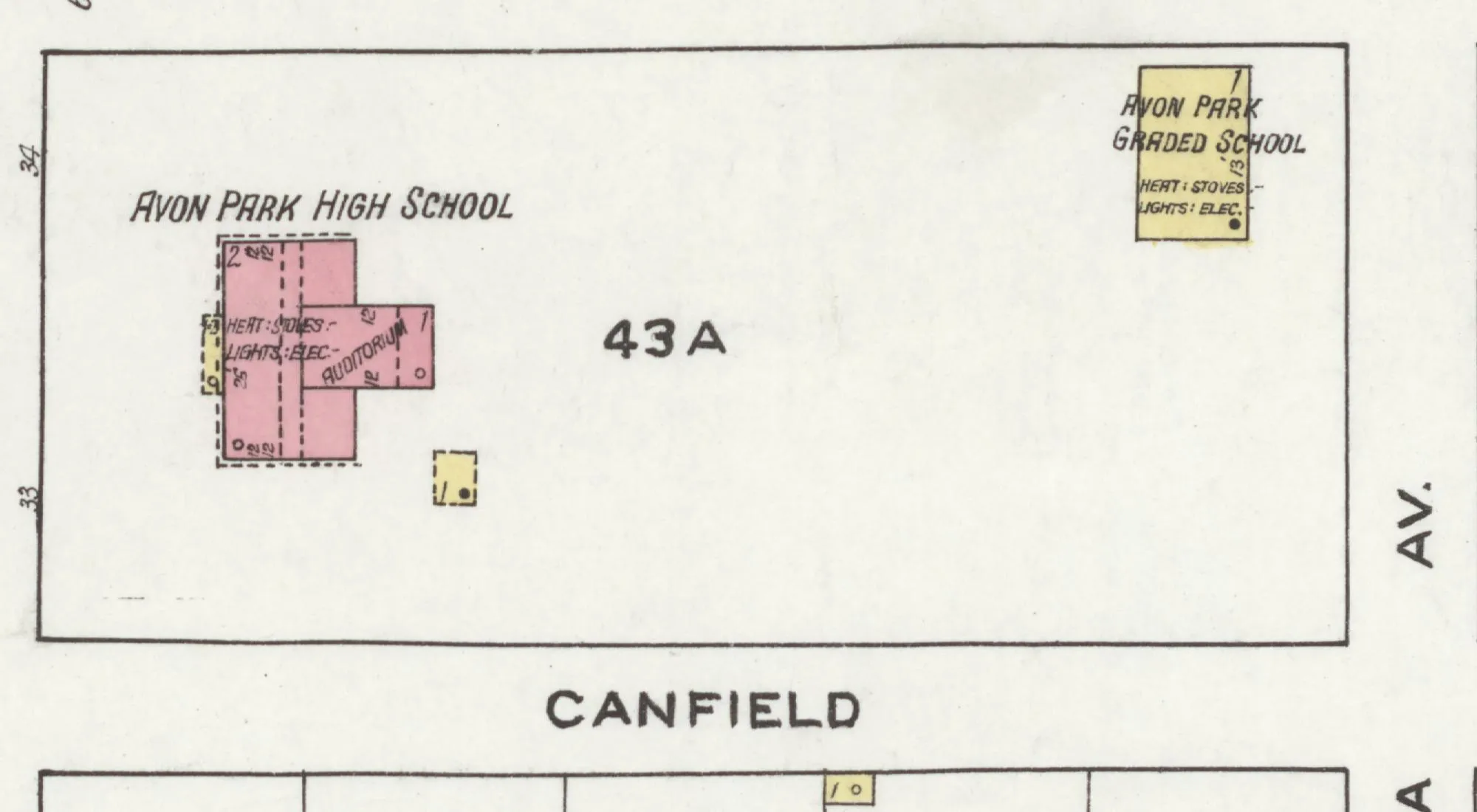
Block 43A on sheet 1 of the Sanborn map of November 1920. Sanborn Map Company, via Library of Congress, Geography and Map Division. Public domain.[sanborn-1920]
The boom-era high school and the middle school campus
The “modern high school building” that Avon Park was promised in 1920 was realized during the Florida land boom. In May 1925 the Legislature validated $40,000 in Special Tax School District No. 6 bonds under Chapter 10620, supplemented by refunding bonds, funding a new $150,000 two-story stucco Mediterranean Revival high school facing South Verona Avenue on the east side of Block 43A, replacing the temporary 1918 frame graded school.[maxwell-1976] The 1925 building featured an expansive auditorium with a balcony that served as Avon Park’s primary civic hall for decades, and a life-sized cement statue of the school mascot—the “Red Devil” with a pitchfork—anchored to its roofline.[maxwell-1976] By the 1926–1928 biennium the state’s table of accredited high schools classified “Avon Park H. S.” as “4-Year Senior,” the full senior rating the town had not held in 1916.[dpi-1926-1928]
The campus continued to evolve on Block 43A across the mid-twentieth century:
- In 1940, a concrete-block and stucco gymnasium and auditorium (18,060 square feet) was added to the campus.
- In 1955, a dedicated elementary school was built on West Winthrop Street and La Grande Street for grades 1–4, and the South Lake/Verona Avenue complex was reorganized as the Avon Park Middle School.[maxwell-1976]
- In 1966, a new $2,000,000 senior high school opened on South Marshall Avenue east of town, transferring high school classes permanently away from the site.[maxwell-1976]
- In 1978–1979, a $2,910,000 reconstruction program erected modern one-story brick facilities on the campus. Students moved into the new buildings on 12 November 1979, following which the historic 1914 brick and 1925 stucco buildings were razed.[maxwell-1976]
In modern property records, Block 43A and adjacent Block 38 have been consolidated across vacated East Canfield Street into the unified campus of Avon Park Middle School at 401 South Lake Avenue (Parcel A-22-33-28-010-0380-0010), with school athletic and tennis facilities at 303 South Lake Avenue (Parcel A-22-33-28-110-0000-0070). See Finding: Cross-Walk of the 1920 Sanborn School Campus on Block 43A to Modern Avon Park Middle School.
Hopewell School and the separate system
Avon Park’s first public school for Black children, Hopewell School, was built in 1926 — forty years after the town was founded and thirteen years after white Avon Park voted its brick school. It stood on what is now Ernest E. Sims Street. Before it there had been a school at Hagan’s turpentine still and, when that closed, classes held at St. Mark Missionary Baptist Church.
The state’s own figures show how far the two systems diverged, and they are worth reading as the county superintendents wrote them rather than as summary. DeSoto County had 55 white schools and 3 colored in 1904-1905, with average terms of 105 days against 100; by 1910-1911 it had 61 white and 6 colored, and the gap in term length had widened to 104 days against 80.[dpi-1904-1906][dpi-1910-1912] Bickley reported the same thing in prose in 1914: “we have increased the average length of term for our white schools from 105 to 108 days, and our negro schools from 90 to 100.”[dpi-1912-1914]
Two figures from the 1914-1916 report say more than any commentary. On repairs:
“My records show that we have repaired 51 school houses for whites at a cost of $11,386, and three colored schools for $391.88. Our motto has been ‘Repair an old building with a new,’ because we believe that the best is not too good for the boys and girls of DeSoto County.”[dpi-1914-1916]
And on the special tax districts — the mechanism that had just built Avon Park’s brick school, and that paid everywhere for longer terms, better salaries and new buildings:
“Number of Districts in County 40, each levying three mills; Schools for whites in these districts, 78; schools for whites not in these districts, 1; schools for negroes in these districts 4.”[dpi-1914-1916]
Seventy-eight to four. The instrument that let a Florida town build itself a school was, in practice, closed to the county’s Black schools.
Above the elementary grades
For secondary schooling the state relied on the John F. Slater Fund, a northern endowment that paid teachers’ salaries in one Black school per county, designated the County Training School and charged with training teachers for all the others.[dpi-1926-1928] Highlands County had no such school at all for its first years. Then, in 1931-32, the disbursement table reads “Highlands — Sebring-Avon Park — 325.”[dpi-1930-1932] It is the only documentary trace of Black secondary schooling attached to Avon Park before 1941, and it lasted one year; the school reverts to plain “Sebring Negro School” the next biennium and loses its aid entirely by 1934-35. See Finding: for one year Highlands County’s Black secondary school was named for Sebring and Avon Park together, which later developed into E. O. Douglas High School.
The 1934-1936 report puts the arrangement beyond doubt in another table. Federal vocational home
economics money was paid to two Highlands County programs: “Highlands — Avon Park” and
“Highlands — Sebring ‘C’.”[dpi-1934-1936] The "C" marks the colored school
throughout that table. Money spent at Avon Park by name went to Avon Park’s white school; the county’s
Black vocational program was at Sebring.
The same volume prints statewide directories of accredited and non-accredited Negro public high schools, twenty-eight schools between them, naming each one’s principal. Not one is in Highlands County. The word “Hopewell” appears nowhere in the volume’s 487 pages.[dpi-1934-1936] That reflects the regional administrative structure behind the Atlanta Daily World’s description in 1941 of James Ellerbe as “principal of the high school at Avon Park” (see James Ellerbe and the Ellerbe Family of Florida Educators (1941)). While Avon Park’s local Black facility (Hopewell School) accommodated only elementary grades 1 through 8, county secondary education was consolidated at Sebring under the Slater Fund’s joint administrative umbrella (“Sebring-Avon Park”), with older Avon Park pupils transported ten miles south by school bus.
Where the record goes quiet, 1936-1960
From the 1936-1938 volume the series was recast as Educational Progress in Florida, a statewide narrative reporting county aggregates and no town names at all.[dpi-1936-1938] Every volume through 1958-1960 was checked and none carries Avon Park detail. The best the state offers for these years is a snapshot from just before the change: in 1934-35 Avon Park’s white junior-senior high school had 237 pupils under principal R. T. Fairey, against Sebring’s 272 and Lake Placid’s 81.[dpi-1934-1936]
For the years after that, the fullest sources are two Avon Park High School yearbooks; the county’s own school board records, which would fill in the rest, are not available online. The 1973 Pitchfork names Aaron Cravens as supervising principal, George Douglass as county superintendent, Leon Garner as assistant principal and Harry Williams, a Florida A&M graduate, as dean of students.[pitchfork-1973]
1968: the closing of Hopewell
Hopewell School closed in 1968 and its pupils were moved into the previously all-white Avon Park school. The account given by the people it happened to, at a reunion in February 2026:
“Finally, in 1968 the school closed and it had a huge impact on the Black children who had to integrate into the white school. When the students were integrated they didn’t feel like they had a say. They felt like they were torn apart, but they had to go along with it.”[newssun-hopewell-2026]
The county laid on no transport. A parent, Jeremiah Boone, drove the children in his truck before going to work. Ernest Cooper, who made that journey: “It was hard for the Black people to come to Avon Park school. They didn’t like us… We didn’t have a bus. We were fighting all the time.”[newssun-hopewell-2026] Hopewell’s principal at the close was Earnest E. Sims, for whom a street in Avon Park is named. See Finding: Hopewell School closed in 1968 and its pupils walked into a hostile white school.
Avon Park’s older Black students desegregated concurrently in 1968. After the final class graduated from the county’s consolidated Black secondary facility, E. O. Douglas High School in Sebring, in 1967, Highlands County enacted complete consolidation of student bodies and instructional staff in 1968. Avon Park’s secondary-grade pupils, who had previously commuted ten miles south to Sebring, were integrated into Avon Park High School alongside the elementary pupils transferring from Hopewell.
No court ordered any of this. A systematic search of the case-law and docket collections covering the Fifth Circuit, the Middle District of Florida and the Florida state courts turns up no proceeding naming the Highlands County Board of Public Instruction; the Fifth Circuit’s consolidated Florida desegregation cases of 1969-1971 name Bay and Alachua counties, not Highlands.[courtlistener] That is a searched negative rather than proof of nothing: districts this size were routinely brought into line by an unpublished consent order or by the threat of a federal funding cut-off, neither of which leaves a reported case behind.
The Hopewell site is now identified. The Highlands County Property Appraiser’s record for 100 Ernest E. Sims Street carries a legal description ending “-HOPEWELL SCHOOL-” and a building note reading “SIMS CENTER R.C.M.A. … ORIGINALLY HOPEWELL SCHOOL.”[hcpao-hopewell] The 1926 building does not survive: every structure on the parcel dates from 1959, 1963 or 1965. The property passed from the City of Avon Park to the school board and out of educational hands altogether in 2000, and since 2009 has belonged to the Redlands Christian Migrant Association, which runs a child development center there still bearing the Hopewell name.[hcpao-hopewell]
County-wide desegregation compliance, 1970
While Avon Park’s Hopewell School closed in 1968, the full desegregation of the Highlands County public school system culminated in 1970. The formal end of the dual school system district-wide was marked that year by the closure of E. O. Douglas High School in Sebring, which had served as the county’s only Black high school. For broader context on Florida’s stalling tactics and eventual compliance, see Finding: Highlands County desegregation culminated in 1970 with the closure of E. O. Douglas High School.
The college, 1960-1970
Avon Park had been trying to get a college since before it got one. The city council passed a resolution endorsing a junior college on 25 April 1960 and offered thirty-five acres of city land east of U.S. 27 as a site that August.[sfsc-history] Five years later, on 7 July 1965, South Florida Junior College was founded, at first under the name Highlands-Hardee Junior College; its advisory committee was appointed by the State Board of Education that September and met first at Griffin’s Restaurant in Avon Park.[sfsc-history]
Dr. William A. Stallard, recruited from Manatee Junior College, became its first president on 18 November 1965 at $15,500 a year. Classes began on 22 August 1966 in borrowed rooms on Main Street — the Todd Building, the Touchton Building and the second floor of the Brickell Building — with fourteen full-time faculty, 164 full-time students and 119 part-time.[sfsc-history] The college graduated its first two students in the Brickell Building lobby on 30 April 1967, won full accreditation on 4 December 1968 faster than any Florida junior college before it, and moved to its permanent campus a mile and a half south of the town in January 1970.[sfsc-history]
It is now South Florida State College, and it is the institution that eventually took on the Hotel Jacaranda: the college’s Foundation acquired the hotel in 1988 for use as a student residence and a training ground for its culinary students.[sfsc-history]
The college was established under State Board of Education administrative action in accordance with the Florida Junior College Act, supported by county appropriations from both Highlands and Hardee counties.[sfsc-history]
Who ran the schools
| Years | Name | Role |
|---|---|---|
| 1904-1912 | E. L. Richardson | Teacher, Avon Park |
| 1908-1912 | Elizabeth Bangs, Sarah E. Bangs | Teachers, Avon Park |
| 1912-1916 | A. J. Gross | Principal/Teacher, Avon Park |
| 1912-1914 | Jas. O. Bickley | Superintendent, DeSoto County |
| 1915 | F. H. McClelland, S. R. Hogan, A. Ware | Board of Public Instruction, DeSoto County |
| 1915-1916 | Martha Livingston | Teacher, Avon Park [dsc-1916-02-03][dsc-1916-04-06-p8] |
| 1916-1917 | Anna Mae Laubach | Teacher, Avon Park [pgh-1916-09-21] |
| 1917-1918 | Laura Chapman | Teacher, Avon Park [let-1917-12-03] |
| 1922-1924 | I. C. M. Ellenberger | Principal, Avon Park |
| 1924-1928 | F. N. K. Bailey | Superintendent, Highlands County |
| 1934-1935 | R. T. Fairey | Principal, Avon Park junior-senior high school |
| 1941 | James Ellerbe | Principal, the Black high school at Avon Park |
| to 1968 | Earnest E. Sims | Principal, Hopewell School |
| 1972-1973 | Aaron Cravens | Supervising principal, Avon Park High School |
| 1965-1973 | George Douglass | Superintendent, Highlands County |
Professor Isaac C. M. Ellenberger was appointed one of Highlands County’s initial school officers in April 1921 following county division, but relinquished the county superintendent commission under Florida’s constitutional dual-officeholding limits to remain supervising principal of Avon Park High School from 1919 through 1924, leading the school to Southern Association accreditation (see The Ellenberger Dual-Officeholding Resolution of 1921).[dpi-1922-1924]
The physical growth of Avon Park’s school system—from the single-teacher frame schoolhouse of 1904 to the multi-building brick high school complex of the boom era and the post-war expansions—mirrored the broader economic transformation of the Lake Wales Ridge.
References
- dsc-1915-02-11 — S. F. Tucker (department editor), The De Soto County News, Arcadia, Fla. The De Soto County News, 11 February 1915, page 7: Avon Park Department, S. F. Tucker, Editor. 11 February 1915. https://www.loc.gov/resource/sn95026908/1915-02-11/ed-1/?sp=7
- sanborn-1920 — Sanborn Map Company. Sanborn Fire Insurance Map from Avon Park, Highlands County, Florida, November 1920, sheet 1. 1 November 1920. https://www.loc.gov/item/sanborn01234_001/
- dpi-1904-1906 — Florida Superintendent of Public Instruction. Biennial Report of the Superintendent of Public Instruction, Florida, 1904-1906: Table II and the teacher-certificate roll. 31 December 1906. florida-superintendent-biennial-reports.md
- dpi-1910-1912 — Florida Superintendent of Public Instruction. Biennial Report of the Superintendent of Public Instruction, Florida, 1910-1912: Table II, 1910-1911. 31 December 1912. florida-superintendent-biennial-reports.md
- dpi-1912-1914 — Florida Superintendent of Public Instruction. Report of the Superintendent of Public Instruction, Florida, 1912-1914: DeSoto County report of Jas. O. Bickley. 31 December 1914. florida-superintendent-biennial-reports.md
- dpi-1914-1916 — Florida Superintendent of Public Instruction. Biennial Report of the Superintendent of Public Instruction, Florida, 1914-1916: DeSoto County report. 31 December 1916. florida-superintendent-biennial-reports.md
- dpi-1918-1920 — Florida Superintendent of Public Instruction. Biennial Report of the Superintendent of Public Instruction, Florida, 1918-1920: DeSoto County report. 31 December 1920. florida-superintendent-biennial-reports.md
- dpi-1922-1924 — Florida Superintendent of Public Instruction. Biennial Report of the Superintendent of Public Instruction, Florida, 1922-1924: Highlands County, and the statewide principals’ roster. 31 December 1924. florida-superintendent-biennial-reports.md
- dpi-1926-1928 — Florida Superintendent of Public Instruction. Biennial Report of the Superintendent of Public Instruction, Florida, 1926-1928: accredited high schools, school bonds, and the Slater Fund. 31 December 1928. florida-superintendent-biennial-reports.md
- dpi-1930-1932 — Florida Superintendent of Public Instruction. Biennial Report of the Superintendent of Public Instruction, Florida, 1930-1932: Table XV, Disbursed from Slater Fund. 31 December 1932. florida-superintendent-biennial-reports.md
- dpi-1934-1936 — Florida Superintendent of Public Instruction. Biennial Report of the Superintendent of Public Instruction, Florida, 1934-1936: high-school directories, the Slater Fund, and vocational funds. 31 December 1936. florida-superintendent-biennial-reports.md
- dpi-1936-1938 — Colin English, State Superintendent of Public Instruction. Educational Progress in Florida, Part I of the Biennial Report of the State Superintendent of Public Instruction, 1936-1938. 15 January 1939. florida-superintendent-biennial-reports.md
- laws-6542-1913 — State of Florida. Chapter 6542 (No. 122), Laws of Florida 1913: an act to authorize special tax school districts to issue bonds. 13 June 1913. https://laws.flrules.org/
- dsc-1915-03-04 — The De Soto County News (Arcadia, Fla.). The De Soto County News, 4 March 1915: notice of school trustee and millage election. 4 March 1915. de-soto-county-news-avon-park-department.md
- dsc-1915-03-11 — The De Soto County News, Arcadia, Fla. The De Soto County News, 11 March 1915, page 7: Avon Park news column. 11 March 1915. https://www.loc.gov/resource/sn95026908/1915-03-11/ed-1/?sp=7
- dsc-1915-03-18 — The De Soto County News, Arcadia, Fla. The De Soto County News, 18 March 1915, page 6: Avon Park news column. 18 March 1915. https://www.loc.gov/resource/sn95026908/1915-03-18/ed-1/?sp=6
- newssun-hopewell-2026 — Margaret Graham, Highlands News-Sun. Hopewell Elementary School educators encouraged Black students to excel. 20 February 2026. https://www.midfloridanewspapers.com/highlands_news-sun/news/hopewell-elementary-school-educators-encouraged-black-students-to-excel/article_19e16e62-e184-4a07-8dff-29f16d1f2cc5.html
- hcpao-hopewell — Highlands County Property Appraiser. Highlands County Property Appraiser, parcel record for 100 Ernest E. Sims Street, Avon Park. 1 September 2026. https://www.hcpao.org/
- sfsc-history — South Florida State College. History, and South Florida State College Through the Years. 1 September 2026. https://www.southflorida.edu/college/history
- pitchfork-1973 — Avon Park High School. The Pitchfork, Avon Park High School yearbook, 1973. 1 June 1973. https://archive.org/details/classmates-yearbook-29634-1973-avon-park-high-school
- courtlistener — Free Law Project. CourtListener case-law and RECAP docket search, Free Law Project. 1 September 2026. https://www.courtlistener.com/
- dsc-1916-10-19 — The De Soto County News, Arcadia, Fla. The De Soto County News, 19 October 1916, page 5: minutes of the DeSoto County Board of Public Instruction, Avon Park Special Tax School District bond assessment and depository. 19 October 1916. https://www.loc.gov/resource/sn95026908/1916-10-19/ed-1/?sp=5
- pgh-1916-09-21 — The Punta Gorda Herald. The Punta Gorda Herald, 21 September 1916, page 7: Local and Personal. 21 September 1916. https://www.loc.gov/resource/sn95047324/1916-09-21/ed-1/?sp=7
- dsc-1916-01-06-p10 — The De Soto County News, Arcadia, Fla. The De Soto County News, 6 January 1916, page 10: Compulsory attendance election returns. 6 January 1916. https://www.loc.gov/resource/sn95026908/1916-01-06/ed-1/?sp=10
- dsc-1916-02-03 — The De Soto County News, Arcadia, Fla. The De Soto County News, 3 February 1916, page 10: Local and Personal Items. 3 February 1916. https://www.loc.gov/resource/sn95026908/1916-02-03/ed-1/?sp=10
- dsc-1916-04-06 — The De Soto County News, Arcadia, Fla. The De Soto County News, 6 April 1916, page 12: Avon Park Column. 6 April 1916. https://www.loc.gov/resource/sn95026908/1916-04-06/ed-1/?sp=12
- dsc-1916-04-06-p8 — The De Soto County News, Arcadia, Fla. The De Soto County News, 6 April 1916, page 8: Local and Personal Items. 6 April 1916. https://www.loc.gov/resource/sn95026908/1916-04-06/ed-1/?sp=8
- dsc-1916-07-27-p7 — The De Soto County News, Arcadia, Fla. The De Soto County News, 27 July 1916, page 7: Board of Public Instruction itemized statement of school requirements. 27 July 1916. https://www.loc.gov/resource/sn95026908/1916-07-27/ed-1/?sp=7
- let-1917-12-03 — Lakeland Evening Telegram. Lakeland Evening Telegram, 3 December 1917, page 4: Avon Park school notes. 3 December 1917. https://www.loc.gov/collections/chronicling-america/
- maxwell-1976 — Leoma Bradshaw Maxwell. The First Hundred Years of Avon Park, Florida, pages 69, 116–120, 1484, 1636–1643. 1976. the-first-hundred-years-of-avon-park_leoma-bradshaw-maxwell_1976.md
- dsc-1905-10-13-schools — The De Soto County News, Arcadia, Fla. The De Soto County News, 13 October 1905, page 17: minutes of the DeSoto County Board of Public Instruction, applications for school libraries. 13 October 1905. https://www.loc.gov/resource/sn95026908/1905-10-13/ed-1/?sp=17
- dsc-1905-11-10 — The De Soto County News, Arcadia, Fla. The De Soto County News, 10 November 1905, page 5: Avon Park Locals. 10 November 1905. https://www.loc.gov/resource/sn95026908/1905-11-10/ed-1/?sp=5
- dsc-1906-02-09 — The De Soto County News, Arcadia, Fla. The De Soto County News, 9 February 1906: Avon Park department and Business Locals. 9 February 1906. de-soto-county-news-avon-park-department.md
- dartmouth-alumni-1912-03 — Rev. S. Winchester Adriance, Class Secretary. Class of 1873: Erving Leander Richardson — Dartmouth Alumni Magazine, Vol. IV, No. 5 (March 1912). 1 March 1912. https://archive.dartmouthalumnimagazine.com/article/1912/3/1/class-of-1873
- willimantic-1898-05-06 — The Willimantic Journal. The Willimantic Journal (Willimantic, Conn.), 6 May 1898, page 8: Liberty Hill Christian Endeavor Union convention. 6 May 1898. https://www.loc.gov/resource/sn82016399/1898-05-06/ed-1/?sp=8
Related
- Reference: the biennial reports of Florida’s Superintendent of Public Instruction
- Finding: Early teachers and principals of Avon Park, 1904-1935
- Finding: The 1905 School Library Grant and the South Forest Avenue Schoolhouse
- Entity: Isaac C. M. Ellenberger
- Finding: The Ellenberger dual-officeholding anomaly of 1921
- Entity: Hopewell School, Avon Park
- Finding: Avon Park school trustee election of March 1915
- Report: founding of South Florida State College
- Finding: Avon Park’s first brick school was paid for by a $25,000 bond issue in 1913
- Finding: for one year Highlands County’s Black secondary school was named for Sebring and Avon Park together
- Entity: E. O. Douglas High School
- Finding: Hopewell School closed in 1968 and its pupils walked into a hostile white school
- Finding: Hopewell School was not a Rosenwald school
- Finding: Black schooling in Highlands County measured, 1950
- Finding: the Avon Park school house burned in 1895
- Report: Avon Park in the county paper
- Report: Avon Park High School Baseball: Championships, Coaches, and Professional Alumni
- Finding: Cross-Walk of the 1920 Sanborn School Campus on Block 43A to Modern Avon Park Middle School
- Finding: James Ellerbe and the Ellerbe Family of Florida Educators (1941)
- Entity: Highlands County
Where this comes from
- Evidence
- corroborated — More than one independent source agrees.
- Review
- unverified — Drafted from sources but not yet checked by a volunteer.
- Rights
- society
Sources
- S. F. Tucker (department editor), The De Soto County News, Arcadia, Fla., The De Soto County News, 11 February 1915, page 7: Avon Park Department, S. F. Tucker, Editor (1915) · newspaper
- Sanborn Map Company, Sanborn Fire Insurance Map from Avon Park, Highlands County, Florida, November 1920, sheet 1 (1920) · archival
- Florida Superintendent of Public Instruction, Biennial Report of the Superintendent of Public Instruction, Florida, 1904-1906: Table II and the teacher-certificate roll (1906)
- Florida Superintendent of Public Instruction, Biennial Report of the Superintendent of Public Instruction, Florida, 1910-1912: Table II, 1910-1911 (1912)
- Florida Superintendent of Public Instruction, Report of the Superintendent of Public Instruction, Florida, 1912-1914: DeSoto County report of Jas. O. Bickley (1914)
- Florida Superintendent of Public Instruction, Biennial Report of the Superintendent of Public Instruction, Florida, 1914-1916: DeSoto County report (1916)
- Florida Superintendent of Public Instruction, Biennial Report of the Superintendent of Public Instruction, Florida, 1918-1920: DeSoto County report (1920)
- Florida Superintendent of Public Instruction, Biennial Report of the Superintendent of Public Instruction, Florida, 1922-1924: Highlands County, and the statewide principals' roster (1924)
- Florida Superintendent of Public Instruction, Biennial Report of the Superintendent of Public Instruction, Florida, 1926-1928: accredited high schools, school bonds, and the Slater Fund (1928)
- Florida Superintendent of Public Instruction, Biennial Report of the Superintendent of Public Instruction, Florida, 1930-1932: Table XV, Disbursed from Slater Fund (1932)
- Florida Superintendent of Public Instruction, Biennial Report of the Superintendent of Public Instruction, Florida, 1934-1936: high-school directories, the Slater Fund, and vocational funds (1936)
- Colin English, State Superintendent of Public Instruction, Educational Progress in Florida, Part I of the Biennial Report of the State Superintendent of Public Instruction, 1936-1938 (1939)
- State of Florida, Chapter 6542 (No. 122), Laws of Florida 1913: an act to authorize special tax school districts to issue bonds (1913)
- The De Soto County News (Arcadia, Fla.), The De Soto County News, 4 March 1915: notice of school trustee and millage election (1915)
- The De Soto County News, Arcadia, Fla., The De Soto County News, 11 March 1915, page 7: Avon Park news column (1915) · newspaper
- The De Soto County News, Arcadia, Fla., The De Soto County News, 18 March 1915, page 6: Avon Park news column (1915) · newspaper
- Margaret Graham, Highlands News-Sun, Hopewell Elementary School educators encouraged Black students to excel (2026)
- Highlands County Property Appraiser, Highlands County Property Appraiser, parcel record for 100 Ernest E. Sims Street, Avon Park (2026)
- South Florida State College, History, and South Florida State College Through the Years (2026)
- Avon Park High School, The Pitchfork, Avon Park High School yearbook, 1973 (1973)
- Free Law Project, CourtListener case-law and RECAP docket search, Free Law Project (2026)
- The De Soto County News, Arcadia, Fla., The De Soto County News, 19 October 1916, page 5: minutes of the DeSoto County Board of Public Instruction, Avon Park Special Tax School District bond assessment and depository (1916) · newspaper
- The Punta Gorda Herald, The Punta Gorda Herald, 21 September 1916, page 7: Local and Personal (1916)
- The De Soto County News, Arcadia, Fla., The De Soto County News, 6 January 1916, page 10: Compulsory attendance election returns (1916) · newspaper
- The De Soto County News, Arcadia, Fla., The De Soto County News, 3 February 1916, page 10: Local and Personal Items (1916) · newspaper
- The De Soto County News, Arcadia, Fla., The De Soto County News, 6 April 1916, page 12: Avon Park Column (1916) · newspaper
- The De Soto County News, Arcadia, Fla., The De Soto County News, 6 April 1916, page 8: Local and Personal Items (1916) · newspaper
- The De Soto County News, Arcadia, Fla., The De Soto County News, 27 July 1916, page 7: Board of Public Instruction itemized statement of school requirements (1916) · newspaper
- Lakeland Evening Telegram, Lakeland Evening Telegram, 3 December 1917, page 4: Avon Park school notes (1917)
- Leoma Bradshaw Maxwell, The First Hundred Years of Avon Park, Florida, pages 69, 116–120, 1484, 1636–1643 (references/the-first-hundred-years-of-avon-park_leoma-bradshaw-maxwell_1976.md) (1976) · book
- The De Soto County News, Arcadia, Fla., The De Soto County News, 13 October 1905, page 17: minutes of the DeSoto County Board of Public Instruction, applications for school libraries (1905) · newspaper
- The De Soto County News, Arcadia, Fla., The De Soto County News, 10 November 1905, page 5: Avon Park Locals (1905) · newspaper
- The De Soto County News, Arcadia, Fla., The De Soto County News, 9 February 1906: Avon Park department and Business Locals (references/de-soto-county-news-avon-park-department.md) (1906) · newspaper
- Rev. S. Winchester Adriance, Class Secretary, Class of 1873: Erving Leander Richardson — Dartmouth Alumni Magazine, Vol. IV, No. 5 (March 1912) (1912) · official
- The Willimantic Journal, The Willimantic Journal (Willimantic, Conn.), 6 May 1898, page 8: Liberty Hill Christian Endeavor Union convention (1898) · newspaper
Something here wrong, or incomplete? The Society would rather know. Tell a volunteer.
Have a question about this record?