The Verona Hotel and Historic Avon Park Landmarks
According to Leoma Bradshaw Maxwell’s account in The First Hundred Years of Avon Park, Florida [maxwell-1976], the Verona Hotel was the architectural, social, and commercial anchor of early Avon Park, serving as the town’s premier gathering place, health resort, and tourist destination from its opening in 1889 until its destruction by fire in 1927.
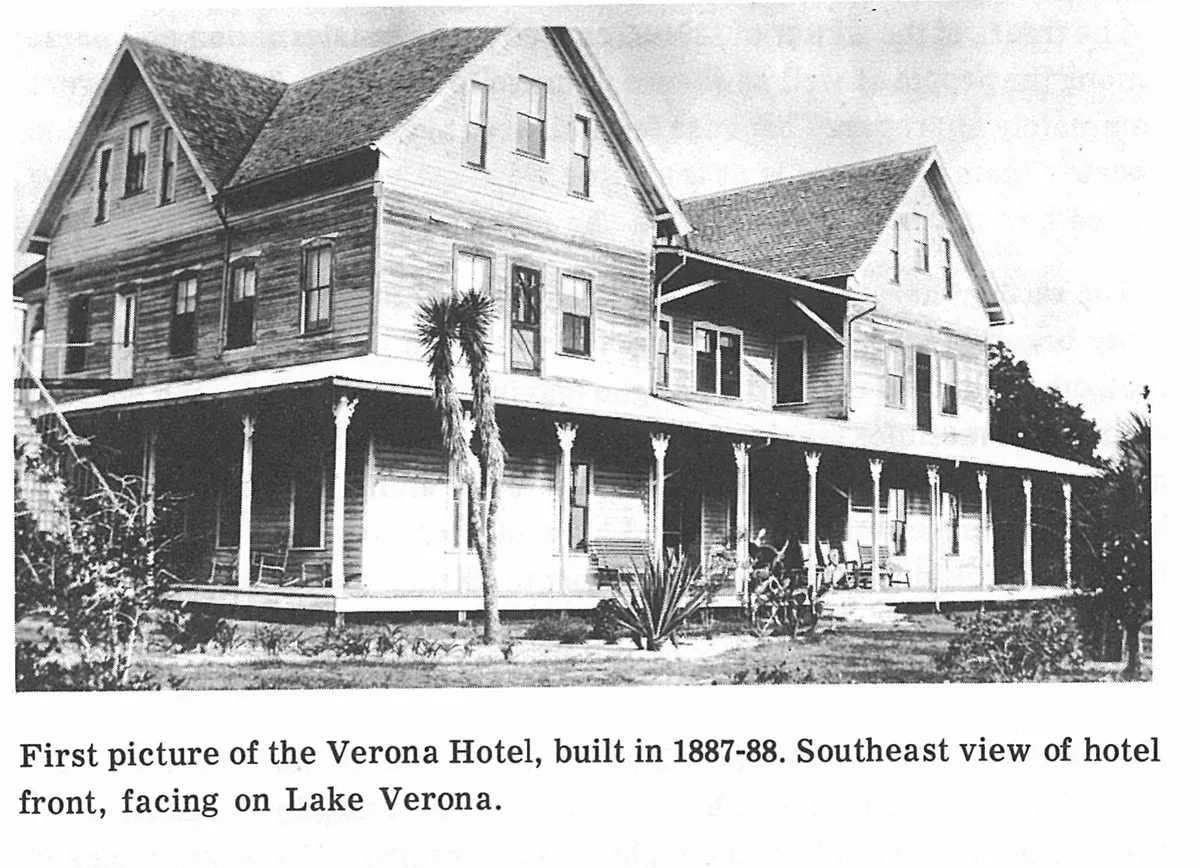
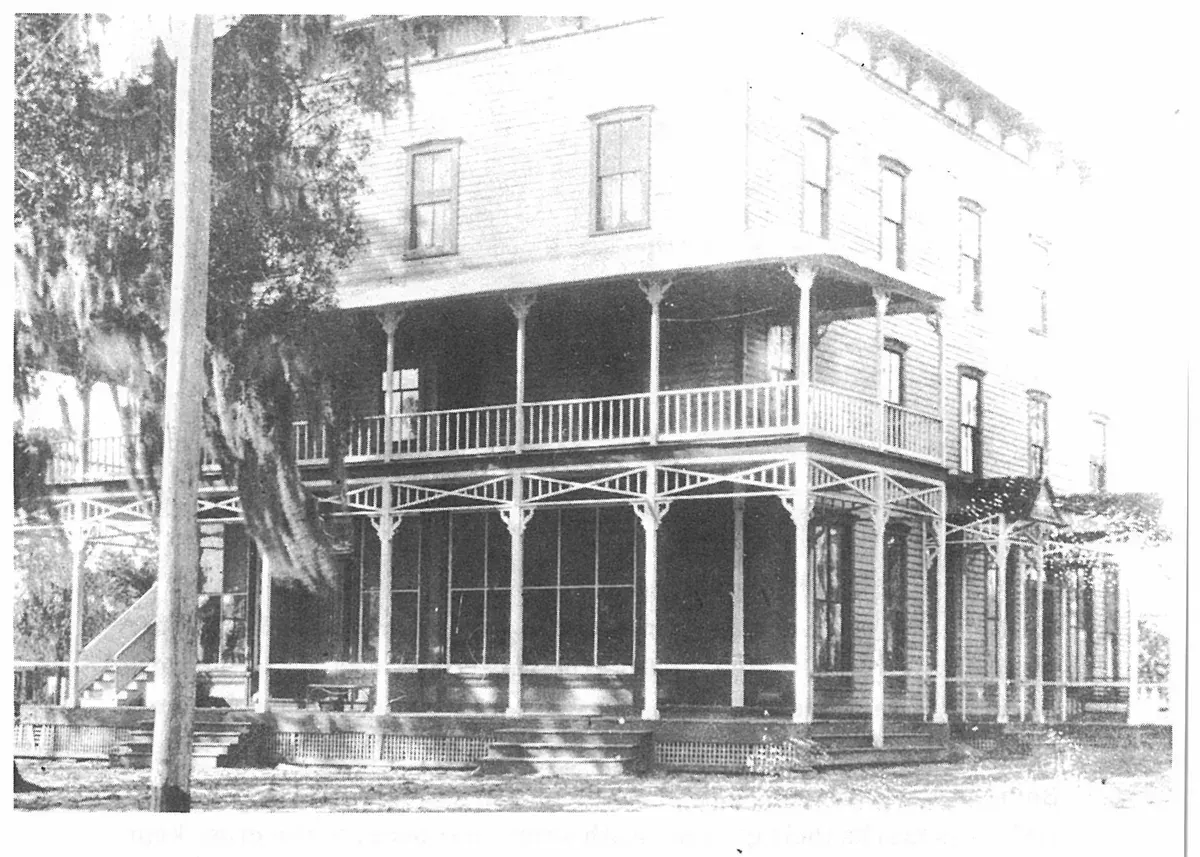
The Verona Hotel, built in 1887–1889, viewed from the southeast facing Lake Verona.[maxwell-1976]
Construction and Architecture of the Verona Hotel
Begun in late 1887 by Oliver M. Crosby, the Verona Hotel was constructed from native virgin yellow pine by master builder J. H. Nettleton of Connecticut [maxwell-1976]. Using a portable sawmill, Nettleton cut and kiln-dried over 200,000 board feet of lumber on site, building both the two-and-a-half-story structure and much of its custom furniture [maxwell-1976].
Although skeptics dubbed the 32-room hotel “Crosby’s Folly” because of its isolated location forty miles from the nearest railroad, Crosby filled the building during its first winter season of 1889–1890 through aggressive northern advertising [maxwell-1976]. Round-trip excursion packages from New York City brought guests via steamship to Jacksonville, train to Fort Meade, and stagecoach to Avon Park for $75 (which included a week’s lodging and meals). Board for regular vacationers was $1.00 to $1.50 per day [maxwell-1976].
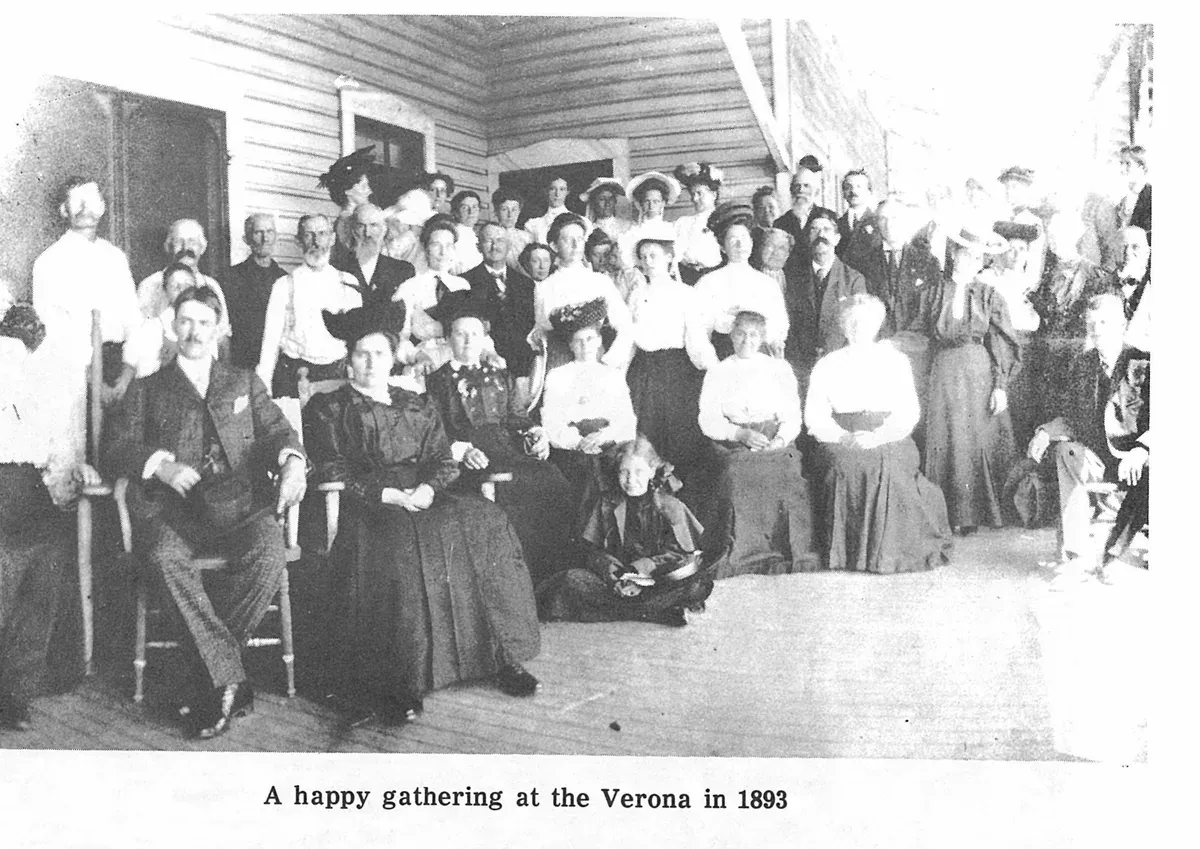
A gathering of winter guests and residents at the Verona Hotel in 1893.[maxwell-1976]
Social and Spiritual Hub
The Verona Hotel served as the heart of civic and social life in the fledgling settlement [maxwell-1976]:
- Evening Gatherings: Guests gathered on the broad verandas lit by a locomotive headlight for card games, music, and social conversation [maxwell-1976].
- Religious Services: Before the Union Evangelical Church was built in 1892, Sunday afternoon services were conducted in the hotel parlor; if no visiting minister was available, a sermon was read aloud to the gathering [maxwell-1976].
- The Bandstand: In 1897, a Victorian bandstand was erected directly in front of the hotel on the shores of Lake Verona, where the 13-member Avon Park Concert Band performed weekly [maxwell-1976].
- Expansion: During the bustling winter of 1892–1893, Mrs. Emma Crosby oversaw the addition of dormer windows in the attic roof to create 15 additional guest rooms, accommodating a register that included 24 ministers and 26 physicians [maxwell-1976].
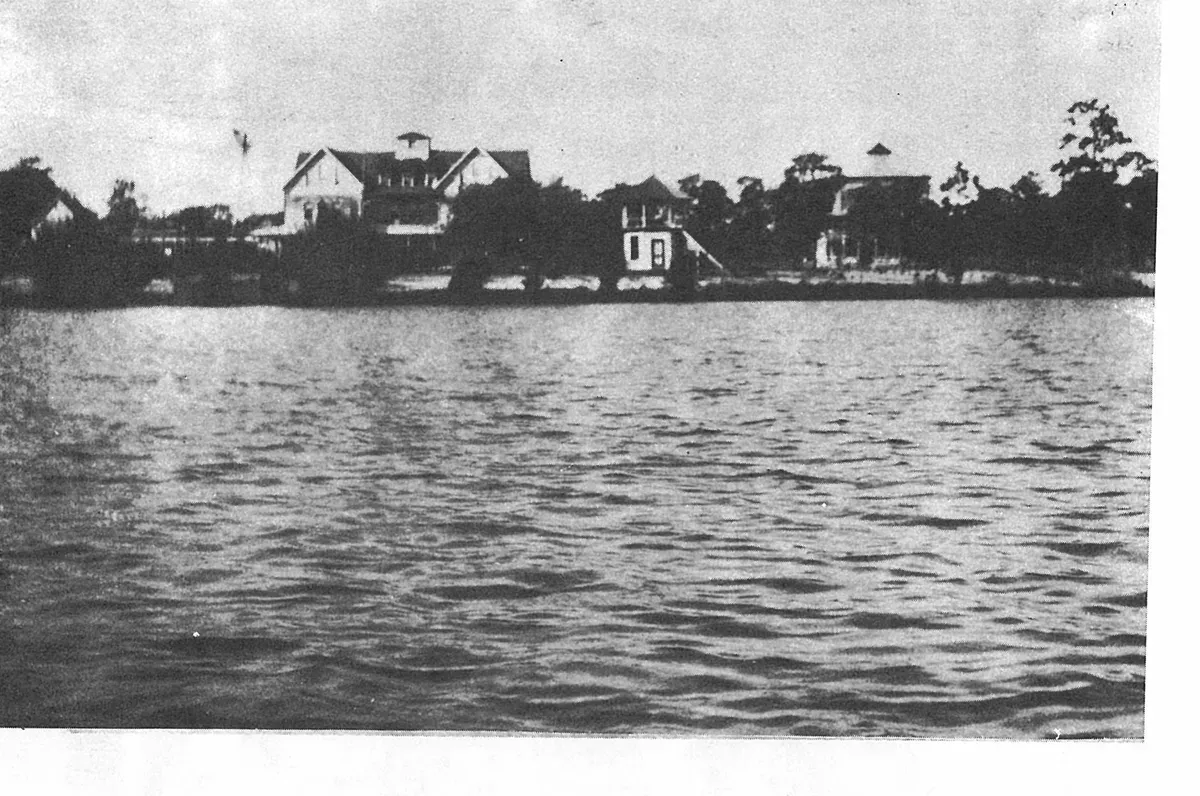
The Victorian bandstand erected in 1897 on the shore of Lake Verona in front of the hotel.[maxwell-1976]
The McCartney Era and Later Years
In 1900, the hotel was purchased by Dr. J. M. McCartney and Dr. Mary McCartney of Rochester, New York [maxwell-1976]. Although they initially planned to convert it into a winter sanitarium for northern patients, local residents pleaded with them to keep it open to the public. The McCartneys hired Samuel Brown as manager and invested heavily in property improvements, remodeling the Verona into a three-story hotel with wrap-around porches on three sides [maxwell-1976].
In 1919, architect-builder D. B. Farnell constructed a new north wing, and during the 1920s boom the property operated as the Avon Hotel, owned by Henry Lander and later the Avon Park Golf and Country Club [maxwell-1976]. In February 1927, the historic hotel was completely destroyed by fire. Salvaged heart-pine timbers were repurposed into several other structures across town [maxwell-1976].
The Avonian Block (Masonic Temple), built in 1893 adjacent to the Verona Hotel, pictured before its demolition in 1961.[maxwell-1976]
Other Historic Landmarks
- The Avonian Block (Annex / Masonic Temple): Erected in 1893 by Perry Haines adjacent to the Verona Hotel for $7,200, this three-story brick structure housed the Florida Development Company, the Bank of Avon Park, and Dr. Lander’s Drug Store on the first floor, professional offices on the second, and 20 hotel overflow rooms on the third [maxwell-1976]. It was demolished in 1961.
- Hollyhurst: A colonial mansion on the south shore of Lake Lotela, built in the 1890s by Dr. Augustine Gandier and later expanded in 1926 by Colonel R. P. Davidson of Wisconsin [maxwell-1976].
- Poinsettia Hotel: Originally built in 1890 as a store and residence by George Wray and J. C. Burleigh on Lakeview Street, remodeled into the Poinsettia Hotel in the 1920s by John D. Raab, Charlie Lanier, and John A. Taylor [maxwell-1976].
- Highlands Lakes Hotel and Casino: Built in the early 1920s on Lake Lillian with an 18-hole golf course and over-water casino pavilion [maxwell-1976]. Novelist Sinclair Lewis was among its notable guests. In 1947, the hotel building was converted into the Walker Memorial Hospital under the Seventh-day Adventist Church [maxwell-1976].
References
- maxwell-1976 — Leoma Bradshaw Maxwell. The First Hundred Years of Avon Park, Florida. 1976. the-first-hundred-years-of-avon-park_leoma-bradshaw-maxwell_1976.md
Related
Where this comes from
- Evidence
- single-source — One source. Treat as reported, not established.
- Review
- unverified — Drafted from sources but not yet checked by a volunteer.
- Rights
- society
Sources
- Leoma Bradshaw Maxwell, The First Hundred Years of Avon Park, Florida (Held at the Avon Park Historical Society Depot Museum, Avon Park, Florida) (1976) · book
Something here wrong, or incomplete? The Society would rather know. Tell a volunteer.
Have a question about this record?