Flint Lumber, Mutual Crate and Avon Manufacturing: three companies on one rail spur
Summary
Three mills stood side by side a mile and a quarter south of the Avon Park post office: a sawmill and a pair of crate mills, drawn together on one sheet of the fire insurance map of November 1920. They were three separate corporations, chartered within eleven months of each other, and the state’s own ledger dates and values each of them.[sanborn-1920][sos-charters]
| Chartered | Letters patent | Capital | |
|---|---|---|---|
| The Flint Lumber Company | filed 9 November 1918 | 12 December 1918 | $75,000 |
| Mutual Crate Company | filed 28 April 1919 | 2 June 1919 | $50,000, raised to $100,000 by May 1920 |
| Avon Manufacturing Company | filed 17 September 1919 | 22 November 1919 | $75,000, raised to $200,000 by November 1920 |
All three gave Avon Park as their principal place of business. Both crate companies multiplied their capital within a year of chartering, which is what a boom looks like in a ledger.[sos-charters]
The Flint Lumber Company
A lumber company, not a crate maker: it cut standing pine into framing timber, and the crate mills used what it could not sell. George Flint, its president, was a Philadelphia capitalist of real substance — a bank directors’ list of about 1930 records him as “George Flint, Flint Lumber Co., 219 N. Broad St., Philadelphia,” and he ran several companies at once.[hsp-bank-directors] The enterprise was chartered directly as The Flint Lumber Company under Charter 8778 on 9 November 1918 and was never incorporated as the “Penn-Florida Lumber Company,” though Flint’s broader Philadelphia syndicate also incorporated the Penn-Florida Cattle Company (Charter 9498) in Avon Park in February 1920 to graze cutover acreage.[sos-charters]
The mill stood outside the city limits. An Avon Park report of 1 April 1920 places it exactly, in passing: a body was found “on the bank of the Alligator creek, just outside of the city limits, and within 100 yards of the Flint lumber mill.”[ocala-star-1920-04-01]
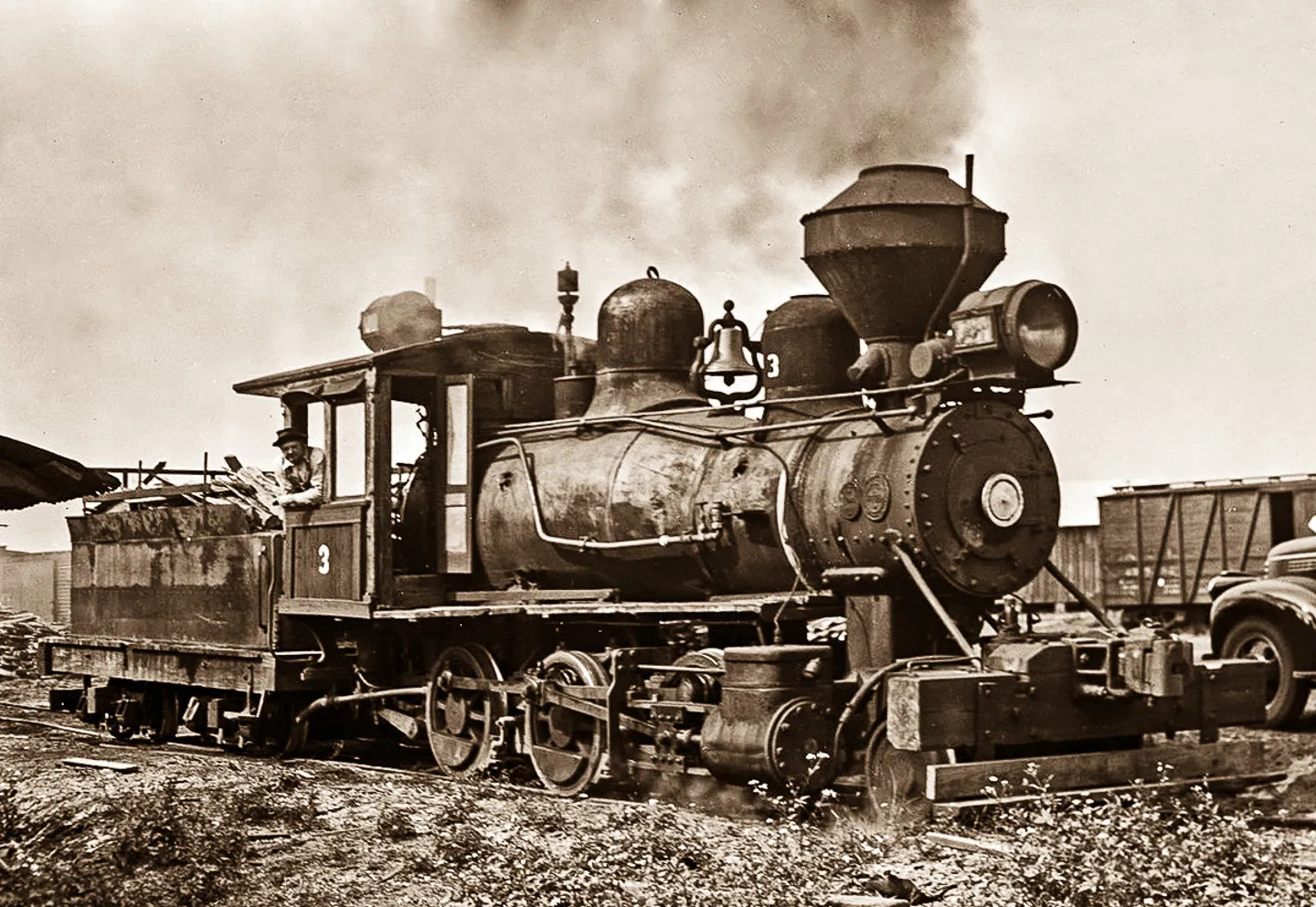
The Sanborn surveyors drew the plant seven months later: a saw mill, a separate engine-powered planing mill with a shavings house, a log run, two loading platforms, a slab pile, a tramway and a refuse burner. Their standard note on the property is unusually bare — “No watchman. No fire apps. Power. Steam. No lights.” No night watchman, no fire apparatus of its own, steam power, and no lighting at all.[sanborn-1920] A compilation of Florida logging railroads records the company at Avon Park in 1920 with a logging railroad and a mill of 60,000 feet daily capacity.[flarr-lumber]
Evidence: single-source. The fuller account of the company — that it was organized by George Flint with L. F. DeBordenave as vice-president and manager (who concurrently directed the affiliated Penn-Jarratt Lumber Company in Marianna), that it bought a 21,000-acre tract called the McArtin tract and expanded to 71,000 acres, that it ran sixteen miles of standard-gauge track with two locomotives, and that when the timber was cut out the Phil Lacey Logging Company logged on over its rails — rests on one railroad-history page.[taplines-mutual] No contemporary source has been found that names the McArtin tract or gives the mileage.
The two crate mills
The Mutual Crate Company was drawn with two buildings each marked “Crate Mill,” an engine, a veneer machine, a machine shop and a blacksmith’s shop. Its Sanborn note records a “night watchman — Newman clock — 8 stats. hourly rounds,” steam power, lights, “no fire hose,” fuel from its own refuse, and a water supply still “to have.”[sanborn-1920]
The Avon Manufacturing Company‘s crate mill, on block 152, was the better-equipped plant: a saw mill, a dry kiln, a concrete steam box, a cistern, and the fullest fire-protection note of the three — “Night, Sunday, & holiday watchman — Newman clock — hourly rounds. Power steam. — Lights elec. Fuel refuse. Private water supply from well. — New fire pump to be installed. — Water tank & mains as planned. — To have 150’ 2½” hose on each hydrant. — Steam jet in dry kiln & dry room. — Metal blowers to wood working machinery — casks & pails.” Much of that was still unbuilt when the surveyors came: the fire pump was “to be installed,” the water tank and mains were “as planned,” and a 10,000-gallon tank 46 feet high was marked “to be built here.”[sanborn-1920] The last phrase of the note records something no other source does — the plant made casks and pails as well as crates.[sanborn-1920]
Neither crate mill was an independent private firm. Half of the Avon Manufacturing Company was owned by the Highlands Crate Company of Bartow, which was itself “managed by the board of directors of the Polk county Sub-Exchange” of the Florida Citrus Exchange; by 1931 both Avon Park companies were described as “subsidiaries of the Polk County Sub-exchange.”[palatka-1922-06-18][brooksville-1931-06-11] Nor were they separately managed: in August 1922 one man, J. A. Caldwell, was “general manager for both.”[ocala-banner-1922-08-25] The ownership and management of the crate mills are set out in full in Avon Park’s crate mills belonged to the citrus growers.
The Mutual Crate Company’s own account of itself, at its annual meeting of June 1924, was that it was “largely co-operative — its name, the Mutual, coming from the fact that practically its entire output was contracted for by the stockholders.” It reported 975,000 crates and over $200,000 of business for the year, a twenty per cent dividend, and a $12,000 monthly payroll, and said that the other big crate mill in the town was carrying a $20,000 monthly payroll.[tampa-trib-1924-06-15]
Evidence: single-source for those 1924 figures. Only one report of that meeting survives.
The Avon Manufacturing Company was still a going concern a decade later, when it joined the landowners who sued to have their land taken out of the city in the quo warranto proceedings of 1932 to 1934.[supreme-court-1934]
The complex on the ground
 Sanborn Fire Insurance map of 1921 for Avon Park, depicting the lumber operations. Courtesy of Sanborn Map Company and Taplines. [sanborn-1921-taplines]
The three plants sat together on the west side of the Atlantic Coast Line track, south-west of the platted town, under a caption the surveyors printed once across the open ground: “Located 1¼ Miles S. of P.O.”[sanborn-1920] Flint’s own tracks are marked “tram” and “log run” — mill tramways, not a common carrier. The line running past the mills is the Atlantic Coast Line’s, labeled “A.C.L. R.R.” at the depot on Michigan Avenue; no Seaboard line appears on the sheet, the Seaboard having reached Avon Park only in 1924.[sanborn-1920]
East of the track, on ordinary platted blocks, ran a street the surveyors lettered Avon Manufacturing Avenue, with the company’s office, storage building and a two-story boarding house on block 38A, and a street named Mill.[sanborn-1920]
The houses beside the mills
The workers’ settlement was much larger than a glance at the sheet suggests. On the open, unplatted ground beside the plants the surveyors drew a long sequence of small buildings lettered rather than numbered, because the land had no lots: a first run A to P immediately south-west of Flint Lumber, skipping I and O as mapmakers do; a second run R to Z further south in unplatted block 151; and then, the alphabet exhausted, a third run restarting as A.1 to X.1 beside the Avon Manufacturing and Mutual Crate plants. Forty-five buildings in all. Forty-four are marked “D.” for dwelling, all but one of a single story; the forty-fifth, which occupies letter D of the first run, is a two-story building marked “Boarding.”[sanborn-1920]
They have no street, and the only place name printed on the tract is the distance from the post office. The workforce they housed was largely Black: the mills employed hundreds of Black laborers, and by 1938 the district beside them had a name of its own, the Mill Quarters, which the people living there gave as their address on a federal survey of their two churches.[wpa-avonpark-cards]
References
- sanborn-1920 — Sanborn Map Company. Sanborn Fire Insurance Map of Avon Park, Florida, November 1920, sheet 4. 1 November 1920. sanborn-1920-avon-park.md
- sos-charters — Secretary of State of the State of Florida. Report of the Secretary of State of the State of Florida, lists of corporations chartered, 1917-1918 and 1919-1920: charters 8647, 8778, 8958 and 9248. 31 December 1920. florida-secretary-of-state-corporation-charters.md
- taplines-mutual — Donald R. Hensley, Jr., taplines.net. Mutual Crate Company of Avon Park, FL. 11 April 2020. http://taplines.net/MUTUAL/MUTUAL.html
- tampa-trib-1924-06-15 — The Tampa Tribune. Mutual Crate Co., Enjoys Great Year, The Tampa Tribune, 15 June 1924, page 14, as reproduced in facsimile on taplines.net. 15 June 1924. https://www.newspapers.com/image/326848123/
- palatka-1922-06-18 — Palatka Daily News. Palatka Daily News, 18 June 1922, page 2: the crate mill at Avon Park, its timber, its railroad and its ownership. 18 June 1922. http://www.loc.gov/resource/sn78001466/1922-06-18/ed-1/?sp=2
- ocala-star-1920-04-01 — The Ocala Evening Star. The Ocala Evening Star, 1 April 1920, page 1: an Avon Park report placing the Flint lumber mill on Alligator Creek outside the city limits. 1 April 1920. http://www.loc.gov/resource/sn84027621/1920-04-01/ed-1/?sp=1
- brooksville-1931-06-11 — The Brooksville Journal. The Brooksville Journal, 11 June 1931, page 13: W. H. Yates elected manager of the Highlands Crate and Avon Manufacturing companies. 11 June 1931. http://www.loc.gov/resource/sn95047246/1931-06-11/ed-1/?sp=13
- hsp-bank-directors — Historical Society of Pennsylvania. List of Bank of Philadelphia and Trust Company directors, circa 1930. 1930. https://digitalhistory.hsp.org/bnktr/doc/list-bank-philadelphia-and-trust-company-directors-circa-1930
- flarr-lumber — flarr.com. Florida lumber companies and their logging railroads, The Florida Railroad History Website. 2018. https://web.archive.org/web/20200129174641/http://www.flarr.com/lumbercos.htm
- supreme-court-1934 — Supreme Court of Florida. State ex rel. Davis, Attorney General, et al. v. City of Avon Park, 117 Fla. 565, 158 So. 159 (1934). 20 November 1934. avon-park-in-the-florida-supreme-court-1928-1934.md
- wpa-avonpark-cards — Works Progress Administration, Historical Records Survey; State Archives of Florida. Historical Records Survey, Church Inventory Forms 1938: the Avon Park cards, Highlands County. 21 September 1938. https://www.floridamemory.com/items/show/248623
Related
- Corporate Identity and Origins of the Flint Lumber Company and the Penn-Florida Syndicate
- Avon Park’s crate mills belonged to the citrus growers
- Flint Lumber Company
- Where Black Avon Park worked
- The Florida Secretary of State’s charter ledgers
- Avon Park in the Florida Supreme Court, 1928-1934
Where this comes from
- Evidence
- corroborated — More than one independent source agrees.
- Review
- unverified — Drafted from sources but not yet checked by a volunteer.
- Rights
- society
Sources
- Sanborn Map Company, Sanborn Fire Insurance Map of Avon Park, Florida, November 1920, sheet 4 (references/sanborn-1920-avon-park.md) (1920) · archival
- Secretary of State of the State of Florida, Report of the Secretary of State of the State of Florida, lists of corporations chartered, 1917-1918 and 1919-1920: charters 8647, 8778, 8958 and 9248 (references/florida-secretary-of-state-corporation-charters.md) (1920) · official
- Donald R. Hensley, Jr., taplines.net, Mutual Crate Company of Avon Park, FL (2020) · secondary
- The Tampa Tribune, Mutual Crate Co., Enjoys Great Year, The Tampa Tribune, 15 June 1924, page 14, as reproduced in facsimile on taplines.net (1924) · newspaper
- Palatka Daily News, Palatka Daily News, 18 June 1922, page 2: the crate mill at Avon Park, its timber, its railroad and its ownership (1922) · newspaper
- The Ocala Banner, The Ocala Banner, 25 August 1922, page 4: the opening of the big crate mills at Avon Park (1922) · newspaper
- The Ocala Evening Star, The Ocala Evening Star, 1 April 1920, page 1: an Avon Park report placing the Flint lumber mill on Alligator Creek outside the city limits (1920) · newspaper
- The Brooksville Journal, The Brooksville Journal, 11 June 1931, page 13: W. H. Yates elected manager of the Highlands Crate and Avon Manufacturing companies (1931) · newspaper
- Historical Society of Pennsylvania, List of Bank of Philadelphia and Trust Company directors, circa 1930 (1930) · archival
- flarr.com, Florida lumber companies and their logging railroads, The Florida Railroad History Website (2018) · secondary
- Supreme Court of Florida, State ex rel. Davis, Attorney General, et al. v. City of Avon Park, 117 Fla. 565, 158 So. 159 (1934) (references/avon-park-in-the-florida-supreme-court-1928-1934.md) (1934) · official
- Works Progress Administration, Historical Records Survey; State Archives of Florida, Historical Records Survey, Church Inventory Forms 1938: the Avon Park cards, Highlands County (1938) · archival
Something here wrong, or incomplete? The Society would rather know. Tell a volunteer.
Have a question about this record?