Where Black Avon Park worked — the crate mills, the Mill Quarters, and the turpentine camps
Black Avon Park’s neighborhoods and its churches are described elsewhere in this bundle. This report is about where it worked. The answer, for most of the twentieth century, was wood: the crate mills that boxed the town’s citrus, and, before and beyond them, the turpentine camps in the pines.
1918-1922: a Philadelphia lumber company and its two crate mills
Avon Park had no crate mill in 1918. The state gazetteer for that year lists two sawmills in the town, A. J. Pollard’s and W. E. Shockley’s, and its classified list of Florida’s crate manufacturers names fourteen towns and not Avon Park.[gaz-1918]
In November 1918 a group of Philadelphia investors — George Flint, president, and L. F. DeBordenave, vice-president and general manager — organized the Flint Lumber Company, bought 21,000 acres of timber known as the McArtin tract, expanded it to 71,000 acres within a year, and logged it over sixteen miles of standard-gauge track with two steam locomotives.[taplines-mutual] By 1922 the company had built two crate mills on its sawmill property to use the small logs its sawmill threw off: the Mutual Crate Company and the Avon Manufacturing Company, both partly owned by the Polk County and Highlands County citrus exchanges — the growers’ own cooperatives, buying into the mills that boxed their fruit.[taplines-mutual]
The Sanborn map of November 1920 shows them. Sheet 4, the town’s south-western quadrant, carries the whole complex along a spur of the Atlantic Coast Line south-west of Walnut Street: the Flint Lumber Company’s saw and planing mill “located 1¼ miles S. of P.O.,” with loading platforms, a tram railway and a refuse burner; the Mutual Crate Co., with its own saw mill and two buildings marked “Crate Mill”; and the Avon Mf’g Co. Crate Mill, steam-powered, electrically lit, with a dry kiln and a night watchman on an hourly clock. A street named Mill runs “W. of Railroad Ave.” past it, and the spur itself is lettered “Avon Manufacturing Co.”[sanborn-1920]
The Avon Manufacturing Company that joined the landowners’ suit of 1932 to get out of the city was this crate mill.
1924: the mills at full speed
A Tampa Tribune report of 15 June 1924, “Mutual Crate Co. Enjoys Great Year,” gives the mills at their height. Mutual was rated at 975,000 crates a year, ran from September to June, supplied “boxes to several big growers and shippers up and down the East Coast having been built here when it was found that the timber along the lower East Coast was not suitable for orange boxes.” It did over $200,000 of business in 1924, paid a 20 per cent dividend, and met a $12,000-a-month payroll; “the other big crate mill here” was running a $20,000-a-month payroll — the larger employer by wages, and almost certainly the Avon Manufacturing Company, though the report does not name it. Mutual was “largely co-operative,” its output contracted in advance by its own stockholder-growers, with enough standing timber near Avon Park “to insure full speed ahead for fifteen to twenty-five years.”[tampa-trib-1924]
The officers were the region’s citrus men: general manager Neal Trent; president I. C. Smith of DeLand; vice-president C. H. Walker of Bartow; secretary-treasurer A. V. Anderson of Avon Park; and as directors J. J. Parrish of Titusville, A. G. Smith of Wauchula, and C. E. Lanier and J. A. Caldwell of Avon Park.[tampa-trib-1924] Lanier — the town’s first tax collector, its bank cashier, later its state representative — is on the board of the crate mill too.
But the mills were not two separate businesses under two managements. Two years earlier the Ocala Banner had reported the opening of “the big crate mills here — the Mutual Crate Company and the Avon Manufacturing Company — within the next twenty days, according to J. A. Caldwell, general manager for both,” the two together “turned up to produce two and a half million crates.”[ocala-banner-1922] And they were the growers’ own: half of the Avon Manufacturing Company was owned by the Highlands Crate Company of Bartow, which was “managed by the board of directors of the Polk county Sub-Exchange” of the Florida Citrus Exchange.[palatka-1922] See Avon Park’s crate mills belonged to the citrus growers.
By 1924 the Flint company had cut out the big timber; the Phil Lacey Logging Company logged on over Flint’s tracks, and the mills’ sixty-day summer shutdown put the laid-off mill hands to work on Lacey’s crews building spurs.[taplines-mutual]
The Mill Quarters
Who were the mill hands? The 1920 Sanborn sheet gives the first answer without a word. On the open, unplatted ground beside the plants the surveyor drew forty-five small buildings lettered instead of numbered, because there were no lots to number: a run A to P south-west of Flint Lumber, skipping I and O as mapmakers do; a run R to Z further south; and then, the alphabet used up, a third run restarting as A.1 to X.1 beside the Avon Manufacturing and Mutual Crate plants. Forty-four are marked “D.” for dwelling; the forty-fifth, at letter D of the first run, is a two-story building marked “Boarding.” A line ruled round them reads “NO EXPOSURE” and “NO EXPOSURE BEYOND” — the Sanborn Company’s notation for buildings too slight to insure. They have no street name, and the only place name printed on the tract is the distance from the post office, “Located 1¼ Miles S. of P.O.” They are the mill’s houses.[sanborn-1920] A 1941 aerial photograph reproduced on the same railroad-history page labels the cluster beside the Avon Manufacturing Company, east of the Atlantic Coast Line track, “Company Houses.”[taplines-mutual]
The 1938 church survey names the place. Saint John Baptist “met in old frame building on west side of road just across the Seaboard Railroad Track from 1922 to 1930, when the building was moved on the east side of Seaboard Railroad Track”; its clerk Perry Sharp, its B.Y.P.U. secretary Thelma Bryant and its missionary secretary Grace Fletcher all gave their address as “Mill Quarters,” and Mt. Zion Methodist’s steward and secretary gave theirs as “Crate Mill Quarters.”[wpa-avonpark-cards] The WPA’s 1942 Guide to Supplementary Vital Statistics from Church Records in Florida likewise locates the Church of God and the Church of God in Christ in “Mill Quarters, Avon Park,” with records kept in the homes of residents Miss Myrtle Campbell and Neoma Miller.[wpa-guide-1942] A Black district named for the crate mill, with its own two churches, straddling the Seaboard track — which had been laid alongside the Coast Line’s in 1924, so that the same ground was “beside the railroad” under either name.
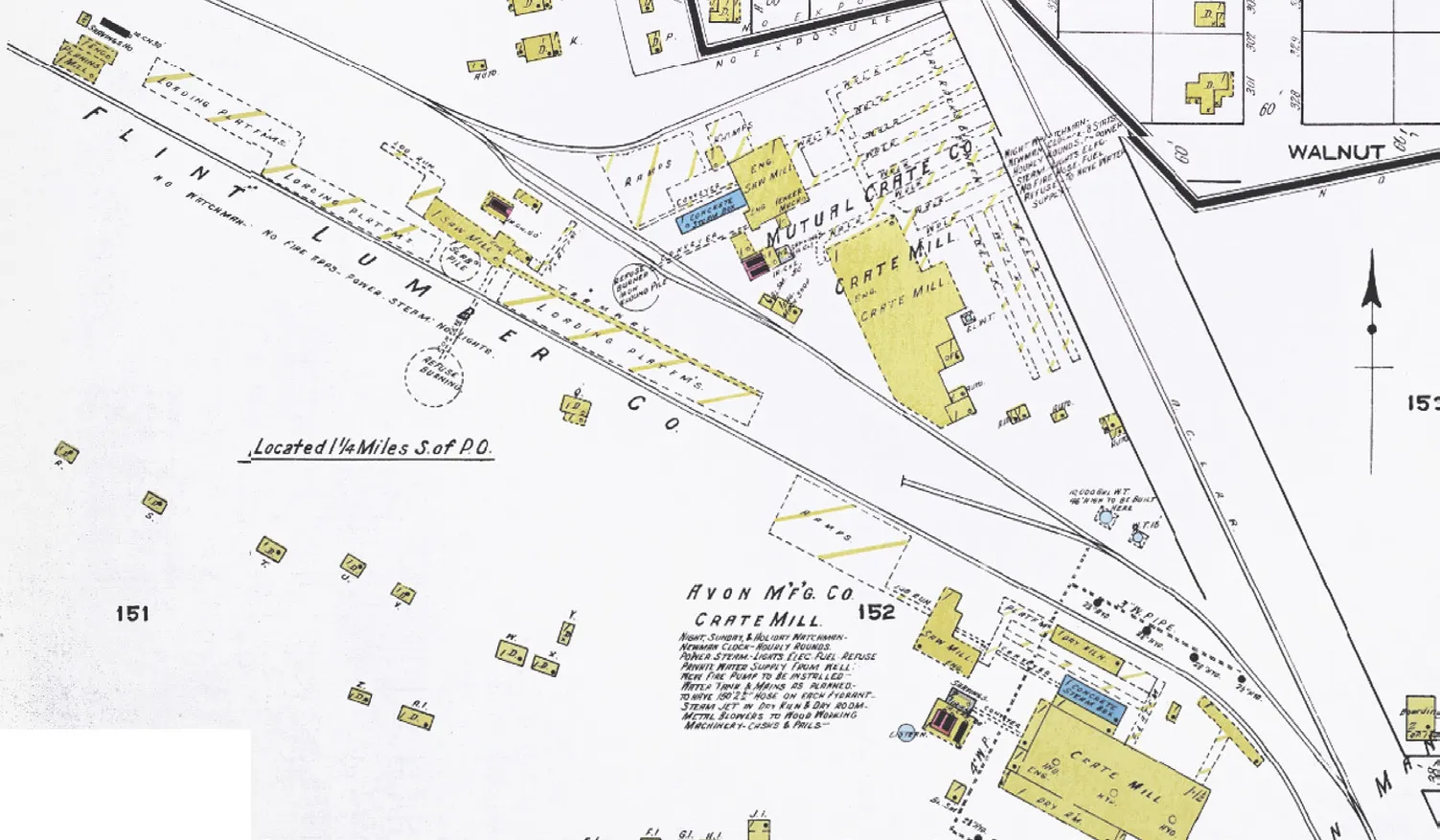 Detail from the November 1920 Sanborn Fire Insurance Map of Avon Park, showing the Mutual Crate Company and Avon Manufacturing Company mills and company houses. Sanborn Map Company. Public domain.[sanborn-1920]
And the 1950 census gives the work. In enumeration district 28-7, whose enumerator headed one sheet “Block 13 west of Railroad,” the men are “Crate Hand, Crate Factory,” “Mill Hand, Crate Factory,” “Helper, Crate Mill” — Thomas E. Sims at forty-one, Bonnie Sims at thirty-one working seventy-seven hours a week, Elihu Sims at thirty-three.[census-1950-black-avon-park] Three brothers of the Sims family of Castle Street, one of whom would be a Hopewell principal and one of whom may have run the Black polling place in 1951, were crate-mill hands.
The placement, stated carefully. The 1920 mill houses and the 1938 Mill Quarters are very probably the same ground eighteen years on, south-west of the old town between the two railroads, but no known document says so in words.
After 1930
The crate business at Avon Park went on, and it stayed in the citrus growers’ hands. When J. A. Caldwell died in 1931 the Brooksville Journal reported that W. H. Yates, for several years office manager of “the Highlands Crate company and the Avon Manufacturing company, at Avon Park,” had been elected manager of both to succeed him, and noted that “the two companies are subsidiaries of the Polk County Sub-exchange.”[brooksville-1931] In November 1935 the Highlands Crate Company bought a fourth Avon Park mill, the Ridge Crate Company, for $40,000 and put in equipment for wire-bound crates; the buyer was still described as “a subsidiary of the Polk County Sub-Exchange of the Florida Citrus exchange.”[brooksville-1935]
Following the Mutual Crate Company’s June 1930 receivership and August 1933 liquidation sale, the mill was acquired in the mid-1950s by the Revell Crate Company of Wauchula, directed by F. L. Revell.[taplines-mutual] On 5 March 1986, F. L. Revell, Jr. and K. D. Revell conveyed the 5.01-acre main mill property on Hatcher Avenue to the Elberta Crate & Box Co. of Bainbridge, Georgia, for $500,000.[hcclerk-deed-875-397] Elberta Crate expanded the facility in 2004 by acquiring the adjacent 3.15-acre parcel east of the tracks and erecting a modern warehouse in 2005. In 2008, facing union contract rejections, safety citations, and the transition of citrus packing away from wooden veneer crates, active manufacturing ceased.[osha-elberta-2008] On 30 March 2016, Elberta Crate liquidated its Highlands County real estate, selling the entire 8.16-acre complex for $108,000 to 224-229 Hatcher Avenue, LLC, which sold to Florida Realco LLC in 2017, concluding a century of crate making on the site.[hcclerk-deed-2521-153]
The turpentine camps
Before the crate mills there was turpentine, and it did not stop when they came.
The state’s own manufacturing census confirms the immediate presence of both industries upon the county’s creation. While the 1919-1920 biennial report recorded no such operations in DeSoto County, the very next Biennial Report of the Department of Agriculture for 1921-1922 — the first to separate Highlands County from DeSoto — lists an active “Naval Stores” sector in Highlands County employing 30 average wage earners with $190,000 in capital invested, alongside a “Saw Mill” sector employing 136 wage earners.[agr-1922] (DeSoto County simultaneously reported its own sawmill and turpentine still, proving the industry was active in both jurisdictions.[agr-1922]) By 1923-1924, Highlands County’s agricultural returns were submitted too late for the manufacturing tabulation, but DeSoto’s continued presence in the report confirms the regional persistence of the industry.[agr-1924]
The only still identifiable near the town is Hagan’s, from a single sentence: when “the school at Hagan’s Turpentine Still closed, classes for Black children were held at St. Mark for several months” — St. Mark having been organized in 1916.[newssun-churches] A still with a school is a camp with families. The 1918 gazetteer lists a Hagan Naval Stores Company at Avon Park.[gaz-1918] Where it stood and who Hagan was remain unknown.
The one camp that can be described in detail is Nalaka, and it is out on the range: a Consolidated Naval Stores camp on Kissimmee Island, worked from about 1919 to about 1928, with 213 residents in 1920, 187 of them Black or “mulatto”, in at least fifty-three houses laid out by race, with its own still and cooperage a mile off, a commissary that paid in scrip, and by local memory a school and a church.[zeil-2013] It is one of eighteen camps Consolidated ran in the region, and the only one named. When the pines were bled out its people scattered — to Hicoria, to Florinda, to Sumica. See Entity: Nalaka turpentine camp.
These camps were labor-intensive and coercive operations. Workers were frequently paid in tokens or “scrip” that was redeemable only at the company commissary at exorbitant prices, a system designed to ensure permanent debt peonage.[zeil-2013] The work itself was highly specialized: “chippers” cut slanted notches or “cat faces” into the pine trunks to stimulate sap flow, “pullers” worked the higher notches once the face extended up the trunk, “dippers” scraped the collected resin into barrels, and “rakers” cleared pine needles away from the trees to prevent fires.[zeil-2013] During the 1920s labor shortages, companies even employed “headhunters” to lure Black laborers to the camps with promises of free rent and food.[zeil-2013]
African American Turpentine Laborers / “Chippers” and “Dippers” at work, circa 1920s. State Archives of Florida, Florida Memory. [floridamemory-rc12543]
Not all turpentine laborers lived in isolated company camps; the 1920 manuscript census proves that some lived inside the town of Avon Park itself. Manuel Boatwright, 45, born in North Carolina, was enumerated as a “Turpentine Farm Laborer” renting a home in Avon Park with his wife Susie.[census-1920-boatwright] Family records indicate that Emmanuel (Manuel) Boatwright and his brother had left the Carolinas around 1895 to work in the Florida turpentine industry, moving south from Tallahassee to Avon Park, where he brought in his wife’s siblings and helped establish them in the town.[boatwright-genealogy]
A turpentine still operating in South/Central Florida, typical of the operations in DeSoto and Highlands counties. State Archives of Florida, Florida Memory. [floridamemory-turpentine-still]
Photographic evidence from the late 1930s captured by the Farm Security Administration provides a vivid picture of the continued stark living and working conditions in the regional timber industry. At Childs, just south of Avon Park in Highlands County, Black sawmill workers lived in shacks built from scrap lumber with “no light, no privies, one outdoor water pump for whole camp” while earning two dollars for a ten-hour day, six days a week.[loc-2017799788][loc-2017799800]
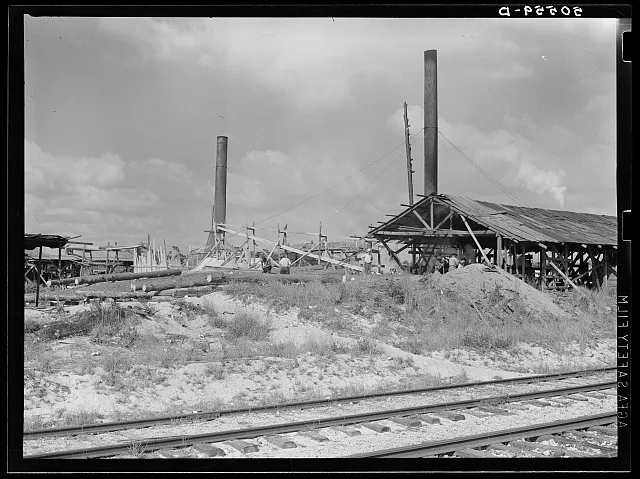
Small sawmill in Childs, Florida, 1939. Farm Security Administration / Library of Congress.[loc-2017799788]
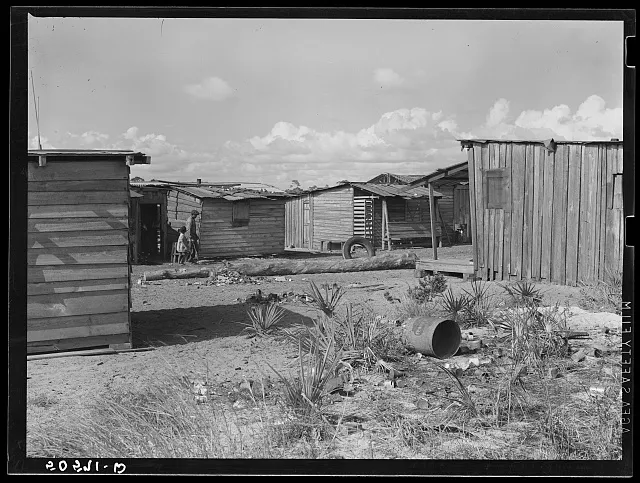
Sawmill workers’ homes in Childs, Florida, 1939. Farm Security Administration / Library of Congress.[loc-2017799800]
What this adds up to
By 1924 two crate mills with a combined payroll of some $32,000 a month stood on a rail spur a mile and a quarter south-west of the post office, boxing the citrus of three counties, with their hands housed in unnumbered company houses beside them. Those houses became a district with a name and two churches. The men in them were, by 1950, Black families living on Castle Street and Fairfield Avenue. And behind the mills lay the turpentine country — Hagan’s still with its camp school, Nalaka with its two hundred people — where much of that workforce had come from. That is the economic geography of Black Avon Park.
References
- tampa-trib-1924 — The Tampa Tribune. Mutual Crate Co., Enjoys Great Year, The Tampa Tribune, 15 June 1924, page 14, as reproduced in facsimile on taplines.net. 15 June 1924. https://www.newspapers.com/image/326848123/
- palatka-1922 — Palatka Daily News. Palatka Daily News, 18 June 1922, page 2: the crate mill at Avon Park, its timber, its railroad and its ownership. 18 June 1922. http://www.loc.gov/resource/sn78001466/1922-06-18/ed-1/?sp=2
- brooksville-1931 — The Brooksville Journal. The Brooksville Journal, 11 June 1931, page 13: W. H. Yates elected manager of the Highlands Crate and Avon Manufacturing companies. 11 June 1931. http://www.loc.gov/resource/sn95047246/1931-06-11/ed-1/?sp=13
- brooksville-1935 — The Brooksville Journal. The Brooksville Journal, 28 November 1935, page 1: Avon Park crate plant sold to citrus concern. 28 November 1935. http://www.loc.gov/resource/sn95047246/1935-11-28/ed-1/?sp=1
- sanborn-1920 — Sanborn Map Company. Sanborn Fire Insurance Map from Avon Park, Highlands County, Florida, November 1920, sheet 4. 1 November 1920. sanborn-1920-avon-park.md
- taplines-mutual — Donald R. Hensley, Jr., taplines.net. Mutual Crate Company, Avon Park — a page on the logging railroads of Florida, reproducing a Tampa Tribune report of 15 June 1924, ‘Mutual Crate Co. Enjoys Great Year,’ and a 1941 aerial photograph. 2 September 2026. http://taplines.net/MUTUAL/MUTUAL.html
- gaz-1918 — R. L. Polk & Co. Florida State Gazetteer and Business Directory, 1918, s.v. Avon Park and the classified list of crate manufacturers. 1918. florida-business-directories.md
- wpa-avonpark-cards — Works Progress Administration, Historical Records Survey; State Archives of Florida. Historical Records Survey, Church Inventory Forms 1938: the Avon Park cards, Highlands County — Saint John Baptist and Mt. Zion Methodist. 21 September 1938. black-churches-of-avon-park-1938.md
- census-1950-black-avon-park — United States Bureau of the Census. Seventeenth Census of the United States, 1950, Population Schedules, Florida, Highlands County, EDs 28-7 and 28-8. 27 April 1950. where-black-avon-park-lived-1950.md
- zeil-2013 — Deborah Zeil. Which Way to the Jook Joint? Historical Archaeology of a Polk County, Florida Turpentine Camp (M.A. thesis, University of Central Florida, 2013). 2013. nalaka-turpentine-camp.md
- osha-elberta-2008 — SVEP Navigator, from Occupational Safety and Health Administration records. Elberta Crate & Box Co., Avon Park, FL — OSHA inspection record of 2008, as republished from Department of Labor data by SVEP Navigator. 2008. https://svepnavigator.com/facility/elberta-crate-box-co-avon-park-fl.html
- newssun-churches — Robert Miller, Highlands News-Sun, 29 January 2023. 100-year-old churches in Avon Park. 29 January 2023. churches-of-avon-park.md
- hcclerk-deed-875-397 — Highlands County Clerk of Courts. Highlands County Clerk of the Circuit Court and Comptroller, Official Records Book 875, Page 397 (Warranty Deed, 5 March 1986, Instrument #577984). 5 March 1986. https://acclaim.highlandsclerkfl.gov/AcclaimWeb/Details/GetDocumentByBookPage/OR/875/397
- hcclerk-deed-2521-153 — Highlands County Clerk of Courts. Highlands County Clerk of the Circuit Court and Comptroller, Official Records Book 2521, Page 153 (Warranty Deed, 30 March 2016, Instrument #1808835). 30 March 2016. https://acclaim.highlandsclerkfl.gov/AcclaimWeb/Details/GetDocumentByBookPage/OR/2521/153
- wpa-guide-1942 — Historical Records Survey, Works Progress Administration. Guide to Supplementary Vital Statistics from Church Records in Florida (Volume 1). 1942. https://archive.org/details/guidetosupplemen01hist/
- census-1920-boatwright — United States Bureau of the Census. 1920 Census population schedules, Florida, De Soto County, Avon Park, Enumeration District 23 (transcription of Manuel Boatwright household). 28 January 1920. https://www.boatwrightgenealogy.com/boatwrightfamily2.html
- boatwright-genealogy — Boatwright Family. Boatwright Family Genealogy. 18 September 2026. https://www.boatwrightgenealogy.com/boatwrightfamily2.html
- floridamemory-rc12543 — State Archives of Florida. African American Turpentine Laborers / Chippers and Dippers at work. 1920. https://www.floridamemory.com/fpc/reference/rc12543.jpg
- floridamemory-turpentine-still — State Archives of Florida. Turpentine still operating in South/Central Florida. 1920. https://www.floridamemory.com/fpc/memory/turpentine_still.jpg
- agr-1922 — Florida Department of Agriculture. Biennial Report of the Department of Agriculture of the State of Florida for the years 1921-1922. 31 December 1922. https://archive.org/details/BiennialReportOfTheDepartmentOfAgricultureOfTheStateOfFloridaFor
- agr-1924 — Florida Department of Agriculture. Biennial Report of the Department of Agriculture of the State of Florida for the years 1923-1924. 31 December 1924. https://archive.org/details/BiennialReportOfTheDepartmentOfAgricultureOfTheStateOfFloridaFor_241
- loc-2017799788 — Farm Security Administration. Small sawmill, Childs, Florida, 1939. 1939. fsa-small-sawmill-childs-florida-1939.md
- loc-2017799800 — Farm Security Administration. Negro sawmill workers’ homes, Childs, Florida, 1939. 1939. fsa-sawmill-workers-homes-childs-florida-1939.md


Related
- Finding: Closure of the Avon Park Crate Mill and the Elberta Crate Corporate Succession
- Finding: Corporate Identity and Origins of the Flint Lumber Company and the Penn-Florida Syndicate
- Entity: Flint Lumber Company
- Finding: Flint Lumber Company, Mutual Crate Company, and Avon Manufacturing Company: Corporate structure and industrial differentiation
- Entity: Nalaka turpentine camp
- Entity: C. E. Lanier
- Report: The Black churches of Avon Park in 1938
- Report: citrus, crates and cattle
- Finding: where Black Avon Park lived in 1950
- Reference: the Sanborn map of Avon Park, 1920
- Reference: Avon Park in the Florida Supreme Court, 1928-1934
Where this comes from
- Evidence
- corroborated — More than one independent source agrees.
- Review
- unverified — Drafted from sources but not yet checked by a volunteer.
- Rights
- society
Sources
- The Tampa Tribune, Mutual Crate Co., Enjoys Great Year, The Tampa Tribune, 15 June 1924, page 14, as reproduced in facsimile on taplines.net (1924) · newspaper
- The Ocala Banner, The Ocala Banner, 25 August 1922, page 4: the opening of the big crate mills at Avon Park (1922) · newspaper
- Palatka Daily News, Palatka Daily News, 18 June 1922, page 2: the crate mill at Avon Park, its timber, its railroad and its ownership (1922) · newspaper
- The Brooksville Journal, The Brooksville Journal, 11 June 1931, page 13: W. H. Yates elected manager of the Highlands Crate and Avon Manufacturing companies (1931) · newspaper
- The Brooksville Journal, The Brooksville Journal, 28 November 1935, page 1: Avon Park crate plant sold to citrus concern (1935) · newspaper
- Sanborn Map Company, Sanborn Fire Insurance Map from Avon Park, Highlands County, Florida, November 1920, sheet 4 (1920)
- Donald R. Hensley, Jr., taplines.net, Mutual Crate Company, Avon Park — a page on the logging railroads of Florida, reproducing a Tampa Tribune report of 15 June 1924, 'Mutual Crate Co. Enjoys Great Year,' and a 1941 aerial photograph (2026)
- R. L. Polk & Co., Florida State Gazetteer and Business Directory, 1918, s.v. Avon Park and the classified list of crate manufacturers (1918)
- Works Progress Administration, Historical Records Survey; State Archives of Florida, Historical Records Survey, Church Inventory Forms 1938: the Avon Park cards, Highlands County — Saint John Baptist and Mt. Zion Methodist (1938)
- United States Bureau of the Census, Seventeenth Census of the United States, 1950, Population Schedules, Florida, Highlands County, EDs 28-7 and 28-8 (1950)
- Deborah Zeil, Which Way to the Jook Joint? Historical Archaeology of a Polk County, Florida Turpentine Camp (M.A. thesis, University of Central Florida, 2013) (2013)
- SVEP Navigator, from Occupational Safety and Health Administration records, Elberta Crate & Box Co., Avon Park, FL — OSHA inspection record of 2008, as republished from Department of Labor data by SVEP Navigator (2008)
- Robert Miller, Highlands News-Sun, 29 January 2023, 100-year-old churches in Avon Park (2023)
- Highlands County Clerk of Courts, Highlands County Clerk of the Circuit Court and Comptroller, Official Records Book 875, Page 397 (Warranty Deed, 5 March 1986, Instrument #577984) (1986) · official
- Highlands County Clerk of Courts, Highlands County Clerk of the Circuit Court and Comptroller, Official Records Book 2521, Page 153 (Warranty Deed, 30 March 2016, Instrument #1808835) (2016) · official
- Historical Records Survey, Works Progress Administration, Guide to Supplementary Vital Statistics from Church Records in Florida (Volume 1) (1942) · book
- United States Bureau of the Census, 1920 Census population schedules, Florida, De Soto County, Avon Park, Enumeration District 23 (transcription of Manuel Boatwright household) (1920) · official
- Boatwright Family, Boatwright Family Genealogy (2026) · secondary
- State Archives of Florida, African American Turpentine Laborers / Chippers and Dippers at work (1920) · archival
- State Archives of Florida, Turpentine still operating in South/Central Florida (1920) · archival
- Florida Department of Agriculture, Biennial Report of the Department of Agriculture of the State of Florida for the years 1921-1922 (1922) · official
- Florida Department of Agriculture, Biennial Report of the Department of Agriculture of the State of Florida for the years 1923-1924 (1924) · official
- Farm Security Administration, Small sawmill, Childs, Florida, 1939 (media/fsa-small-sawmill-childs-florida-1939.md) (1939) · archival
- Farm Security Administration, Negro sawmill workers' homes, Childs, Florida, 1939 (media/fsa-sawmill-workers-homes-childs-florida-1939.md) (1939) · archival
Something here wrong, or incomplete? The Society would rather know. Tell a volunteer.
Have a question about this record?