Citrus, crates and cattle — the industries the railway made
Avon Park was founded to sell land to citrus growers, and the freezes of 1894-95 destroyed that proposition before it could be tested. What the town became instead had to wait for the Atlantic Coast Line, which arrived in 1912. Within ten years there was a packing-house and crate-mill economy running out of a strip of land beside the tracks, and the town’s population had tripled.
Citrus and the packing houses
The National Register nomination is the fullest account, and it names the businesses.
The Avon Park Citrus Growers Association merged with the larger Florida Citrus Exchange and built a large packing house north of Main Street.[nrhp-90000486]
In 1915 C. Parke Anderson and his brother organized the Pittsburgh-Florida Citrus Growers Association and the Lake Byrd Packing Company. By 1922 they had four thousand acres planted in citrus and had built the Pittsburgh-Florida Packing House. Later they added an orange and grapefruit juice canning plant at Avon Park, a facility managed by Charles Grover Metcalfe Sr.[nrhp-90000486]
W. F. Ward came to the town in 1917 and built a citrus nursery that eventually covered some five hundred acres.[nrhp-90000486]
The pattern is worth noticing. These are not local men expanding a family grove. The Andersons named their company for Pittsburgh; the association that took the packing house was a statewide co-operative. Avon Park’s second citrus boom was financed and organized from outside, exactly as its first had been by Oliver Crosby’s Florida Development Company thirty years earlier.
The mill and crate district
The November 1920 Sanborn fire insurance sheets put the industrial quarter one and a quarter miles south of the post office, on the railroad. Three concerns are drawn there:[sanborn-1920]
- the Flint Lumber Company — an engine-powered saw mill and planing mill with loading platforms, a tram railway, a log run, a slab pile and a refuse burner;
- the Mutual Crate Company;
- the Avon Manufacturing Company’s crate mill.
Nearer the center, on Railroad Avenue, stood the Florida Ice & Power Company plant and the Avon Park Steam Laundry.[sanborn-1920] Ice and crates and a packing house are the whole apparatus of a citrus town: you cannot ship fruit without all three.
That the crates mattered is confirmed from an unexpected direction. In the year ending February 1924 the Railroad Commission recorded a complaint by Alexander & Baird Co. of Beresford against the Atlantic Coast Line for “delay in transit car crate material, Avon Park to Beresford”; the file notes the service was improved.[frc-27] Avon Park was making crates in enough volume to supply growers in another county.
What the county looked like on paper
The Florida Department of Agriculture’s biennial report for 1923-24 carries a statistical return for Highlands County — arriving, its own note says, too late to be tabulated with the other counties, so printed on its own.[agr-1924] The optical character recognition of the table is poor and several figures cannot be read with confidence, but the legible ones give the shape of the place three years after the county was created:
| Acres reported in farms | 146,272 |
| Acres in actual cultivation | about 8,000 |
| Bearing orange trees | 157,837 |
| Bearing grapefruit trees | 86,658 |
| Stock cattle | 18,887 |
| Milk cows | 70 |
| Horses | 186 |
| Mules | 140 |
| Honey | 20,080 lb |
Two things stand out. Only a small fraction of the county’s farmland was under cultivation — the great majority was open range. And the county ran nearly nineteen thousand head of stock cattle against seventy milk cows: this was still cattle country in the old Florida sense, beef ranged over unfenced scrub, not dairying. The 1925 legislature passed no fewer than two acts prohibiting livestock from running at large in parts of Highlands County, amending two more from 1923 — a fair measure of how contested the open range was becoming as groves and subdivisions spread.
The department’s own boosterish county description from the 1921-22 report reads as a land advertisement, which is what it was:
“There is no more favorable location in Florida for the development of citrus growth than in Highlands County. It lies in the highland region of the central peninsula, just south of the splendid fruit belt of Polk County. There is no part of the State freer from frost and better adapted to the development of the citrus fruit industry on a large scale.”[agr-1922]
The claim about frost is the founding claim of the whole Lake Wales Ridge — it is why Crosby came in 1886 and why the Andersons came in 1915 — and the freezes of 1894-95 had already shown it to be optimistic.
A weather record for the town
The Department of Agriculture’s reports print the United States Weather Bureau’s Florida climatological tables in full, and Avon Park is one of the reporting stations in the Southern Division, listed under DeSoto County.[agr-1921] For 1919 and 1920 the tables give the town’s monthly and annual precipitation with departures from normal, its monthly and annual mean, maximum and minimum temperatures with dates, and the dates of the last killing frost in spring and the first in autumn.
After the boom: the industry went on building
The report above stops at the boom. It should not: the citrus business at Avon Park was still putting up buildings in the second year of the Depression, and three notices in the syndicated Florida Weekly Industrial Review prove it.[brooksville-1930-06-19][brooksville-1930-07-31][gadsden-1930-09-11]
| Date | Notice |
|---|---|
| 19 June 1930 | “Avon Park — Work started on 300,000-box packing house by American Fruit Growers, Inc., costing $50,000.”[brooksville-1930-06-19] |
| 31 July 1930 | “Avon Park — Simmons and Gifford received contract for construction of … Lat Maxey packing house.” (The sum is illegible in the scan.)[brooksville-1930-07-31] |
| 11 September 1930 | “At Avon Park, Highlands county, a new crate mill will begin capacity operations tomorrow. The sawmill department was started last week to provide material for other sections.”[gadsden-1930-09-11] |
The September notice sits inside a statewide story: “Polk and Highlands counties fruitmen alone have let contracts totaling $1,500,500 for the construction of new packing houses and additions to others,” against an expected sixty-million-box crop.[gadsden-1930-09-11] The land boom was five years dead and the citrus industry was spending a million and a half dollars on plant.
And the count of packing houses can now be pushed back to 1913. A wintering Connecticut visitor told his home-town paper that year: “Some of these teams drive in 80 miles with their loads of the best oranges. They have two large orange packing houses at Avon Park.”[nhu-1913-05-04] Two, a year after the railway. The photographs printed with his account show ox teams hauling fruit to them.
The nurseryman has a name. The National Register nomination records that W. F. Ward “moved to the community in 1917 and developed a citrus nursery that eventually covered some 500 acres.”[nrhp-90000486] That is the Ward Nurseries the 1939 WPA guide describes, with its twenty-six-acre avocado grove “one of the largest in Florida.”
Two of the packing houses named above turn out to have had their own brand names. A Florida Crate Label Collection label for “Floridainty” brand fruit credits the Lake Byrd Citrus Packing Company,[fm-floridainty] confirming the Andersons’ packing house from the section above; a second, for “Golden Bud” brand, credits the Avon Park Citrus Growers Association directly.[fm-golden-bud] Both labels date from about 1930; their rights status is unresolved, so neither image is reproduced here.
A fourth grower has a name and an articulated philosophy. By 1930 Paul L. Rumpsa, who arrived in Avon Park in May 1917 with the W. P. Kennedy Construction Company road crew paving Main Street and settled at 24 East Walnut Street, operated his own boutique packing house and grove, publishing the promotional treatise Citrus Par Excellence detailing an independent direct-to-consumer express shipping enterprise that rejected artificial heat coloring and refrigerated railcar transit in favor of tree-ripened, tissue-wrapped gift boxes.[fm-rumpsa-1930] By 1952 Ben Hill Griffin, Inc. — the statewide citrus concern headquartered in Frostproof — was operating at Avon Park as “Grower and Shipper, Florida Citrus Fruit,” and its founder Ben Hill Griffin Jr. resided in the town.[sjw-1952-09-19]
Other specific local facilities processing fruit from Highlands, Polk, and Hardee counties included Davis Citrus Farms (owned by Joe L. Davis, Sr.) and Maxwell Groves. The processing of that fruit into juice also began early: around 1914, Claude E. Street established a laboratory in Avon Park where he successfully demonstrated that grapefruit juice could be bottled and preserved, producing it on a small scale before expanding operations to Haines City.
Who did the work
The federal census’s published county and town tables — not the household-by-household manuscript, which is not indexed for public search, but the aggregate tables the Census Bureau itself printed — give the shape of the labor force behind all of this building.
In 1940, agriculture was Highlands County’s largest employer of men. Of 2,346 employed men in the county, 734 worked in agriculture — more than any other industry — and 548 were counted specifically as wage-earning farm laborers and foremen, against only 162 farmers and farm managers.[census-1940-t23] Most of the people who worked the county’s groves owned nothing in them. Of the county’s 522 employed Black men that year, 476 — 91 percent — were wage and salary workers, not employers or family workers.[census-1940-t23]
By 1950 the same pattern holds inside Avon Park itself. The town’s own census table makes “farm laborers and foremen” the single largest specific occupation among its 1,151 employed men — 269 of them — ahead of every other named trade, and “agriculture, forestry, and fisheries” its second-largest industry after wholesale and retail trade.[census-1950-t39]
And the county’s Black labor force was concentrated in the groves more than any other group. In 1950, of Highlands County’s 1,360 employed Black residents, 623 — 46 percent — worked in agriculture, forestry, and fisheries, and 600 (490 men, 110 women) were classed as farm laborers and foremen — the single largest occupation for Black men in the county at 56 percent of all employed Black men.[census-1950-t44-45a] Domestic service was its counterpart for women: 208 of 479 employed Black women, 43 percent, were private household workers.[census-1950-t44-45a] The wage gap this work paid was direct and measurable: median income for Highlands County’s Black families and individuals in 1949 was $949, against $1,596 for all Avon Park families and individuals of every race.[census-1950-t44-45a][census-1950-t39]
This sits directly behind another finding, Avon Park lost a fifth of its Black population in the 1930s and got it all back in the 1940s: Highlands County’s Black population fell by a quarter between 1930 and 1940, and its 1930 surplus of Black men of working age over Black women had vanished by 1940, read there as “the signature of a labor force, not a settled population.” The occupation tables above are the direct evidence behind that reading: agriculture and general labor were where the county’s working-age Black men and women actually were.
A 1924 photograph of a packing-house interior survives, the only known image that shows an Avon Park packing-house workforce at its tables, though it does not name the building or the workers’ race.[fm-rc09038]
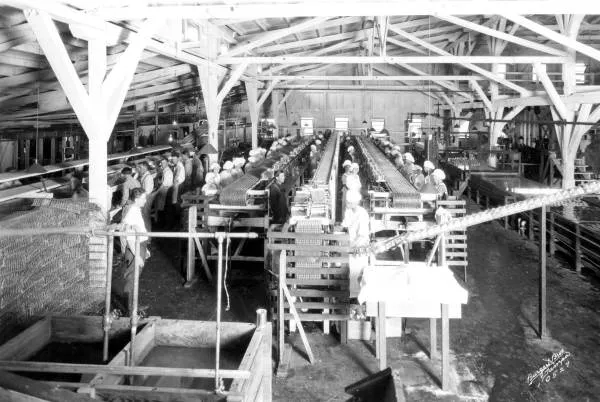
Citrus packing house, Avon Park, Florida, 1924. State Archives of Florida, Florida Memory, image RC09038. Public domain.[fm-rc09038]
References
- brooksville-1930-06-19 — The Brooksville Journal (Brooksville, Fla.). Florida Weekly Industrial Review, The Brooksville Journal, 19 June 1930, page 5. 19 June 1930. avon-park-in-the-outside-press-1916-1941.md
- brooksville-1930-07-31 — The Brooksville Journal (Brooksville, Fla.). Florida Weekly Industrial Review, The Brooksville Journal, 31 July 1930, page 3. 31 July 1930. https://www.loc.gov/resource/sn95047246/1930-07-31/ed-1/?sp=3
- gadsden-1930-09-11 — Gadsden County Times (Quincy, Fla.). Packing Houses Plan Many Improvements To Handle Citrus Crop, Gadsden County Times, 11 September 1930, page 13. 11 September 1930. https://www.loc.gov/resource/sn95047334/1930-09-11/ed-1/?sp=13
- nhu-1913-05-04 — The New Haven Union (New Haven, Conn.). Misses Japan But Lands in Florida — Harry Leigh’s Fine Outing in the South, The New Haven Union, 4 May 1913, page 23. 4 May 1913. new-haven-union-1913-avon-park.md
- nrhp-90000486 — United States Department of the Interior, National Park Service. National Register of Historic Places Registration Form: Avon Park Historic District. 22 March 1990. https://npgallery.nps.gov/NRHP/GetAsset/NRHP/90000486_text
- sanborn-1920 — Sanborn Map Company. Sanborn Fire Insurance Map from Avon Park, Highlands County, Florida, November 1920. 1 November 1920. sanborn-1920-avon-park.md
- frc-27 — Railroad Commission of the State of Florida. Twenty-seventh Annual Report of the Railroad Commission of the State of Florida, for the year ending 29 February 1924. 29 February 1924. https://archive.org/details/Twenty-seventhAnnualReportOfTheRailroadCommissionOfTheStateOfFlorida
- agr-1922 — Florida Department of Agriculture. Biennial Report of the Department of Agriculture of the State of Florida for the years 1921-1922. 1922. https://archive.org/details/BiennialReportOfTheDepartmentOfAgricultureOfTheStateOfFloridaFor
- agr-1924 — Florida Department of Agriculture. Biennial Report of the Department of Agriculture of the State of Florida for the years 1923-1924. 1924. https://archive.org/details/BiennialReportOfTheDepartmentOfAgricultureOfTheStateOfFloridaFor_241
- agr-1921 — Florida Department of Agriculture. Report of the Department of Agriculture of the State of Florida for the years 1919 and 1920. 1921. https://archive.org/details/SixteenthBiennialReportOfTheDepartmentOfAgricultureOfTheStateOf
- census-1940-t23 — United States Bureau of the Census. Sixteenth Census of the United States: 1940, Population, Volume II, Part 2, Florida, Table 23: Employment Status, Class of Worker, Major Occupation Group, Industry Group, and Sex, by Counties, page 65. 1943. https://www2.census.gov/library/publications/decennial/1940/population-volume-2/33973538v2p2ch2.pdf
- census-1950-t39 — United States Bureau of the Census. Census of Population: 1950, Volume II, Part 10, Florida, Table 39: Economic Characteristics of the Population, for Urban Places of 2,500 to 10,000, page 10-75. 1952. https://www2.census.gov/library/publications/decennial/1950/population-volume-2/41601748v2p10ch2.pdf
- census-1950-t44-45a — United States Bureau of the Census. Census of Population: 1950, Volume II, Part 10, Florida, Tables 44 and 45a: Characteristics and Income of the Nonwhite Population, for Counties, pages 10-107 and 10-112. 1952. https://www2.census.gov/library/publications/decennial/1950/population-volume-2/41601748v2p10ch2.pdf
- fm-rc09038 — State Archives of Florida. Citrus packing house - Avon Park, Florida. 1924. avon-park-citrus-packing-house-1924-interior.md
- fm-floridainty — Lake Byrd Citrus Packing Company. Floridainty Brand Citrus Label. 1930. lake-byrd-citrus-packing-floridainty-label.md
- fm-golden-bud — Avon Park Citrus Growers Association. Golden Bud Brand Citrus Label. 1930. avon-park-citrus-growers-golden-bud-label.md
- sjw-1952-09-19 — The Southern Jewish Weekly (Jacksonville, Fla.). Ben Hill Griffin, Inc. advertisement, The Southern Jewish Weekly, 19 September 1952, page 17. 19 September 1952. https://www.loc.gov/resource/sn78000090/1952-09-19/ed-1/?sp=17
- fm-rumpsa-1930 — Paul L. Rumpsa; printed by Drew Press (Jacksonville, Fla.). Citrus Par Excellence by Paul L. Rumpsa, 1930 (State Library of Florida, Federal Documents Collection, call number Fla 634.3 R937, item flc_634.3-r937_01). 1930. citrus-par-excellence_paul-l-rumpsa_1930.md
Related
- Report: the railroads and the making of modern Avon Park
- Entity: Avon Park Citrus Growers Association
- Entity: Paul L. Rumpsa
- Finding: Paul L. Rumpsa and Boutique Citrus Gift Shipping (1923–1931)
- Finding: The Florida Citrus Exchange organized at Avon Park in 1909
- Reference: the 1920 Sanborn fire insurance map of Avon Park
- Entity: Highlands County
- Entity: Atlantic Coast Line Railroad, Haines City Branch
- Finding: Avon Park lost a fifth of its Black population in the 1930s and got it all back in the 1940s
- Finding: Closing the open range in Highlands County with the stock laws of 1923 and 1925
- Image: Citrus packing house, Avon Park, Florida, 1924
Where this comes from
- Evidence
- corroborated — More than one independent source agrees.
- Review
- unverified — Drafted from sources but not yet checked by a volunteer.
- Rights
- society
Sources
- The Brooksville Journal (Brooksville, Fla.), Florida Weekly Industrial Review, The Brooksville Journal, 19 June 1930, page 5 (1930)
- The Brooksville Journal (Brooksville, Fla.), Florida Weekly Industrial Review, The Brooksville Journal, 31 July 1930, page 3 (1930)
- Gadsden County Times (Quincy, Fla.), Packing Houses Plan Many Improvements To Handle Citrus Crop, Gadsden County Times, 11 September 1930, page 13 (1930)
- The New Haven Union (New Haven, Conn.), Misses Japan But Lands in Florida — Harry Leigh's Fine Outing in the South, The New Haven Union, 4 May 1913, page 23 (1913)
- United States Department of the Interior, National Park Service, National Register of Historic Places Registration Form: Avon Park Historic District (1990)
- Sanborn Map Company, Sanborn Fire Insurance Map from Avon Park, Highlands County, Florida, November 1920 (1920)
- Railroad Commission of the State of Florida, Twenty-seventh Annual Report of the Railroad Commission of the State of Florida, for the year ending 29 February 1924 (1924)
- Florida Department of Agriculture, Biennial Report of the Department of Agriculture of the State of Florida for the years 1921-1922 (1922)
- Florida Department of Agriculture, Biennial Report of the Department of Agriculture of the State of Florida for the years 1923-1924 (1924)
- Florida Department of Agriculture, Report of the Department of Agriculture of the State of Florida for the years 1919 and 1920 (1921)
- United States Bureau of the Census, Sixteenth Census of the United States: 1940, Population, Volume II, Part 2, Florida, Table 23: Employment Status, Class of Worker, Major Occupation Group, Industry Group, and Sex, by Counties, page 65 (1943)
- United States Bureau of the Census, Census of Population: 1950, Volume II, Part 10, Florida, Table 39: Economic Characteristics of the Population, for Urban Places of 2,500 to 10,000, page 10-75 (1952)
- United States Bureau of the Census, Census of Population: 1950, Volume II, Part 10, Florida, Tables 44 and 45a: Characteristics and Income of the Nonwhite Population, for Counties, pages 10-107 and 10-112 (1952)
- State Archives of Florida, Citrus packing house - Avon Park, Florida (1924)
- Lake Byrd Citrus Packing Company, Floridainty Brand Citrus Label (1930)
- Avon Park Citrus Growers Association, Golden Bud Brand Citrus Label (1930)
- The Southern Jewish Weekly (Jacksonville, Fla.), Ben Hill Griffin, Inc. advertisement, The Southern Jewish Weekly, 19 September 1952, page 17 (1952)
- Paul L. Rumpsa; printed by Drew Press (Jacksonville, Fla.), Citrus Par Excellence by Paul L. Rumpsa, 1930 (State Library of Florida, Federal Documents Collection, call number Fla 634.3 R937, item flc_634.3-r937_01) (references/citrus-par-excellence_paul-l-rumpsa_1930.md) (1930)
Something here wrong, or incomplete? The Society would rather know. Tell a volunteer.
Have a question about this record?