
The railroads and the making of modern Avon Park
Avon Park was laid out in 1886 and had no railway until 1912. Twenty-six years is a long time for a Florida town to wait, and almost everything that is puzzling about the town’s early history — the collapse of its founder, the disappearance of its first settlers, the flatness of its population curve — follows from that wait. When the rails finally came, the town tripled in size in a decade. When a second railway arrived thirteen years after the first, it arrived in the middle of the land boom and put up the building the town now keeps its history in.
Twenty-six years without a railway
The nearest railhead to Avon Park in the 1890s was Bartow or Bowling Green, more than twenty miles off over sand. Fruit had to be hauled by wagon to reach a market, and a wagon haul of that length ate the profit on the fruit. The town’s founder, Oliver M. Crosby, and his Florida Development Company tried to solve the problem the way small Florida promoters often did, by building a railway themselves.
What they built was not an ordinary railway. In December 1894 John C. Burleigh moved a twelve-ton Shay locomotive twenty-three miles overland from the railhead at Bowling Green by laying wooden beams in front of it and picking them up behind. In January 1895 the trick was turned into a company: the Avon Park Transportation Company, capital $25,000, chartered to build forty miles of wooden-railed line north to Haines City, where it would meet the Plant System’s track for Jacksonville and the north.[harpers-1895-novelty] The novelty of this project was reported in out-of-state newspapers as far away as Savannah, Georgia, and Washington, D.C.[morning-news-1895][morning-times-1895] The tramway reached Pabor Lake, a few miles out, on 7 September 1895. It never reached Haines City, and the freezes of 1894-95 destroyed the citrus economy that was supposed to pay for it. Crosby lost the town at a sheriff’s sale in 1897.
The National Register nomination for the Avon Park Historic District records another attempt from the same moment: in early 1895 Henry Plant was approached about extending his railway to Avon Park and refused, because of the economic damage the freeze had done.[nrhp-90000486] (The nomination calls it “his Atlantic Coast Line Railway,” which is an anachronism — Plant’s was the Plant System, which the Atlantic Coast Line only absorbed in 1902 — but the substance of the story is separate from the label.)
So the town settled into fifteen years of near-stasis. Its population was 225 in 1900 and 285 in 1910.[nrhp-90000486]
The isolation had a human measure. In October 1905 the Avon Park column of the county paper noted that “little Fanny Bennett, who was born at Avon Park ten years ago, had never seen a railroad or a train of cars until she was at Winter Haven two weeks ago.”[dsc-1905-10-13-locals]
The survey of 1906
The first sign that a real railway was coming appears in the town’s own newspaper. The Avon Park page of The De Soto County News — a department of the town’s own newspaper, The South Florida Sun — reported on 18 May 1906:
“The railroad survey southward from Haines City is slowly making its way in this direction, we are told, having begun nearly three weeks ago at the above named point.”[dsc-1906-05-18]
Surveyors in the field at Haines City in the last week of April 1906, running south. The route is the same one the town had tried to build for itself eleven years before, from the same starting point. Nothing was built for another four years, but the line existed on paper from 1906. By 30 December 1910 The St. Lucie County Tribune reported that eight miles of grading south from Haines City and two miles of track had been completed, permitting a construction train to operate, with grading then projected to reach Avon Park by 1 September 1911.[slct-1910-12-30]
The Atlantic Coast Line arrives, 1912
The Railroad Commission of the State of Florida printed a table of every station on every line in the state, with mileages, in each of its annual reports. Those tables date the branch’s progress better than any local account.
| Commission report, year ending | The branch |
|---|---|
| 28 February 1911 | does not exist[frc-14] |
| 29 February 1912 | “Haines City to Frostproof,” 28.0 miles[frc-15] |
| 28 February 1913 | “Haines City to Sebring,” 46.5 miles[frc-16] |
| 28 February 1914 | Avon Park listed at mile 39.0[frc-17] |
The rails were laid through Avon Park in calendar 1912, thirty-nine miles south of Haines City and seven and a half miles north of Sebring. The National Register nomination gives the same year, with Lake Wales in 1911.[nrhp-90000486]
The service was not immediately good. In the year ending February 1915 the Railroad Commission had to travel to Sebring and Avon Park to hold “investigations as to train service on the Haines City Branch.”[frc-18] In the following year E. E. Thompson of Avon Park complained that there were no toilets at the depot; the Commission recorded the matter as “handled and facilities provided.”[frc-19]
The Atlantic Coast Line operated many “named” trains on the branch, including the Champion series.[wiki-haines-city-branch] According to a 1930 newspaper report, passenger train No. 191 passed through Avon Park on its way south.[loc-alaska-1930] The train line typically ran through town twice per week and was primarily used for shipping agricultural and local products, including citrus, produce, and naval stores.[wiki-haines-city-branch]
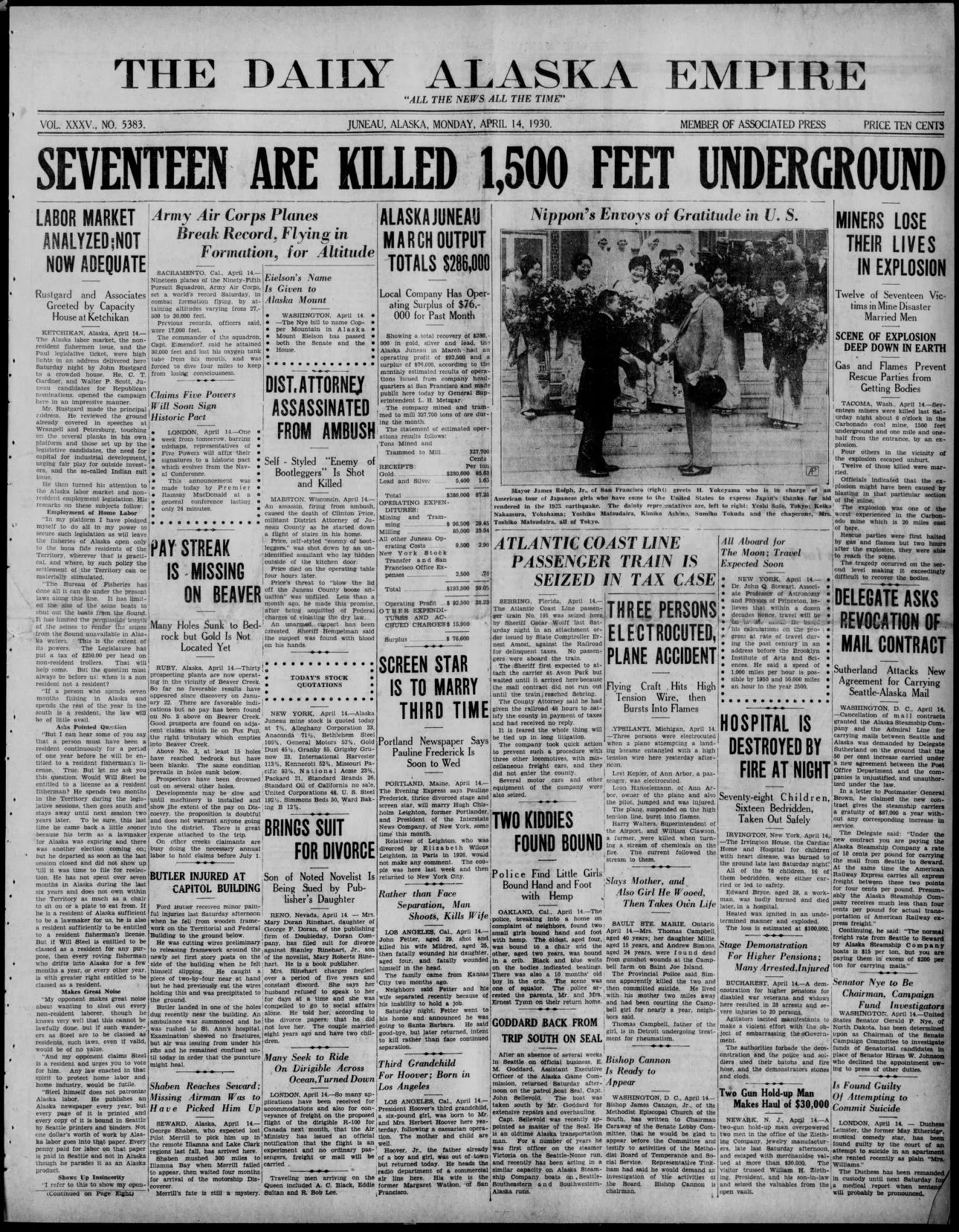
The Daily Alaska Empire, 14 April 1930. Library of Congress / Chronicling America. Public domain.[loc-alaska-1930]
Bad service or not, it changed everything. Between 1910 and 1920 Avon Park’s population went from 285 to 890.[nrhp-90000486] Citrus, produce and naval stores could now be shipped, and the industries that shipped them grew up beside the track: the Avon Park Citrus Growers Association’s packing house; the Pittsburgh-Florida Citrus Growers Association and Lake Byrd Packing Company, organized by C. Parke Anderson and his brother in 1915 and farming four thousand acres of citrus by 1922; W. F. Ward’s five-hundred-acre citrus nursery from 1917.[nrhp-90000486] By 1920 the Sanborn surveyors found a mill and crate district a mile and a quarter south of the post office — the Flint Lumber Company’s steam saw and planing mill, the Mutual Crate Company, and the Avon Manufacturing Company’s crate mill — and the Coast Line’s freight and passenger depot on Michigan Avenue at Church Street, with a section house and company dwellings beside it.[sanborn-1920] By 1923 a firm at Beresford was complaining to the Commission about delays to crate material moving out of Avon Park, which is what a working industrial town looks like in a regulator’s file.[frc-27]
Depot operations across the Coast Line’s fifty-six years in Avon Park were directed by three primary station agents: Archibald E. Conoley (1912–1920s), the inaugural agent who opened the ridge line alongside track section foreman L. M. Marsh; Clayton A. Denmark (1920s–1950s), who managed boom-era construction shipments, freight embargoes, and seasonal citrus movements; and James N. McDugald (1957–1968), who directed the station through the 1 July 1967 merger into the Seaboard Coast Line.[maxwell-1976]
The town incorporated in 1913, the year after the rails came.[nrhp-90000486]
The Seaboard Air Line arrives, 1925
The second railway was a product of the land boom rather than a cause of it. In April 1924 the Seaboard Air Line chartered a subsidiary, the Florida Western and Northern Railroad, to build from its main line at Coleman, south of Wildwood, straight down the middle of the peninsula to West Palm Beach.[wiki-fwn] The Interstate Commerce Commission heard the application for a certificate of convenience and necessity at Jacksonville on 1 May 1924, with a Florida railroad commissioner present.[frc-28] On 20 June 1924, the ICC issued its decision (Finance Docket 3445, 90 I.C.C. 221), officially authorizing the construction of the 204-mile route.[icc-90-221]
It was built in about nine months by the Jefferson Construction Company of Charleston, South Carolina, with the American Bridge Company supplying swing bridge spans for river crossings.[wiki-fwn] The final spike on the Coleman-to-West Palm Beach segment went in on 21 January 1925, and on 25 January 1925 a special Orange Blossom Special ran the length of the new road carrying the Seaboard’s president, S. Davies Warfield, and some five hundred guests.[wiki-fwn] The train passed through Avon Park.
Again the Commission’s own tables bracket it. The station list for the year ending 29 February 1924 knows Avon Park only as a station on the Coast Line branch;[frc-27] the list for the following year adds the Seaboard’s line running Polk City, Auburndale, Winter Haven, West Lake Wales, West Frostproof, Avon Park, Hartt, Sebring, Okeechobee, West Palm Beach.[frc-28] For the next forty-six years the two railways ran through Avon Park within half a mile of each other, competing for the same fruit and the same tourists.
What the Seaboard brought that the Coast Line had not was through passenger service to the north-east in style. The Orange Blossom Special connected Avon Park to points between West Palm Beach and New York City,[nrhp-90000486] and the Silver Meteor also served the town. In a June 1, 1941 schedule, the southbound Silver Meteor was listed as stopping in Avon Park at 11:15 AM.[wiki-fwn] The tourists it brought are the reason the town put up a tent camp a block north of Main Street and finished the Hotel Jacaranda in time for the 1926 season. The same season, Avon Park changed its corporate status from town to city: Chapter 10320, Laws of Florida 1925, abolished the town and created the City of Avon Park with effect from 1 January 1926.[nrhp-90000486]
The boom did not last. In the autumn of 1925 the railways, buried under building materials moving south, declared a freight embargo, and the embargo is one of the things that broke the boom.[nrhp-90000486] Even so, the Seaboard and the Coast Line were still spending enormous sums in Florida in the year to February 1926: the Coast Line building 160 miles of new line and 53 miles of double track, buying 1,250 steel cars and 113 locomotives; the Seaboard extending from West Palm Beach to Florida City and out to Fort Myers, Naples and LaBelle, and buying fifty locomotives.[frc-29]
Abandonment and what survives
By 1968, the Seaboard Coast Line began abandoning parts of the line north of Sebring to favor the parallel Miami Subdivision route. This included the abandonment of track from Frostproof to Sebring, with the exception of a short segment in Avon Park that remained as a spur.[wiki-haines-city-branch]
The Atlantic Coast Line station on Michigan Avenue at Church Street was torn down in 1970, clearing the Block 55 site along with the demolished Maxcy packing house for the First National Bank motor bank and parking lot.[maxwell-1976] (Subsequent regional architectural surveys casually reported the demolition as “the early 1980s,”[nrhp-90000486][riches-depots] but the Historical Society’s centennial record confirms the depot was razed in 1970).
The Seaboard Air Line station on Museum Avenue still stands on its original site. It was designed by the prominent West Palm Beach architectural firm Harvey and Clarke (partners Henry Stephen Harvey and Louis Phillips Clarke) as part of Seaboard president S. Davies Warfield’s Florida Western and Northern construction program.[wiki-harvey-clarke] It is a one-story hollow-tile and stucco building in the Spanish Eclectic / Mediterranean Revival manner, with a round-arched entrance, arcaded windows divided by spiral columns, and a long parapeted freight wing. The National Register nomination dates it 1925; other accounts say 1924 or 1926.[nrhp-90000486] Passenger service ended on 30 April 1971 when Amtrak took over the surviving trains, the building was given to the Old Settlers Association on 4 January 1979, and it is now the Depot Museum and the home of the Historical Society of Avon Park, with a 1948 California Zephyr dining car bought in 1986.[riches-depots]
A caution for anyone using published images: at least one catalogue record for a photograph of the Coast Line depot carries a description of the Seaboard building’s history instead. The two stations are routinely confused. The museum is the Seaboard one.
References
- dsc-1905-10-13-locals — The De Soto County News, Arcadia, Fla. The De Soto County News, 13 October 1905, page 17: Avon Park Locals, Department of The South Florida Sun. 13 October 1905. https://www.loc.gov/resource/sn95026908/1905-10-13/ed-1/?sp=17
- harpers-1895-novelty — Harper’s Weekly, Vol. 39, No. 2008. A Novelty Among Railroads. 15 June 1895. harpers-weekly-1895-novelty-among-railroads.md
- morning-news-1895 — The morning news. The morning news (Savannah, Ga.), 24 June 1895. 24 June 1895. https://www.loc.gov/item/sn86063034/1895-06-24/ed-1/
- morning-times-1895 — The morning times. The morning times (Washington, D.C.), 8 September 1895. 8 September 1895. https://www.loc.gov/item/sn84024442/1895-09-08/ed-1/
- dsc-1906-05-18 — O. R. Thacher (department editor), The De Soto County News, Arcadia, Fla. The De Soto County News, 18 May 1906, page 8: Department of The South Florida Sun, Avon Park Locals. 18 May 1906. de-soto-county-news-avon-park-department.md
- frc-14 — Railroad Commission of the State of Florida. Fourteenth Annual Report of the Railroad Commission of the State of Florida, for the year ending 28 February 1911. 28 February 1911. https://archive.org/details/FourteenthAnnualReportOfTheRailroadCommissionOfTheStateOfFlorida
- frc-15 — Railroad Commission of the State of Florida. Fifteenth Annual Report of the Railroad Commission of the State of Florida, for the year ending 29 February 1912. 29 February 1912. https://archive.org/details/FifteenthAnnualReportOfTheRailroadCommissionOfTheStateOfFlorida
- frc-16 — Railroad Commission of the State of Florida. Sixteenth Annual Report of the Railroad Commission of the State of Florida, for the year ending 28 February 1913. 28 February 1913. https://archive.org/details/SixteenthAnnualReportOfTheRailroadCommissionOfTheStateOfFlorida
- frc-17 — Railroad Commission of the State of Florida. Seventeenth Annual Report of the Railroad Commission of the State of Florida, for the year ending 28 February 1914. 28 February 1914. https://archive.org/details/SeventeenthAnnualReportOfTheRailroadCommissionOfTheStateOfFlorida
- frc-18 — Railroad Commission of the State of Florida. Eighteenth Annual Report of the Railroad Commission of the State of Florida, for the year ending 28 February 1915. 28 February 1915. https://archive.org/details/EighteenthAnnualReportOfTheRailroadCommissionOfTheStateOfFlorida
- frc-19 — Railroad Commission of the State of Florida. Nineteenth Annual Report of the Railroad Commission of the State of Florida, for the year ending 29 February 1916. 29 February 1916. https://archive.org/details/NineteenthAnnualReportOfTheRailroadCommissionOfTheStateOfFlorida
- frc-27 — Railroad Commission of the State of Florida. Twenty-seventh Annual Report of the Railroad Commission of the State of Florida, for the year ending 29 February 1924. 29 February 1924. https://archive.org/details/Twenty-seventhAnnualReportOfTheRailroadCommissionOfTheStateOfFlorida
- frc-28 — Railroad Commission of the State of Florida. Twenty-eighth Annual Report of the Railroad Commission of the State of Florida, for the year ending 28 February 1925. 28 February 1925. https://archive.org/details/Twenty-eighthAnnualReportOfTheRailroadCommissionOfTheStateOfFlorida
- frc-29 — Railroad Commission of the State of Florida. Twenty-ninth Annual Report of the Railroad Commission of the State of Florida, for the year ending 28 February 1926. 28 February 1926. https://archive.org/details/Twenty-ninthAnnualReportOfTheRailroadCommissionOfTheStateOfFlorida
- nrhp-90000486 — United States Department of the Interior, National Park Service. National Register of Historic Places Registration Form: Avon Park Historic District. 22 March 1990. https://npgallery.nps.gov/NRHP/GetAsset/NRHP/90000486_text
- wiki-fwn — Wikipedia. Miami Subdivision: the Seaboard’s Coleman to West Palm Beach line, built by the Florida Western and Northern Railroad. 31 August 2026. https://en.wikipedia.org/wiki/Miami_Subdivision
- riches-depots — RICHES of Central Florida, University of Central Florida. Railroad Depots of Avon Park, in Central Florida Railroad Depots. 31 August 2026. https://richesmi.cah.ucf.edu/omeka/exhibits/show/railroaddepots/avonpark
- icc-90-221 — Interstate Commerce Commission. Interstate Commerce Commission Reports, Volume 90 (Finance Docket No. 3445, Construction of lines by Florida Western & Northern R. R., decided June 20, 1924). 20 June 1924. https://catalog.hathitrust.org/Record/007911857
- wiki-harvey-clarke — Wikipedia. Harvey and Clarke (Architectural Firm). 31 August 2026. https://en.wikipedia.org/wiki/Harvey_and_Clarke
- sanborn-1920 — Sanborn Map Company. Sanborn Fire Insurance Map from Avon Park, Highlands County, Florida, November 1920. 1 November 1920. sanborn-1920-avon-park.md
- maxwell-1976 — Leoma Bradshaw Maxwell. The First Hundred Years of Avon Park, Florida. 1976. the-first-hundred-years-of-avon-park_leoma-bradshaw-maxwell_1976.md
- loc-alaska-1930 — The Daily Alaska Empire. Tax Disputes involving Atlantic Coast Line passenger train No. 191. 14 April 1930. https://chroniclingamerica.loc.gov/lccn/sn84020657/1930-04-14/ed-1/seq-1/
- wiki-haines-city-branch — Wikipedia. Haines City Branch. 17 September 2026. https://en.wikipedia.org/wiki/Haines_City_Branch
- slct-1910-12-30 — The St. Lucie County Tribune. The St. Lucie County Tribune (Fort Pierce, Fla.), 30 December 1910, page 2: Florida Topics, grading south from Haines City toward Avon Park. 30 December 1910. https://www.loc.gov/resource/sn89058426/1910-12-30/ed-1/?sp=2
Related
- Entity: Harvey and Clarke
- Entity: Atlantic Coast Line Railroad, Haines City Branch
- Entity: Seaboard Air Line Railway station, Avon Park
- Entity: Avon Park Transportation Company
- Entity: The South Florida Sun
- Finding: Atlantic Coast Line Railroad Station Agents in Avon Park (1912–1968)
- Finding: Bougainvillea Cemetery Marker Transcription: Resolving Clayton A. Denmark (1883–1982) and Lulah Inez Denmark (d. 1952)
- Finding: Seaboard Air Line depot architecture and Harvey and Clarke attribution
- Finding: the railroad reached Avon Park in 1912
- Finding: a railroad survey was working south from Haines City in 1906
- Finding: automobile transit and Wauchula road proposal in 1906
- Finding: Avon Park had two railway stations
- Finding: the city charter is Chapter 10320 of 1925 and the city began on 1 January 1926
- Report: Burleigh’s steam engine and the Avon Park wooden railroad
Where this comes from
- Evidence
- single-source — One source. Treat as reported, not established.
- Review
- unverified — Drafted from sources but not yet checked by a volunteer.
- Rights
- society
Sources
- The De Soto County News, Arcadia, Fla., The De Soto County News, 13 October 1905, page 17: Avon Park Locals, Department of The South Florida Sun (1905) · newspaper
- Harper's Weekly, Vol. 39, No. 2008, A Novelty Among Railroads (1895)
- The morning news, The morning news (Savannah, Ga.), 24 June 1895 (1895)
- The morning times, The morning times (Washington, D.C.), 8 September 1895 (1895)
- O. R. Thacher (department editor), The De Soto County News, Arcadia, Fla., The De Soto County News, 18 May 1906, page 8: Department of The South Florida Sun, Avon Park Locals (1906)
- Railroad Commission of the State of Florida, Fourteenth Annual Report of the Railroad Commission of the State of Florida, for the year ending 28 February 1911 (1911)
- Railroad Commission of the State of Florida, Fifteenth Annual Report of the Railroad Commission of the State of Florida, for the year ending 29 February 1912 (1912)
- Railroad Commission of the State of Florida, Sixteenth Annual Report of the Railroad Commission of the State of Florida, for the year ending 28 February 1913 (1913)
- Railroad Commission of the State of Florida, Seventeenth Annual Report of the Railroad Commission of the State of Florida, for the year ending 28 February 1914 (1914)
- Railroad Commission of the State of Florida, Eighteenth Annual Report of the Railroad Commission of the State of Florida, for the year ending 28 February 1915 (1915)
- Railroad Commission of the State of Florida, Nineteenth Annual Report of the Railroad Commission of the State of Florida, for the year ending 29 February 1916 (1916)
- Railroad Commission of the State of Florida, Twenty-seventh Annual Report of the Railroad Commission of the State of Florida, for the year ending 29 February 1924 (1924)
- Railroad Commission of the State of Florida, Twenty-eighth Annual Report of the Railroad Commission of the State of Florida, for the year ending 28 February 1925 (1925)
- Railroad Commission of the State of Florida, Twenty-ninth Annual Report of the Railroad Commission of the State of Florida, for the year ending 28 February 1926 (1926)
- United States Department of the Interior, National Park Service, National Register of Historic Places Registration Form: Avon Park Historic District (1990)
- Wikipedia, Miami Subdivision: the Seaboard's Coleman to West Palm Beach line, built by the Florida Western and Northern Railroad (2026)
- RICHES of Central Florida, University of Central Florida, Railroad Depots of Avon Park, in Central Florida Railroad Depots (2026)
- Interstate Commerce Commission, Interstate Commerce Commission Reports, Volume 90 (Finance Docket No. 3445, Construction of lines by Florida Western & Northern R. R., decided June 20, 1924) (1924) · official
- Wikipedia, Harvey and Clarke (Architectural Firm) (2026)
- Sanborn Map Company, Sanborn Fire Insurance Map from Avon Park, Highlands County, Florida, November 1920 (1920)
- Leoma Bradshaw Maxwell, The First Hundred Years of Avon Park, Florida (Held at the Avon Park Historical Society Depot Museum, Avon Park, Florida) (1976) · book
- The Daily Alaska Empire, Tax Disputes involving Atlantic Coast Line passenger train No. 191 (1930) · newspaper
- Wikipedia, Haines City Branch (2026)
- The St. Lucie County Tribune, The St. Lucie County Tribune (Fort Pierce, Fla.), 30 December 1910, page 2: Florida Topics, grading south from Haines City toward Avon Park (1910) · newspaper
Something here wrong, or incomplete? The Society would rather know. Tell a volunteer.
Have a question about this record?