Atlantic Coast Line Railroad, Haines City Branch
The branch that made modern Avon Park possible. For its first twenty-six years the town had no railway at all; the wooden tramway of 1895 never reached one. The Atlantic Coast Line’s branch south from Haines City ended that in 1912, and the town’s population tripled in the decade that followed.
The survey of 1906
The earliest local notice of the line found so far is in the Avon Park column of The De Soto County News for 18 May 1906:
“The railroad survey southward from Haines City is slowly making its way in this direction, we are told, having begun nearly three weeks ago at the above named point.”[dsc-1906-05-18]
That puts surveyors in the field at Haines City in late April 1906, four years before construction began. It also shows that Avon Park was already watching for the line, as it had been since the Avon Park Transportation Company was formed in 1895 to build its own forty-mile wooden railway to the very same place.
The place name is badly garbled in the newspaper’s optical character recognition and has not yet been confirmed against the page image; “Haines City” is the reading that fits both the letter shapes and the route the railroad afterwards took.
Construction and the date the rails arrived
The Railroad Commission of the State of Florida published a table of stations and mileages for every line in the state each year, and those tables date the branch’s progress precisely.
| Commission report, year ending | Branch as listed | Southern end |
|---|---|---|
| 28 February 1911 | not listed | — |
| 29 February 1912 | “Haines City to Frostproof”[frc-15] | Frostproof, 28.0 miles |
| 28 February 1913 | “Haines City to Sebring”[frc-16] | Sebring, 46.5 miles |
| 28 February 1914 | “Haines City to Sebring,” Avon Park at mile 39.0[frc-17] | Sebring |
So the branch reached Frostproof during 1911 and Sebring during 1912, and Avon Park station first appears in the state’s own station list in the report for the year ending 28 February 1913. The rails were laid through the town in calendar 1912, not 1911. The National Register nomination for the Avon Park Historic District says the same: through Lake Wales in 1911 and to Avon Park in 1912.[nrhp-90000486]
Avon Park stood 39 miles south of Haines City, seven and a half miles north of Sebring.
Contemporary press, 1912
Two newspaper items fix the date independently of the state’s tables.
7 March 1912. A travel column reprinted from the Florida Grower describes Frostproof as “located amid the fine lakes of Polk county, on the new line of the railroad from Haines City to Avon Park,” and notes that Frostproof “up to this year … has never had a railroad connection with the outside world.” Growers there had been hauling fruit seventeen miles to Fort Meade, the nearest railhead. The writer lists the towns “along the new railroad” as Hamilton, Lake Wales, Dundee, Frostproof and Avon Park, and reports talk of building a central exchange packing house at Haines City to take the fruit of the whole line.[lakeland-1912-03-07]
Note what the line was called in the spring of 1912: not the Frostproof branch or the Sebring branch, but “the railroad from Haines City to Avon Park.” Avon Park was the destination the road was building toward.
21 June 1912. An Ocala local note mentions a woman traveling north whose “husband, who is finishing up some work on a new railroad at Avon Park, will join her about July 1.”[ocala-1912-06-21] Construction work at Avon Park was being finished in June 1912.
Early operation
The new branch was not immediately a good service. In the year ending February 1915 the Railroad Commission traveled to both Sebring and Avon Park to hold “investigations as to train service on the Haines City Branch of the Atlantic Coast Line Railroad Company.”[frc-18] In the following year E. E. Thompson of Avon Park complained to the Commission that there were no toilets at the depot; the file records the complaint as “handled and facilities provided.”[frc-19]
By 1921 the Commission was approving the removal of Shockley’s Spur near Avon Park,[frc-24] and by 1923 the town was shipping enough crate material for a Beresford firm to complain of delays in transit on cars moving from Avon Park.[frc-27] The traffic the branch was built for — citrus, crates, naval stores and vegetables — was by then well established.
The line beyond Avon Park
South of Sebring the Coast Line kept going: by the mid-1920s its station list ran on through Istokpoga, Stearns, Childs, Hicoria, Venus, Palmdale and Moore Haven,[frc-27] and the line was eventually pushed to Immokalee and, in 1928, to Everglades City. Much of the branch north of Sebring was abandoned after the 1967 merger that created the Seaboard Coast Line.[riches-depots]
The station and operating personnel
The Coast Line’s freight and passenger depot stood on Block 55, bounded by North Michigan Avenue, West Main Street, Church Street, and the main tracks. Sheet 4 of the November 1920 Sanborn Fire Insurance Map details the complete facility: a single-story wood-frame combination depot with a passenger waiting room and projecting trackside bay window at the south end fronting Main Street, a freight warehouse occupying the northern two-thirds, and an elevated wooden loading platform extending toward Church Street.[sanborn-1920] Immediately north of the freight platform stood a separate wood-frame section house (“SECTION HO.”) used by the track maintenance gang for handcars and equipment.[sanborn-1920]
Along North Michigan Avenue, the western half of Block 55 was designated “A. C. L. R. R. PROPERTY” and contained three company-owned frame dwellings with full-width front verandas and detached auto garages, providing on-site living quarters for the station agent, section foreman, and railroad operating staff.[sanborn-1920]
Three primary station agents directed Coast Line operations in Avon Park across more than five decades:
- Archibald Evander Conoley (1912–1920s): Sent as the first station agent when the line arrived in 1912, operating alongside section foreman L. M. Marsh and extra work gang foreman W. D. Cameron during the initial wood-burning locomotive runs.[maxwell-1976]
- Clayton A. Denmark (1920s–1950s): Transferred from the Waverly agency in Polk County, Denmark served through the 1920s boom, the 1925 statewide freight embargo, the Great Depression, and the peak citrus traffic of World War II, residing in Avon Park with his wife Lulah Inez.[maxwell-1976]
- James N. (“Jim”) McDugald (1957–1968): Appointed agent in 1957 after service at Lake Hamilton and Dundee. When the Atlantic Coast Line and Seaboard Air Line merged on 1 July 1967 to form the Seaboard Coast Line (SCL), McDugald held company seniority over Seaboard agent Raymond K. Cook and was appointed consolidated SCL agent for Avon Park.[maxwell-1976]
Following agency consolidation under McDugald at the 1926 Seaboard passenger depot on Museum Avenue, the 1912 wooden Coast Line depot was closed and torn down in 1970, clearing the parcel alongside the adjacent former Maxcy citrus packing plant for the First National Bank of Avon Park motor bank and parking lot.[maxwell-1976] (Later architectural surveys casually described the demolition as “the early 1980s,”[nrhp-90000486] but the Historical Society’s centennial history documents the 1970 clearing). It is not the building now occupied by the Depot Museum — see the Seaboard Air Line station.
The depot, photographed
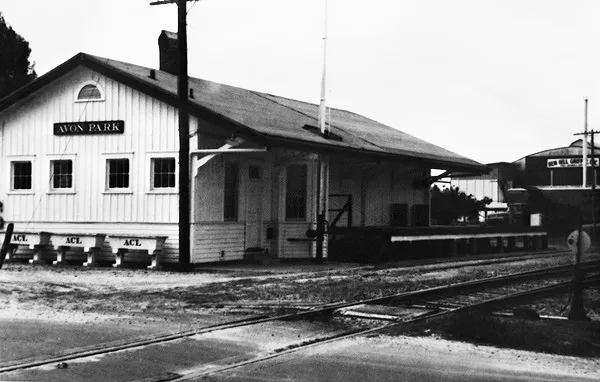
The Avon Park depot, its nameboard lettered AVON PARK and three baggage carts on the platform lettered ACL. State Archives of Florida, Florida Memory, image N027987. Public domain.[fm-n027987]
The archive dates this photograph “circa 1900,” and it cannot be right. The carts on the platform carry the Atlantic Coast Line’s initials, and the Atlantic Coast Line did not reach Avon Park until 1912. The picture must be from 1912 or later. It is the second photograph of an Avon Park depot this project holds, after the 1913 view printed in The New Haven Union, and the two should be compared: this building is a long single-story frame structure with a freight platform at the far end, and it is the Atlantic Coast Line’s, not the Seaboard’s.[fm-n027987]
Post-merger and abandonment
The Atlantic Coast Line and Seaboard Air Line railroads merged on 1 July 1967 to form the Seaboard Coast Line Railroad (SCL). The parallel Seaboard Air Line route through Avon Park (the Miami Subdivision) was retained as the primary main line, making portions of the Haines City Branch redundant.
By 1968, the SCL had abandoned parts of the branch north of Sebring to consolidate traffic onto the Miami Subdivision. Specifically, the track between Waverly and Lake Wales was abandoned, and the segment between Lake Wales and Frostproof was annexed to the Lake Wales Subdivision (this segment has been operated by the Florida Midland Railroad since 1987).[wikipedia-haines-city-branch]
The track from Frostproof south to Sebring was also abandoned in 1968, with one exception: a short segment in Avon Park was retained as an industrial spur branching off the former Seaboard main line (the modern CSX Auburndale Subdivision). Today, this short spur continues south from the Avon Park Depot Museum to serve the Bowsmith Plastic Fabrication Company, a manufacturer of plastic irrigation systems.[grokipedia-haines-city-branch]
References
- dsc-1906-05-18 — O. R. Thacher (department editor), The De Soto County News, Arcadia, Fla. The De Soto County News, 18 May 1906, page 8: Department of The South Florida Sun, Avon Park Locals. 18 May 1906. de-soto-county-news-avon-park-department.md
- frc-15 — Railroad Commission of the State of Florida. Fifteenth Annual Report of the Railroad Commission of the State of Florida, for the year ending 29 February 1912. 29 February 1912. https://archive.org/details/FifteenthAnnualReportOfTheRailroadCommissionOfTheStateOfFlorida
- frc-16 — Railroad Commission of the State of Florida. Sixteenth Annual Report of the Railroad Commission of the State of Florida, for the year ending 28 February 1913. 28 February 1913. https://archive.org/details/SixteenthAnnualReportOfTheRailroadCommissionOfTheStateOfFlorida
- frc-17 — Railroad Commission of the State of Florida. Seventeenth Annual Report of the Railroad Commission of the State of Florida, for the year ending 28 February 1914. 28 February 1914. https://archive.org/details/SeventeenthAnnualReportOfTheRailroadCommissionOfTheStateOfFlorida
- frc-18 — Railroad Commission of the State of Florida. Eighteenth Annual Report of the Railroad Commission of the State of Florida, for the year ending 28 February 1915. 28 February 1915. https://archive.org/details/EighteenthAnnualReportOfTheRailroadCommissionOfTheStateOfFlorida
- frc-19 — Railroad Commission of the State of Florida. Nineteenth Annual Report of the Railroad Commission of the State of Florida, for the year ending 29 February 1916. 29 February 1916. https://archive.org/details/NineteenthAnnualReportOfTheRailroadCommissionOfTheStateOfFlorida
- frc-24 — Railroad Commission of the State of Florida. Twenty-fourth Annual Report of the Railroad Commission of the State of Florida, for the year ending 28 February 1921. 28 February 1921. https://archive.org/details/Twenty-fourthAnnualReportOfTheRailroadCommissionOfTheStateOfFlorida
- frc-27 — Railroad Commission of the State of Florida. Twenty-seventh Annual Report of the Railroad Commission of the State of Florida, for the year ending 29 February 1924. 29 February 1924. https://archive.org/details/Twenty-seventhAnnualReportOfTheRailroadCommissionOfTheStateOfFlorida
- lakeland-1912-03-07 — The Lakeland Evening Telegram. The Lakeland Evening Telegram, 7 March 1912, page 2: Stroller, in Florida Grower, on Frostproof and the new railroad. 7 March 1912. https://www.loc.gov/resource/sn95047222/1912-03-07/ed-1/?sp=2
- ocala-1912-06-21 — The Ocala Banner. The Ocala Banner, 21 June 1912, page 9: local notes. 21 June 1912. https://www.loc.gov/resource/sn88074815/1912-06-21/ed-1/?sp=9
- nrhp-90000486 — United States Department of the Interior, National Park Service. National Register of Historic Places Registration Form: Avon Park Historic District. 22 March 1990. https://npgallery.nps.gov/NRHP/GetAsset/NRHP/90000486_text
- fm-n027987 — State Archives of Florida, Florida Memory. Railroad depot - Avon Park, Florida. 1912. avon-park-railroad-depot-photograph.md
- riches-depots — RICHES of Central Florida, University of Central Florida. Railroad Depots of Avon Park, in Central Florida Railroad Depots. 31 August 2026. https://richesmi.cah.ucf.edu/omeka/exhibits/show/railroaddepots/avonpark
- maxwell-1976 — Leoma Bradshaw Maxwell. The First Hundred Years of Avon Park, Florida. 1976. the-first-hundred-years-of-avon-park_leoma-bradshaw-maxwell_1976.md
- sanborn-1920 — Sanborn Map Company. Sanborn Fire Insurance Map from Avon Park, Highlands County, Florida, November 1920, Sheet 4. 1 November 1920. sanborn-1920-avon-park.md
- wikipedia-haines-city-branch — Wikipedia. Haines City Branch. 31 July 2026. https://en.wikipedia.org/wiki/Haines_City_Branch
- grokipedia-haines-city-branch — Grokipedia. Haines City Branch. 18 September 2026. https://grokipedia.com/page/haines_city_branch
Related
- Entity: Avon Park Transportation Company
- Entity: Seaboard Air Line Railway station, Avon Park
- Finding: Atlantic Coast Line Railroad Station Agents in Avon Park (1912–1968)
- Finding: Bougainvillea Cemetery Marker Transcription: Resolving Clayton A. Denmark (1883–1982) and Lulah Inez Denmark (d. 1952)
- Finding: the Atlantic Coast Line reached Avon Park in 1912, not 1911
- Finding: Avon Park had two railway stations, and the museum is the Seaboard one
- Report: the railroads and the making of modern Avon Park
Where this comes from
- Evidence
- single-source — One source. Treat as reported, not established.
- Review
- unverified — Drafted from sources but not yet checked by a volunteer.
- Rights
- society
Sources
- O. R. Thacher (department editor), The De Soto County News, Arcadia, Fla., The De Soto County News, 18 May 1906, page 8: Department of The South Florida Sun, Avon Park Locals (1906)
- Railroad Commission of the State of Florida, Fifteenth Annual Report of the Railroad Commission of the State of Florida, for the year ending 29 February 1912 (1912)
- Railroad Commission of the State of Florida, Sixteenth Annual Report of the Railroad Commission of the State of Florida, for the year ending 28 February 1913 (1913)
- Railroad Commission of the State of Florida, Seventeenth Annual Report of the Railroad Commission of the State of Florida, for the year ending 28 February 1914 (1914)
- Railroad Commission of the State of Florida, Eighteenth Annual Report of the Railroad Commission of the State of Florida, for the year ending 28 February 1915 (1915)
- Railroad Commission of the State of Florida, Nineteenth Annual Report of the Railroad Commission of the State of Florida, for the year ending 29 February 1916 (1916)
- Railroad Commission of the State of Florida, Twenty-fourth Annual Report of the Railroad Commission of the State of Florida, for the year ending 28 February 1921 (1921)
- Railroad Commission of the State of Florida, Twenty-seventh Annual Report of the Railroad Commission of the State of Florida, for the year ending 29 February 1924 (1924)
- The Lakeland Evening Telegram, The Lakeland Evening Telegram, 7 March 1912, page 2: Stroller, in Florida Grower, on Frostproof and the new railroad (1912)
- The Ocala Banner, The Ocala Banner, 21 June 1912, page 9: local notes (1912)
- United States Department of the Interior, National Park Service, National Register of Historic Places Registration Form: Avon Park Historic District (1990)
- State Archives of Florida, Florida Memory, Railroad depot - Avon Park, Florida (1912)
- RICHES of Central Florida, University of Central Florida, Railroad Depots of Avon Park, in Central Florida Railroad Depots (2026)
- Leoma Bradshaw Maxwell, The First Hundred Years of Avon Park, Florida (Held at the Avon Park Historical Society Depot Museum, Avon Park, Florida) (1976) · book
- Sanborn Map Company, Sanborn Fire Insurance Map from Avon Park, Highlands County, Florida, November 1920, Sheet 4 (1920) · archival
- Wikipedia, Haines City Branch (2026)
- Grokipedia, Haines City Branch (2026)
Something here wrong, or incomplete? The Society would rather know. Tell a volunteer.
Have a question about this record?