
Avon Park in The Florida Agriculturist, 1890–1910
The Florida Agriculturist was a weekly farm paper published at DeLand from 1878 to 1911. It is digitized complete, it is free, and one hundred and forty-six of its pages name Avon Park.
It matters because of what is missing everywhere else. Avon Park’s own newspapers of this period — the Florida Homeseeker, the Avon Park Idea, the South Florida Sun — are all lost, every issue. The Pabor Lake Pineapple survives but stops in September 1897. Between the freeze and the railway there is almost nothing. The Agriculturist runs straight through, and because it was a state paper that reprinted freely from the county press, it preserves in quotation a good deal of the Avon Park writing that has otherwise perished.
What follows is what the run yields, in order.
1890: a town of newcomers, and sixty settlers in one winter
The earliest substantial notice is a letter of April 1890 from a Florida veteran of thirty summers:
Have just visited Avon Park twelve miles south of Keystone. Avon Park is a lovely southern locality in many respects. Most of the people are new comers brought here from the North, and so desirous are they for information concerning their new homes and new employments that as soon as they learned I was an old settler…[fa-1890-04-23]
The same letter reports on that year’s cold: “Some localities in the sand hills escaped surprisingly. Avon Park was not hurt, but as yet her trees are not fruiting.”[fa-1890-04-23] Four years before the freeze that would kill the town, its trees were still too young to bear.
In December of the same year the paper passes on a note from the Bartow Courier-Informant: “Mr. M. Crosby of Avon Park is doing a big thing for Florida, having already brought down sixty settlers this winter.”[fa-1890-12-24] That is the only figure yet found for how fast Crosby was actually filling the town, and it explains how a settlement founded in 1886 reached five hundred people by 1895.
1892–93: the argument about frost
Through the winter of 1892–93 the Agriculturist ran a public argument about whether Avon Park lay below the frost line. James H. White said the claim was untested and that pushing it to sell land “does not savor of either sound or honorable business methods”; W. E. Pabor and a correspondent named R. H. Burr answered him; White answered back.[fa-1893-01-04] Two winters later the freeze settled it. The exchange is set out in Finding: a public argument in 1892-93 warned that Avon Park’s frost protection was unproven.
In the same weeks the paper carried Pabor’s own classified advertisement: “FLORIDA FRUIT GROWERS: — Have you been frozen out of late years? Come to the frost proof lake regions for safety. Write for particulars to Pabor Lake Colony, Avon Park, Fla.”[fa-1893-01-04]
1893: William King’s pineapples, and Avon Park at the World’s Fair
The single most valuable item in the whole run appears on 11 January 1893: a paper read before the Avon Park Township Horticultural Association by William King and reprinted from the Pabor Lake Pineapple, in which the town’s first settler describes planting Avon Park’s first pineapple slips in August 1887 and five years of experiment since.[fa-1893-01-11] It is the only substantial first-person writing by a founding Avon Park settler known to survive, and it is treated in full in Finding: William King planted Avon Park’s first pineapples in August 1887.
In July the paper prints a note under the heading “DeSoto County Pines”:
Mr. N. S. C. Perkins, of Avon Park, writes under a recent date: We forward this morning to Mr. Crosby at Chicago, Niagara grapes and pineapples which will be object lessons in the possibilities of Florida, and a credit to DeSoto County. The pineapples grown without protection will bear elegant testimony that Avon Park the last winter was free from harmful frosts.[fa-1893-07-05]
Chicago in July 1893 is the World’s Columbian Exposition, and Crosby was there. Avon Park grapes and pineapples were sent to the World’s Fair. Perkins is the U. S. C. Perkins listed as a notary in the 1895 business directory.
Two other 1893 residents surface in advertising. W. B. Gardner of Avon Park endorsed the Suwannee Clipper plow — “I have sold dozens of Suwannee Clipper Plows in the past two years… I have used them after trying several other brands in my annual grove work of over a hundred acres” — which makes him both an implement dealer and one of the larger growers in the township.[fa-1893-10-18] A “McDonald, Avon Park, Florida” spent three weeks of the spring trying to trade a nickel-plated .38 Colt’s revolver for a shotgun.
And through the whole of 1893, in nearly every weekly number, runs O. M. Crosby’s advertisement for the Florida Homeseeker — the only surviving text of that newspaper.[fa-1893-11-08]
1895: the tram road, the school house, and a town still called a success
In February 1895, three weeks after the second freeze, a correspondent writes that “the Avon Park tram road is to be built, and that soon, by this place and on to Haines City.”[fa-1895-02-06] This is the earliest independent confirmation of the destination Harper’s Weekly would give four months later: forty miles north to Haines City, to meet the Plant System. By September 1895, when the line actually opened as far as Pabor Lake, the Pabor Lake Pineapple was hedging the destination as “(probably) Bartow” instead. Haines City is where the Atlantic Coast Line eventually built, seventeen years later.
In June the Agriculturist quotes the Avon Park Idea on the county’s cattle: “DeSoto county has the largest cattle owner in the world. Judge Ziba King has over…”[fa-1895-06-26] Through the summer H. G. Burnet advertises Tropical Nurseries, Avon Park — Jamaica sorrel, tropical pawpaw, camphor trees, tea plants, loquats — a specialist tropical nursery on the ridge in the year after the freeze.[fa-1895-06-12] This is the same Burnet whose “feeling” that he had found a frost-protected spot James H. White had mocked two years earlier.
In December the school house burned — the town’s “first fire of any consequence” — taking the new desks and the Episcopal congregation’s organ, hymnals and prayer books, and leaving the trustees to issue $1,200 of bonds for a new building.[fa-1895-12-18] See Finding: the Avon Park school house burned in December 1895.
A week earlier, in an editorial on why Florida colonies fail, the paper had named Avon Park as one that had not: “some colonies have succeeded — even beyond the expectations of those founding them, as witness the venture at Avon Park.”[fa-1895-12-11] That is a year after the first freeze.
1896: a canning factory, a distress sale, and the Avon Park Idea quoted at length
H. B. Todd built his canning factory. On 29 July 1896 the paper reports flatly: “H. B. Todd, of Avon Park, has erected a canning factory and is now ready for guavas.”[fa-1896-07-29] The Florida Development Company had donated ten acres to Henry H. Todd for a canning factory in May 1896, and it was built, within three months. See Finding: Todd’s canning factory was built, and was working by July 1896.
February 1896 finds Crosby on the road: the Jacksonville Citizen, quoted here, lists him among the state’s principal colonization agents, “Mr. O. M. Crosby, of Avon Park, who has started on an extended tour through the West, carrying with him the addresses of over 6,000 people who had written for information in regard to Florida.”[fa-1896-02-12] A year after the freeze he was still working the mailing list.
Others were getting out. Through March a classified runs: “WILL sell all my property at Avon Park, or trade for farming property elsewhere; bargains. SHAW, 116th st., Brooklyn.” Through the autumn another runs weekly into 1897: “DeSOTO COUNTY. — 240 acres of selected land for sale near the model town of Avon Park. Will sell as a whole or will divide. Geo. Frost, Box 1604, Boston, Mass.”
The Avon Park Idea is quoted repeatedly through 1896, and those quotations are all that survives of it. They show a real local paper with opinions: on orange grove sales; on the cost of living; on canneries — “the urgent appeals that have been made for the establishment of canneries should begin to take effect”; on legal advertising — “the state should make a law compelling all legal notices to be printed in the press of the county… The option of posting such notices on three prominent palmetto trees should be done away with”; on a seven-pound bass caught by Geo. Edmiston, “the largest bass ever caught in the lakes here”; on two heads of lettuce grown by C. J. Williams near Lake Pioneer that filled a half-bushel basket; and on a scolding of its own townspeople. That last is worth quoting whole, because it is the voice of Avon Park in the year after the freeze. Reporting that John T. Hendricks had raised, on one acre on Pleasant Street, enough fruit and vegetables to keep a household, the Idea concluded:
So could every other resident of Avon Park if they did a little more work and a little less growling at hard times.[fa-1896-09-30]
1897: Pabor’s memoir, four pineries, and half a million plants
On 6 October 1897 the paper gives its front page to an unsigned article headed “Five Years in Florida.” Everything in it — twenty-five years in Colorado “with more or less of pioneering and town building work mixed with newspaper experience,” a nervous collapse, a month in California, arrival in Florida in mid-summer 1892, about a thousand acres in Avon Park township “bordered by half a dozen lakes,” and “the little colony settlement at Pabor Lake, which soon had its postoffice and monthly newspaper” — identifies the author as W. E. Pabor.[fa-1897-10-06] It is the only known first-hand account of the freezes of 1894-95 written from inside this district, and it is set out in Finding: Pabor’s own account of the freezes.
A month earlier the paper had sent a correspondent to tour the Avon Park pineapple growers, and he reported that nearly half a million pineapple plants stood in the township before the freeze, of which ten to forty per cent were killed.[fa-1897-09-08] See Finding: Avon Park had nearly half a million pineapple plants before the freeze.
In December the Avon Park correspondent of the Bartow Courier-Informant names the plantations: “A Miss Law, of Indiana, has established a pinery on Lake Carter, to be known as the Indiana Pinery. We now have the Bamboo, Holley Hill and Oak Hill pineries, and expect a few more names from the romance of nature.”[fa-1897-12-01] Four named pineapple plantations at Avon Park in 1897, one of them founded by a woman from Indiana, and none of the four names is recorded anywhere else.
November brings another factory: “Considerable cassava is being planted in anticipation of the starch and flour factory which is to be started at Avon Park next spring.”[fa-1897-11-24]
And in April the Florida State Horticultural Society’s committee lists place two Avon Park men among the state’s fruit authorities: O. M. Crosby on Tropical Fruits and O. R. Thacher on Grapes.[fa-1897-04-14] Crosby had lost the town at a sheriff’s sale three months earlier and was still living in it. Thacher, whom this bundle has known only as the editor of the South Florida Sun in 1905–06, turns out to have been at Avon Park at least eight years before that, and to have been a grape grower first.
1899: a burial mound opened, and a motor line proposed
Two items from 1899 stand out, and they point in opposite directions.
In July the Avon Park correspondent of the Arcadia News reported that an ancient burial mound east of the town had been opened and its contents removed:
The Avon Park correspondent of the Arcadia News, writes: “An Indian mound was discovered by Messrs. Mc- Pabor east of this town last week. They took from the mound a quantity of beads, utensils and other things. There was a great quantity of skulls and other human bones in the mound, showing that many dead had been buried here. It is the intention of the finders to make further explorations. It is evident that at some time a battle was fought near here and the dead buried in that mound.”[fa-1899-07-05]
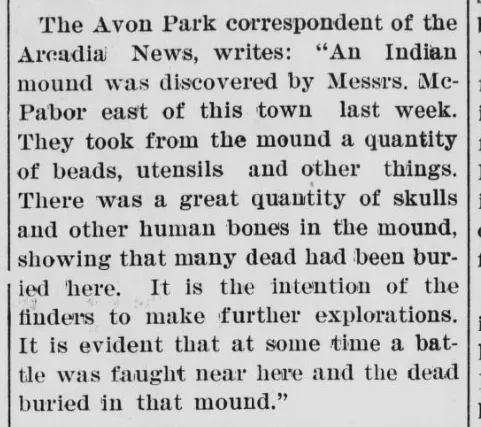
The Florida Agriculturist, 5 July 1899, page 5: Indian mound opened east of Avon Park by Messrs. Mc- Pabor. Image provided by the University of Florida / Library of Congress, Chronicling America. Public domain.[fa-1899-07-05]
The account is quoted and discussed in Finding: a burial mound east of Avon Park was opened in 1899. It is the first documented instance of a mound being dug anywhere in what became Highlands County, and it should be read as a record of a grave being robbed, which is what it describes.
In November the paper reports something nobody has recorded:
Automobile transportation is now the subject in which the people at Avon Park and vicinity are interested. There is a movement on foot to form a joint transportation company. Bartow wants to be the terminus of the line; Zolfo is after it, and so is Bowling Green. There is much argument in favor of each place. It is said that Bartow and Zolfo will take stock in the enterprise, but that Bowling Green will not. The question now is, shall it be Bartow or Zolfo?[fa-1899-11-08]
Four years after the wooden tramway failed and thirteen before a railway reached the town, Avon Park was trying to solve the same problem with motor vehicles, and three towns were bidding to be the railhead it connected to. Nothing came of it — the 1907 directory still gives Wauchula, twenty-two miles off, as the nearest shipping point — but it belongs in the town’s transport history beside the tramway and the Dixie Highway.
1907–1910: the quiet decade, and the Pabors still trading
The paper thins out after 1900 and Avon Park with it, but the last decade of the run shows what became of the Pabor Lake colony after 1900.
It was still trading in 1909. A display advertisement runs: “Orange and Pomelo Groves and Winter Homes in Lake Region of South Florida. Orange, Grapefruit Groves and Pineapple Plantations Set Out and Cared for in the Interest of Non-Residents or Winter Tourist Owners. Full particulars given on application. Address W. E. PABOR & SONS, PABOR LAKE, AVON PARK, FLORIDA.”[fa-1909-12-01] A further advertisement for “Pabor Lake Fruit Lands, Avon Park, Fla.” runs into 1910. Pabor himself is being written to at Avon Park in February 1907 over a newspaper article about the Gulf Stream, and complaining in the same month’s issues that the state’s crate-shipment returns are wrong because “no enumerator came into the Pabor Lake region near Avon Park to get any information whatever.”[fa-1907-04-03] The colony had become a grove-care business run by a father and his sons for absentee owners, and it lasted at least seventeen years, to within two years of Pabor’s death at Denver in 1911.
Three other things belong to this decade.
The Florida Citrus Exchange came to Avon Park in 1909. “At Avon Park a branch of the Florida Citrus Exchange has been organized,” the paper reports in October, in the same paragraph as branches at Sarasota and Bowling Green.[fa-1909-10-01] This is six years before the Avon Park Citrus Growers Association and three before the railway. The growers were organizing to market co-operatively while their fruit still went twenty-two miles by wagon to Wauchula.
Pineapples were still being grown. The issue of 3 April 1907 carries an illustrated piece headed “A Fruiting Pinery at Avon Park, Fla.”[fa-1907-04-03]
And somebody at Avon Park was experimenting with eucalyptus. In January 1910 the paper notes that “at Avon Park, DeSoto county, there are a number of healthy eucalypts of different kinds and ages,” and in April an Avon Park writer reports specimens “three and one-half feet in circumference… a dozen years old from seed… grown to their present size without care or fertilizing, one of them in the street,” concluding that “it argues well for the future of Avon Park that the most valuable tree on the face of the globe is at home here.”[fa-1910-04-01] Trees a dozen years old from seed in 1910 were planted about 1898. E. Thompson of Avon Park — the E. E. Thompson listed as a nurseryman in the 1911 business directory — was advertising eucalyptus seed and trees, and roselle seed, by post through the spring of 1910.[fa-1910-02-01]
A pineapple town that fell slowly
Avon Park was a pineapple town. Not incidentally: half a million plants, four named pineries, the town’s first settler as the crop’s pioneer, a correspondent traveling from DeLand because the fruit was the best in the state, and a colony founder who chose the place because pineapples paid in two years and oranges took seven. The citrus story is the one the town remembers, but the pineapples are better documented, and they are what carried it through the freeze.
The freeze did not empty the town in 1895; it emptied it slowly. The Agriculturist is still calling Avon Park a successful colony in December 1895, Todd is building a canning factory in July 1896, Crosby is touring the West with six thousand addresses in February 1896, the pineries are being named and founded in December 1897, and a cassava starch factory is planned for 1898. What killed Avon Park was not one winter but the long failure of everything that was tried afterwards.
The population figures from this period do not agree with one another. The 1895 business directory gives the town 500 people and the 1907 and 1911 directories give it 300; the federal census counted 225 in the Avon Park precinct in 1900; and the National Register nomination records a fall from nearly 500 before the freezes to 128 after them. A directory canvasser’s round number, a census enumerator’s count of a precinct, and a nomination’s undated “after the freezes” are three different measurements. What all of them agree on is the direction.
The lost newspapers are partly recoverable. The Florida Homeseeker’s advertisement, the Avon Park Idea’s editorials and local items, the Pabor Lake Pineapple’s reprinted articles, and the Avon Park departments of the Arcadia News and the Bartow Courier-Informant all survive here in quotation, reprinted freely by a state paper that valued Avon Park’s local news enough to borrow it.
References
- fa-1890-04-23 — The Florida Agriculturist (DeLand, Fla.). The Florida Agriculturist, 23 April 1890, page 4: correspondent’s visit to Avon Park. 23 April 1890. florida-agriculturist.md
- fa-1890-12-24 — The Florida Agriculturist (DeLand, Fla.). The Florida Agriculturist, 24 December 1890, page 15: Crosby bringing settlers, from the Bartow Courier-Informant. 24 December 1890. florida-agriculturist.md
- fa-1893-01-04 — James H. White, in The Florida Agriculturist (DeLand, Fla.). The Florida Agriculturist, 4 January 1893, page 3: Water Protection and Pabor Lake Pineapple. 4 January 1893. florida-agriculturist.md
- fa-1893-01-11 — William King, via The Florida Agriculturist (DeLand, Fla.). The Florida Agriculturist, 11 January 1893, page 6: Pineapple Culture in DeSoto County, by Wm. King. 11 January 1893. florida-agriculturist.md
- fa-1893-07-05 — N. S. C. Perkins, in The Florida Agriculturist (DeLand, Fla.). The Florida Agriculturist, 5 July 1893, page 4: DeSoto County Pines. 5 July 1893. florida-agriculturist.md
- fa-1893-10-18 — The Florida Agriculturist (DeLand, Fla.). The Florida Agriculturist, 18 October 1893, page 9: W. B. Gardner of Avon Park endorsing the Suwannee Clipper plow. 18 October 1893. florida-agriculturist.md
- fa-1893-11-08 — O. M. Crosby, in The Florida Agriculturist (DeLand, Fla.). The Florida Agriculturist, 8 November 1893, page 6: advertisement for The Florida Homeseeker. 8 November 1893. florida-agriculturist.md
- fa-1895-02-06 — The Florida Agriculturist (DeLand, Fla.). The Florida Agriculturist, 6 February 1895, page 1: the Avon Park tram road to be built on to Haines City. 6 February 1895. florida-agriculturist.md
- fa-1895-06-12 — H. G. Burnet, in The Florida Agriculturist (DeLand, Fla.). The Florida Agriculturist, 12 June 1895, page 9: Tropical Nurseries, H. G. Burnet, Supt., Avon Park. 12 June 1895. florida-agriculturist.md
- fa-1895-06-26 — Avon Park Idea, via The Florida Agriculturist (DeLand, Fla.). The Florida Agriculturist, 26 June 1895, page 15: quoting the Avon Park Idea on Judge Ziba King. 26 June 1895. florida-agriculturist.md
- fa-1895-12-11 — The Florida Agriculturist (DeLand, Fla.). The Florida Agriculturist, 11 December 1895, page 3: colony successes and failures. 11 December 1895. florida-agriculturist.md
- fa-1895-12-18 — The Florida Agriculturist (DeLand, Fla.). The Florida Agriculturist, 18 December 1895, page 15: the Avon Park school house fire. 18 December 1895. florida-agriculturist.md
- fa-1896-02-12 — The Florida Agriculturist (DeLand, Fla.). The Florida Agriculturist, 12 February 1896, page 15: Crosby’s western tour, from the Jacksonville Citizen. 12 February 1896. florida-agriculturist.md
- fa-1896-07-29 — The Florida Agriculturist (DeLand, Fla.). The Florida Agriculturist, 29 July 1896, page 4: H. B. Todd has erected a canning factory at Avon Park. 29 July 1896. florida-agriculturist.md
- fa-1896-09-30 — Avon Park Idea, via The Florida Agriculturist (DeLand, Fla.). The Florida Agriculturist, 30 September 1896, page 6: An Acre of Land, from the Avon Park Idea. 30 September 1896. florida-agriculturist.md
- fa-1897-04-14 — The Florida Agriculturist (DeLand, Fla.). The Florida Agriculturist, 14 April 1897, page 8: Florida State Horticultural Society committees. 14 April 1897. florida-agriculturist.md
- fa-1897-09-08 — A. L. R., The Florida Agriculturist (DeLand, Fla.). The Florida Agriculturist, 8 September 1897, page 1: Among the Pineapple Growers. 8 September 1897. florida-agriculturist.md
- fa-1897-10-06 — Unsigned; almost certainly W. E. Pabor, in The Florida Agriculturist (DeLand, Fla.). The Florida Agriculturist, 6 October 1897, page 1: Five Years in Florida. 6 October 1897. florida-agriculturist.md
- fa-1897-12-01 — The Florida Agriculturist (DeLand, Fla.). The Florida Agriculturist, 1 December 1897, page 13: the Indiana Pinery on Lake Carter, from the Avon Park correspondent of the Bartow Courier-Informant. 1 December 1897. florida-agriculturist.md
- fa-1897-11-24 — The Weekly Tribune, via The Florida Agriculturist (DeLand, Fla.). The Florida Agriculturist, 24 November 1897, page 15: a starch and flour factory to be started at Avon Park. 24 November 1897. florida-agriculturist.md
- fa-1899-07-05 — Arcadia News, via The Florida Agriculturist (DeLand, Fla.). The Florida Agriculturist, 5 July 1899, page 5: an Indian mound opened east of Avon Park, from the Avon Park correspondent of the Arcadia News. 5 July 1899. https://www.loc.gov/resource/sn96027724/1899-07-05/ed-1/?sp=5&r=0.15,0.241,0.53,0.322,0
- fa-1907-04-03 — The Florida Agriculturist (Jacksonville, Fla.). The Florida Agriculturist, 3 April 1907, page 1: A Fruiting Pinery at Avon Park, Fla. 3 April 1907. florida-agriculturist.md
- fa-1909-10-01 — The Florida Agriculturist (Jacksonville, Fla.). The Florida Agriculturist, 1 October 1909, page 29: a branch of the Florida Citrus Exchange organized at Avon Park. 1 October 1909. florida-agriculturist.md
- fa-1909-12-01 — W. E. Pabor & Sons, in The Florida Agriculturist (Jacksonville, Fla.). The Florida Agriculturist, 1 December 1909, page 33: advertisement of W. E. Pabor & Sons, Pabor Lake, Avon Park. 1 December 1909. florida-agriculturist.md
- fa-1910-04-01 — The Florida Agriculturist (Jacksonville, Fla.). The Florida Agriculturist, 1 April 1910, page 12: eucalyptus at Avon Park. 1 April 1910. florida-agriculturist.md
- fa-1910-02-01 — E. Thompson, in The Florida Agriculturist (Jacksonville, Fla.). The Florida Agriculturist, 1 February 1910, page 19: E. Thompson, Avon Park, advertising eucalyptus and roselle seed. 1 February 1910. florida-agriculturist.md
- fa-1899-11-08 — The Florida Agriculturist (DeLand, Fla.). The Florida Agriculturist, 8 November 1899, page 5: an automobile transportation company proposed at Avon Park. 8 November 1899. florida-agriculturist.md
Related
- Reference: The Florida Agriculturist, 1878-1911
- Finding: William King planted Avon Park’s first pineapples in August 1887
- Finding: Avon Park had nearly half a million pineapple plants before the freeze
- Finding: a public argument in 1892-93 warned that Avon Park’s frost protection was unproven
- Finding: Pabor’s own account of the freezes
- Finding: Todd’s canning factory was built, and was working by July 1896
- Finding: a burial mound east of Avon Park was opened in 1899
- Finding: the Avon Park school house burned in December 1895
- Finding: Avon Park was a Weather Bureau station from 1892
- Report: Avon Park in the state business directories, 1895-1925
- Finding: Pioneer Pineries and Agricultural Experimenters of Avon Park, 1890–1910
- Finding: The Avon Park Eucalyptus Forestry Experiment, 1898–1910
- Entity: H. G. Burnet
- Entity: George Edmiston
- William E. Pabor
- Oliver Marvin Crosby
Where this comes from
- Evidence
- single-source — One source. Treat as reported, not established.
- Review
- unverified — Drafted from sources but not yet checked by a volunteer.
- Rights
- society
Sources
- The Florida Agriculturist (DeLand, Fla.), The Florida Agriculturist, 23 April 1890, page 4: correspondent's visit to Avon Park (1890)
- The Florida Agriculturist (DeLand, Fla.), The Florida Agriculturist, 24 December 1890, page 15: Crosby bringing settlers, from the Bartow Courier-Informant (1890)
- James H. White, in The Florida Agriculturist (DeLand, Fla.), The Florida Agriculturist, 4 January 1893, page 3: Water Protection and Pabor Lake Pineapple (1893)
- William King, via The Florida Agriculturist (DeLand, Fla.), The Florida Agriculturist, 11 January 1893, page 6: Pineapple Culture in DeSoto County, by Wm. King (1893)
- N. S. C. Perkins, in The Florida Agriculturist (DeLand, Fla.), The Florida Agriculturist, 5 July 1893, page 4: DeSoto County Pines (1893)
- The Florida Agriculturist (DeLand, Fla.), The Florida Agriculturist, 18 October 1893, page 9: W. B. Gardner of Avon Park endorsing the Suwannee Clipper plow (1893)
- O. M. Crosby, in The Florida Agriculturist (DeLand, Fla.), The Florida Agriculturist, 8 November 1893, page 6: advertisement for The Florida Homeseeker (1893)
- The Florida Agriculturist (DeLand, Fla.), The Florida Agriculturist, 6 February 1895, page 1: the Avon Park tram road to be built on to Haines City (1895)
- H. G. Burnet, in The Florida Agriculturist (DeLand, Fla.), The Florida Agriculturist, 12 June 1895, page 9: Tropical Nurseries, H. G. Burnet, Supt., Avon Park (1895)
- Avon Park Idea, via The Florida Agriculturist (DeLand, Fla.), The Florida Agriculturist, 26 June 1895, page 15: quoting the Avon Park Idea on Judge Ziba King (1895)
- The Florida Agriculturist (DeLand, Fla.), The Florida Agriculturist, 11 December 1895, page 3: colony successes and failures (1895)
- The Florida Agriculturist (DeLand, Fla.), The Florida Agriculturist, 18 December 1895, page 15: the Avon Park school house fire (1895)
- The Florida Agriculturist (DeLand, Fla.), The Florida Agriculturist, 12 February 1896, page 15: Crosby's western tour, from the Jacksonville Citizen (1896)
- The Florida Agriculturist (DeLand, Fla.), The Florida Agriculturist, 29 July 1896, page 4: H. B. Todd has erected a canning factory at Avon Park (1896)
- Avon Park Idea, via The Florida Agriculturist (DeLand, Fla.), The Florida Agriculturist, 30 September 1896, page 6: An Acre of Land, from the Avon Park Idea (1896)
- The Florida Agriculturist (DeLand, Fla.), The Florida Agriculturist, 14 April 1897, page 8: Florida State Horticultural Society committees (1897)
- A. L. R., The Florida Agriculturist (DeLand, Fla.), The Florida Agriculturist, 8 September 1897, page 1: Among the Pineapple Growers (1897)
- Unsigned; almost certainly W. E. Pabor, in The Florida Agriculturist (DeLand, Fla.), The Florida Agriculturist, 6 October 1897, page 1: Five Years in Florida (1897)
- The Florida Agriculturist (DeLand, Fla.), The Florida Agriculturist, 1 December 1897, page 13: the Indiana Pinery on Lake Carter, from the Avon Park correspondent of the Bartow Courier-Informant (1897)
- The Weekly Tribune, via The Florida Agriculturist (DeLand, Fla.), The Florida Agriculturist, 24 November 1897, page 15: a starch and flour factory to be started at Avon Park (1897)
- Arcadia News, via The Florida Agriculturist (DeLand, Fla.), The Florida Agriculturist, 5 July 1899, page 5: an Indian mound opened east of Avon Park, from the Avon Park correspondent of the Arcadia News (1899)
- The Florida Agriculturist (Jacksonville, Fla.), The Florida Agriculturist, 3 April 1907, page 1: A Fruiting Pinery at Avon Park, Fla. (1907)
- The Florida Agriculturist (Jacksonville, Fla.), The Florida Agriculturist, 1 October 1909, page 29: a branch of the Florida Citrus Exchange organized at Avon Park (1909)
- W. E. Pabor & Sons, in The Florida Agriculturist (Jacksonville, Fla.), The Florida Agriculturist, 1 December 1909, page 33: advertisement of W. E. Pabor & Sons, Pabor Lake, Avon Park (1909)
- The Florida Agriculturist (Jacksonville, Fla.), The Florida Agriculturist, 1 April 1910, page 12: eucalyptus at Avon Park (1910)
- E. Thompson, in The Florida Agriculturist (Jacksonville, Fla.), The Florida Agriculturist, 1 February 1910, page 19: E. Thompson, Avon Park, advertising eucalyptus and roselle seed (1910)
- The Florida Agriculturist (DeLand, Fla.), The Florida Agriculturist, 8 November 1899, page 5: an automobile transportation company proposed at Avon Park (1899)
Something here wrong, or incomplete? The Society would rather know. Tell a volunteer.
Have a question about this record?