
Avon Park had nearly half a million pineapple plants before the freeze
The Florida Agriculturist of 8 September 1897 led its front page with an extensive report by a traveling correspondent investigating pineapple production in northern DeSoto County:
We had been eating pineapples from Biscayne, from St. Petersburg, from Indian River and from Avon Park. We found the pines from Avon Park so superior in flavor that we set out to find why it was so.[fa-1897-09-08]
The correspondent described Avon Park as “a small settlement of northern people about 20 miles south east of Fort Meade, and in the northern part of DeSoto county,” situated on elevated yellow-sand ridge soils dotted with deep freshwater lakes. His survey recorded the scale of the township’s plantings:
Nearly half a million pineapple plants had been put out before the freeze. From ten to forty per cent of the plants were killed in the various plantations. A few escaped almost unharmed.[fa-1897-09-08]
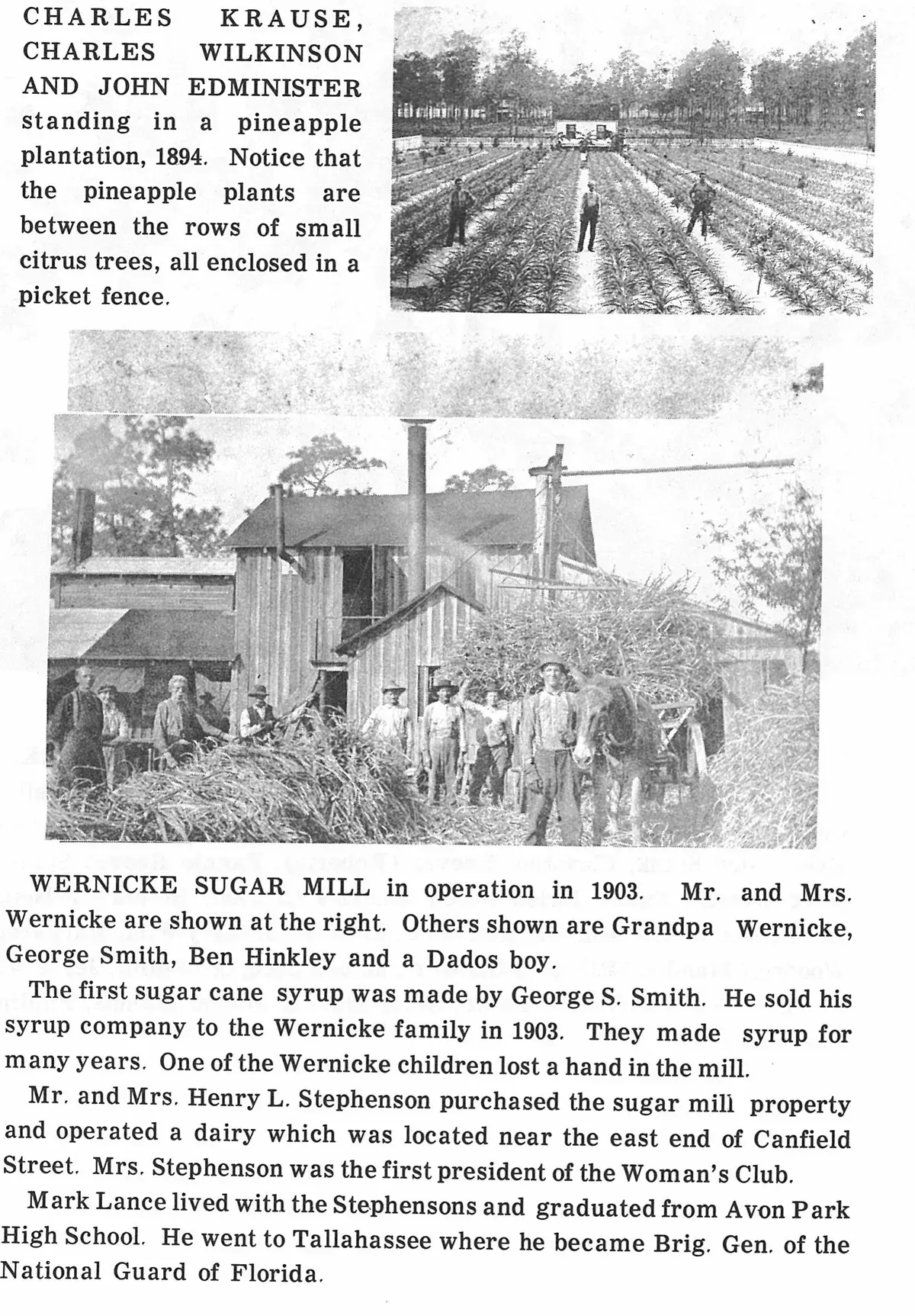
CHARLES KRAUSE, CHARLES WILKINSON AND JOHN EDMINISTER standing in a pineapple plantation, 1894. Notice that the pineapple plants are between the rows of small citrus trees, all enclosed in a picket fence. The First Hundred Years of Avon Park, Florida (1976), page 140. Avon Park Historical Society.[maxwell-1976]
Post-Freeze Agricultural Resilience
While popular accounts of Avon Park’s settlement frequently treat the Great Freeze of 1894–1895 as an immediate and total economic end, contemporary agricultural reporting demonstrates substantial diversification. Orange and lemon groves suffered near-total destruction of their canopies and bearing wood, but the township’s estimated 500,000 pineapple plants sustained comparatively moderate losses of 10 to 40 percent.
Because pineapples could produce a marketable crop eighteen months after planting, growers expanded their fields through 1896 and 1897 to generate cash flow while citrus groves slowly recovered. Calculated at prevailing field densities of 5,000 to 10,000 plants per acre (whether planted in dedicated beds or intercropped in young citrus rows), 500,000 plants represented between 50 and 100 acres under cultivation across Township 33 South, Range 28 East.
The 1897 Growers and Plantations
The September 1897 survey detailed the specific varietal trials and cultural methods of six leading growers:
- Charles Wilkinson: Operated what was recognized across the region as the “model acre in pines,” producing specimen fruits weighing four to seven pounds. Wilkinson evaluated varieties by dessert quality (ranking Abaka first, followed by Enville City, Blood, Strawberry, Queen, and Red Spanish) and size (Porto Rico leading). He was among the few growers constructing slatted sheds to protect tender Blood and Strawberry varieties.
- George Edmiston (or John Edminster): Pioneer vineyardist and fruit grower who operated the district’s premier Niagara grape vineyard alongside a commercial pinnery, placing Smooth Cayenne at the head of the list for combined size and market quality.
- E. L. Hall: Pioneer grower who tested Black Jamaica (praising its sweetness but noting market resistance to its conical shape) while cultivating Smooth Cayenne and Abaka for commercial shipments. Hall subsequently established the town’s principal jewelry business on Main Street.
- John T. Hendricks: Abstractor, notary public, and real estate dealer who maintained a one-acre model garden on East Pleasant Street shipping Cayennes, Abakas, and Red Spanish.
- A. E. Bennett: Local livery stable operator who managed the Condon place, harvesting twelve-pound pineapples cultivated with specialized organic bone and potash fertilizers.
- J. Bell: Pioneer resident near Lake Tulane who was setting several thousand new slips in late 1897 across six varieties (Abaka, Queen, Blood, Strawberry, Porto Rico, and Red Spanish).
By December 1897, four commercial plantations were operating by name in the township: the Indiana Pinery on Lake Carter (established by Miss Law of Indiana), the Bamboo Pinery, the Holley Hill Pinery, and the Oak Hill Pinery.[fa-1897-12-01]
Transportation Obstacles and Eventual Decline
The vast majority of Avon Park’s pineapples were grown in the open field without slat shading, relying on the thermal buffering of adjacent lakes. The industry faced severe logistical bottlenecks: fruit had to be hauled twenty miles over heavy sand roads by wagon to Fort Meade or Bowling Green, or shipped over the intermittent wooden tramway to Pabor Lake.
The arrival of Henry Flagler’s Florida East Coast Railway through the Indian River and St. Lucie pineapple districts (such as Jensen and Fort Pierce) gave coastal growers express refrigerated transit to northern cities at lower freight rates. Following additional winter cold events (including the freeze of February 1899) and the gradual canopy closure of maturing reconstituted citrus groves, Avon Park growers shifted their acreage back to citrus and hardy winter truck crops. By the publication of the 1907 and 1911 state business directories, commercial pineapple growing had ceased to be listed among the town’s active trades.
References
- fa-1897-09-08 — A. L. R., The Florida Agriculturist (DeLand, Fla.). The Florida Agriculturist, 8 September 1897, page 1: Among the Pineapple Growers. 8 September 1897. florida-agriculturist.md
- fa-1897-12-01 — The Florida Agriculturist (DeLand, Fla.). The Florida Agriculturist, 1 December 1897, page 13: the Indiana Pinery on Lake Carter, from the Avon Park correspondent of the Bartow Courier-Informant. 1 December 1897. florida-agriculturist.md
- maxwell-1976 — Leoma Bradshaw Maxwell. The First Hundred Years of Avon Park, Florida. 1976. the-first-hundred-years-of-avon-park_leoma-bradshaw-maxwell_1976.md
Related
- Finding: William King planted Avon Park’s first pineapples in August 1887
- Finding: The Avon Park Township Horticultural Association and the ridge pineapple industry
- CHARLES KRAUSE, CHARLES WILKINSON AND JOHN EDMINISTER standing in a pineapple plantation, 1894
- Report: Avon Park in The Florida Agriculturist, 1890-1910
- Report: citrus, crates and cattle
- Report: the founding of Avon Park and its first decade
- Avon Park Transportation Company
Where this comes from
- Evidence
- corroborated — More than one independent source agrees.
- Review
- unverified — Drafted from sources but not yet checked by a volunteer.
- Rights
- society
Sources
- A. L. R., The Florida Agriculturist (DeLand, Fla.), The Florida Agriculturist, 8 September 1897, page 1: Among the Pineapple Growers (1897)
- The Florida Agriculturist (DeLand, Fla.), The Florida Agriculturist, 1 December 1897, page 13: the Indiana Pinery on Lake Carter, from the Avon Park correspondent of the Bartow Courier-Informant (1897)
- Leoma Bradshaw Maxwell, The First Hundred Years of Avon Park, Florida (Held at the Avon Park Historical Society Depot Museum, Avon Park, Florida) (1976) · book
Something here wrong, or incomplete? The Society would rather know. Tell a volunteer.
Have a question about this record?