
Education and Schools in Avon Park (1886–1980)
According to Leoma Bradshaw Maxwell’s detailed historical account in The First Hundred Years of Avon Park, Florida [maxwell-1976], public and private education in Avon Park progressed from informal classes in frontier log cabins to a comprehensive regional school system and collegiate campus.
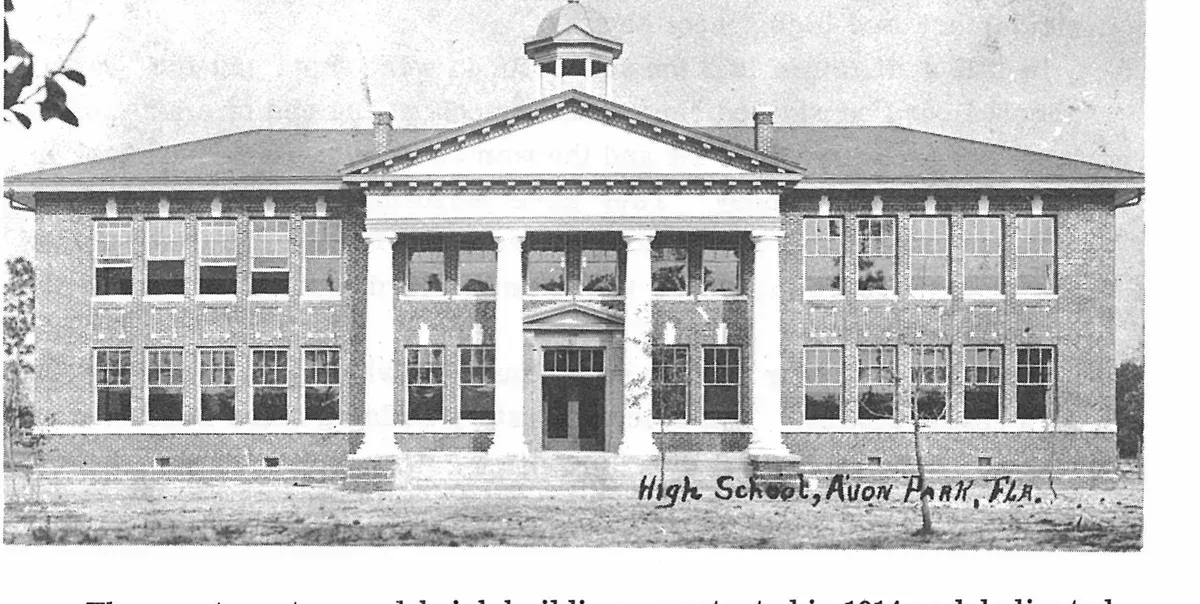
The two-story red brick High School building on South Lake Avenue, dedicated on April 15, 1915.[maxwell-1976]
Pioneer Schools and the 1895 Arson
Avon Park’s first educational classes were taught in 1886 by pioneer settler A. B. Dewey in a log cabin on Lake Tulane, followed by Walter Byrd [maxwell-1976]. In late 1888, the community erected the first dedicated schoolhouse on West Bell Street—a one-room frame structure painted blue, which also served as the venue for Sunday school and town meetings [maxwell-1976].
In 1893, growing enrollment prompted construction of a new two-story frame schoolhouse on South Forest Avenue and West Walnut Street under Rev. and Mrs. Francis D. Rood [maxwell-1976]. On December 4, 1895, the building was deliberately burned to the ground by an individual in a drunken grievance against town leadership [maxwell-1976]. Classes resumed in January 1896 in Sargent’s Hall on North Lake Avenue until a new frame school was completed in October 1897 under Professor E. L. Richardson of Dartmouth College [maxwell-1976].
The Brick High School and Expansion
In 1914, construction began on a substantial two-story red brick High School facing South Lake Avenue, dedicated on April 15, 1915 [maxwell-1976]. Professor I. C. M. Ellenberger became principal in 1919, leading the school into accreditation with the Southern Association of Secondary Schools as enrollment surpassed 200 [maxwell-1976].
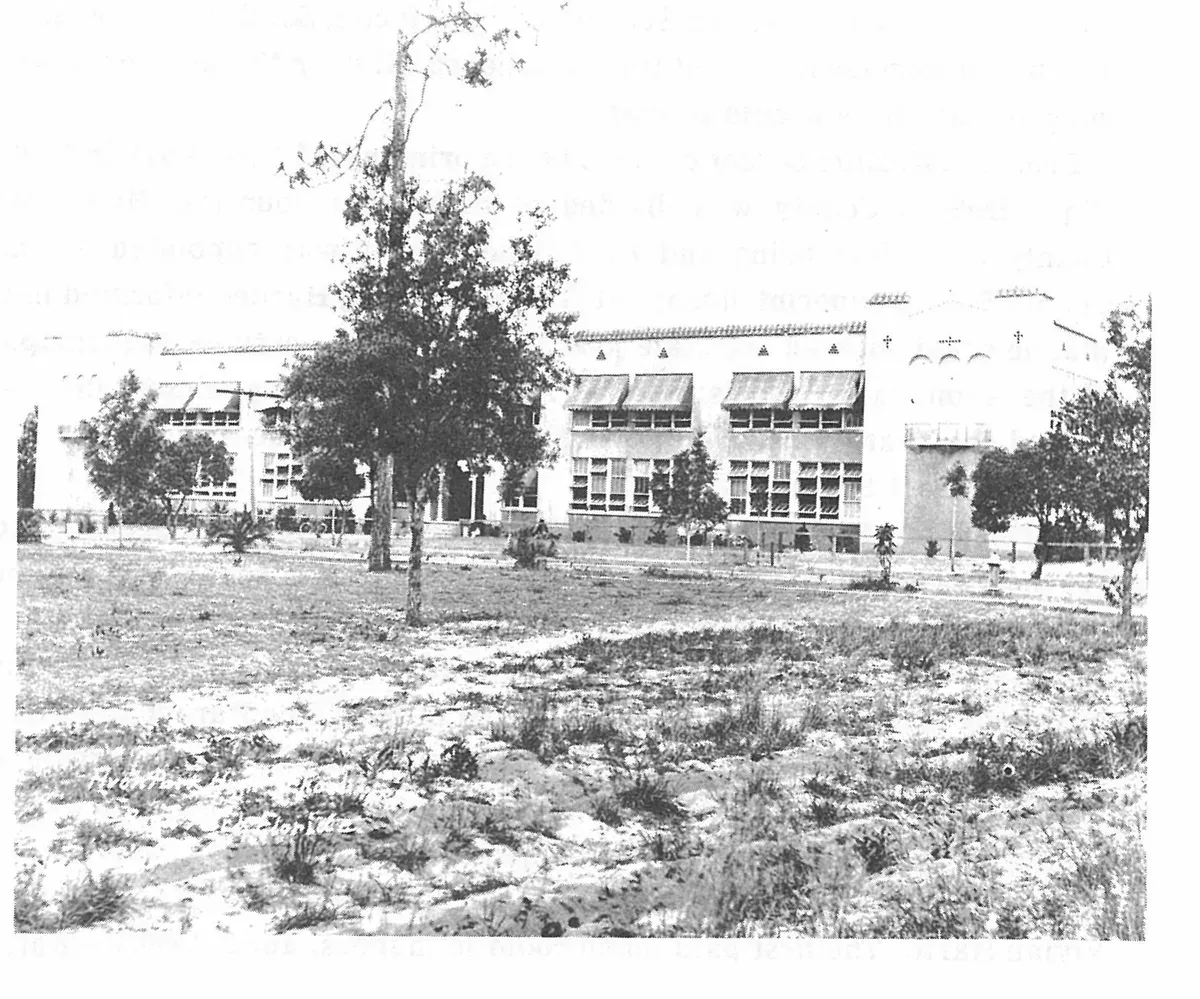
The 1925 Mediterranean-style High School building facing South Verona Avenue.[maxwell-1976]
In 1925, the city completed a $150,000 Mediterranean-style high school facing South Verona Avenue, featuring a large auditorium and balcony that served as the primary community civic hall for over fifty years [maxwell-1976].
- The Red Devils: In the early 1920s, athletic teams adopted the moniker “Red Devils.” Amateur sculptor Paul S. (Mickie) Heath created a life-sized concrete statue of a devil holding a pitchfork, which was anchored onto the roof of the high school [maxwell-1976].
- Yearbooks: The graduating class of 1925–1926 published the school’s first annual, The Galleon, which was subsequently titled The Pitchfork [maxwell-1976].
- Community Support: When county school funds fell short during the 1922 and 1932 depressions, the PTA and local women staged performances, bake sales, and door-to-door fund drives to keep schools operating for the full academic term [maxwell-1976].
Hopewell School and E. O. Douglas
The earliest formal schooling for Black children in the area was conducted around 1910 at Hagan’s Turpentine Still south of town, followed by private instruction in the home of Mrs. Wilson on Pineland Avenue and classes at St. Mark’s Church [maxwell-1976].
The County School Board subsequently established the Hopewell School in the Crate Mill section [maxwell-1976]. Professor Earnest E. Sims, who graduated from Florida Memorial College and Columbia University, served 35 years as principal of Hopewell and assistant principal of the integrated middle school, holding the longest teaching tenure among Black educators in Highlands County [maxwell-1976]. Desegregation was accomplished smoothly starting on a voluntary basis in 1966.
Higher Education: South Florida Community College
In 1965, the Florida Legislature established the South Florida Junior College to serve Highlands, Hardee, and DeSoto Counties [maxwell-1976]. Classes began in 1966 on the second floor of the historic Brickel Building on Main Street under founding President Dr. William A. Stallard. In 1970, the college moved to its permanent campus overlooking Lake Glenada on Highway 27, later evolving into South Florida Community College (SFCC) [maxwell-1976].
References
- maxwell-1976 — Leoma Bradshaw Maxwell. The First Hundred Years of Avon Park, Florida. 1976. the-first-hundred-years-of-avon-park_leoma-bradshaw-maxwell_1976.md
Related
Where this comes from
- Evidence
- single-source — One source. Treat as reported, not established.
- Review
- unverified — Drafted from sources but not yet checked by a volunteer.
- Rights
- society
Sources
- Leoma Bradshaw Maxwell, The First Hundred Years of Avon Park, Florida (Held at the Avon Park Historical Society Depot Museum, Avon Park, Florida) (1976) · book
Something here wrong, or incomplete? The Society would rather know. Tell a volunteer.
Have a question about this record?