
Fire and storm at Avon Park
Summary
Avon Park was built of the pine it stood in, and for its first forty years it had almost nothing to fight a fire with. The school house burned in December 1895, the town’s “first fire of any consequence.” In November 1920 the fire-insurance surveyors found a volunteer company with “no organization,” one hand-drawn chemical cart kept under the bandstand on Main Street, and water mains that gave “no fire service.” The town bought a motor fire truck in 1923, a siren in 1924, and built a fire station in 1928, and in between, on the night of 2 February 1927, it lost the Verona, Oliver Crosby’s hotel of 1887 and the first tourist hotel in the interior of south Florida, which burned to the ground in two hours with thirty-six guests fleeing in their nightclothes.
The great hurricanes of the 1920s spared the town the worst. In September 1926 Avon Park was where the first train out of West Palm Beach brought the refugees, and it sent one of the relief trains to Moore Haven. In September 1928 the storm’s center passed close by, its pressure lowest over land nine miles west of the town; the lake-country families fled to Avon Park, the wind threw down trees and lifted a bungalow off its foundations, and the grapefruit crop lost half its fruit. Hurricane Donna in September 1960 brought gusts the Weather Bureau put at 100 to 125 miles an hour and six and a half inches of rain. What the town lost after that it mostly pulled down itself: the Masonic Temple of 1893 in 1961, the Coast Line station, the Highlands Lakes Casino, the old Pinecrest Hotel in 2007 and the Wild Building in 2021.
A wooden town without a fire engine
The first fire the town recorded was deliberate. On the night of 4 December 1895 the two-story school house of 1893 burned with everything in it: new desks, and the organ, hymnals and prayer books of the Episcopalians, who had held services there through the summer. It had been deeded to the county school board and was not insured. The Bartow paper called it “the first fire of any consequence in Avon Park” and reported the trustees arranging a $1,200 bond issue to rebuild at once.[fa-1895-12-18] The Society’s 1976 history names the arsonist, one Squire Budd, “a vicious mean man” in drink, who bore a grudge against William King and Oliver Crosby and left town “just in time to avoid being lynched.”[maxwell-1976] The fire fell in the winter of the great freeze, and the same history records that the houses the ruined settlers walked away from were “eventually ravaged by wild fires.”[maxwell-1976] The full story of the school house is in The Avon Park school house burned in 1895.
A quarter of a century later the town was hardly better armed. The Sanborn Map Company’s surveyors, who drew every building in Avon Park for the insurance underwriters in November 1920, wrote across the head of their index sheet: “Fire Dept: Volunteer. No organization. One Deluge 2-35 gal. tank cart with 200’ r hose. Alarm, whistle. No fire limits enforced.” The water was worse: “Domestic service only from Florida Ice & Power Co. 2” & 3” mains supplied from 50,000 gal. W.T. elevd 100’. No fire service.” The cart is drawn on the Main Street sheet, “under band stand,” and at the crate mills south of town the Mutual Crate Company, with a night watchman making hourly rounds, had “no fire hose,” burned its own mill refuse for fuel, and was only “to have” a water supply, with a ten-thousand-gallon tank “to be built here.”[sanborn-1920] The wooden buildings on the north side of Main Street were themselves counted a fire hazard, and their removal was one of the arguments for widening the street into the Mall.[nrhp-90000486]
The years that followed changed that. The council bought a fire truck on 6 August 1923 for $12,400, the first siren on 2 June 1924 for $480.50, elected W. H. McCarthy fire chief on 7 January 1928 and completed a fire station on 5 December 1928, the building that later became the police station.[maxwell-1976][nrhp-90000486] That story is told in The Avon Park Fire Department.
The night the Avon Park Hotel burned
Evidence: corroborated.
The Verona Hotel, built for Crosby between 1887 and 1889 to lodge the land buyers he brought up by wagon from Fort Meade, had been remodeled three times and renamed the Avon Hotel by the 1920s, and was trading as the Avon Park Hotel under a proprietor named R. C. Holmes when, at about 2.30 on the morning of Wednesday, 2 February 1927, a fire started in its boiler room. The Associated Press dispatch sent from the town that morning told the rest: the three-story frame building was “enveloped” by the time “fire-fighters arrived from Sebring, Frostproof and Wauchula to aid the local department”; thirty-six guests “escaped in scanty clothing hastily thrown on as they fled from the fierce flames”; Holmes put the loss at $100,000; and the hotel, “the first of the large tourist hotels to be built in interior South Florida,” had been “remodeled and redecorated at a cost of about $50,000 last spring.”[keowee-1927-02-09] The short form of the dispatch was on the front page of the Washington Evening Star that afternoon.[star-1927-02-02] Neither account reports a death or an injury. The city council’s minute of the same day reads “Avon Park Hotel burned,” and the salvaged timbers went into other buildings, among them the West Beach Hotel on Lake Lotela.[maxwell-1976]
The Society’s website gives the year as 1926, and that date is wrong; the case is set out in The Avon Park Hotel burned on 2 February 1927, and the hotel’s whole life in The Verona Hotel.
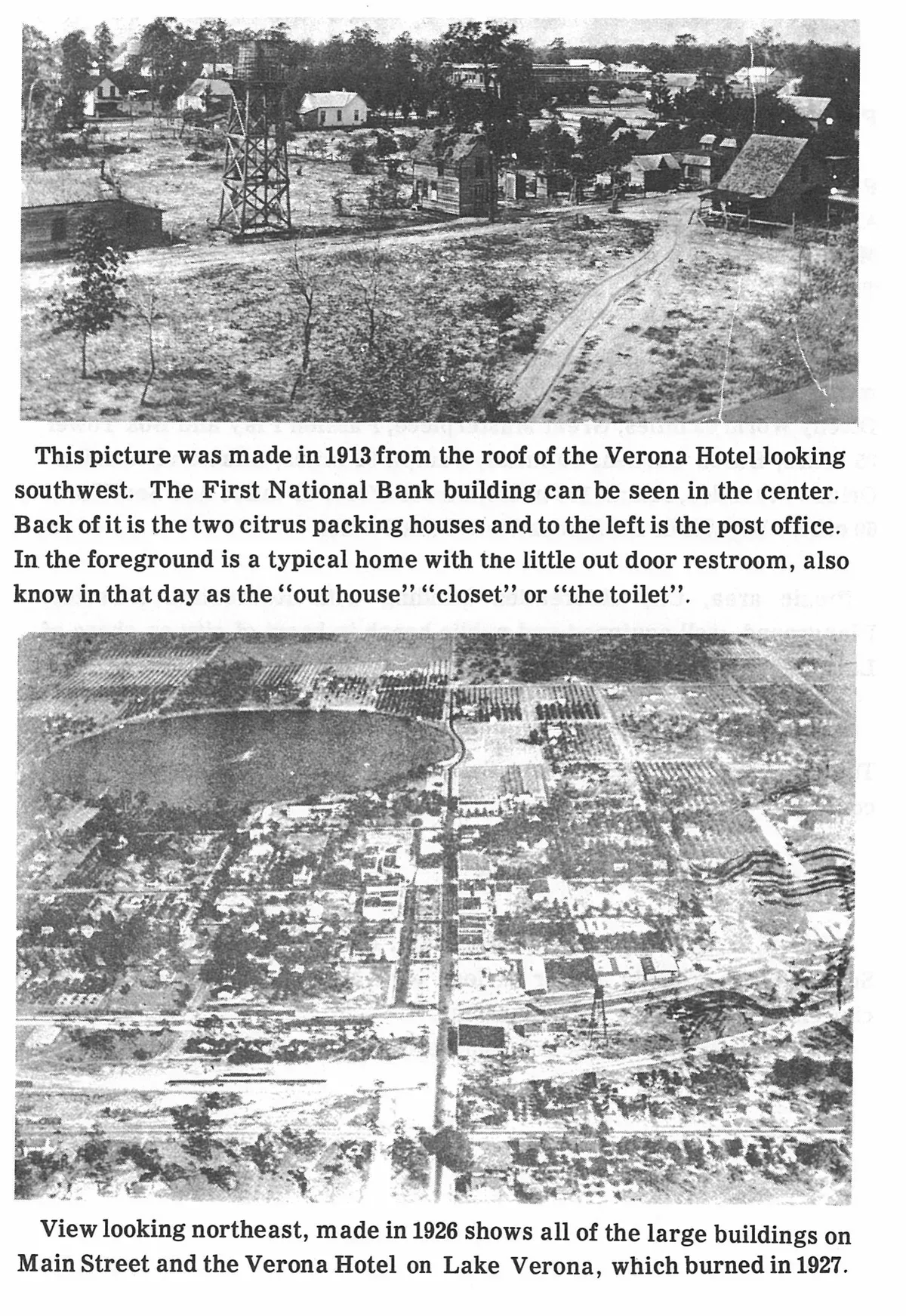
The town in 1926, looking north-east over the large buildings on Main Street to the Verona Hotel on Lake Verona, a year before it burned. The First Hundred Years of Avon Park, Florida (1976), page 217. Avon Park Historical Society.[maxwell-1976]
The fire came three weeks before the St. Louis Cardinals, world champions of 1926, arrived for the first of their three springs at Head Field, and the loss of the town’s largest hotel did not stop them: the Evening Star’s roster of 23 February still listed “Avon Park, Fla., training camp.”[star-1927-02-23] It did give the club’s owner an argument two years later. When Sam Breadon took the Cardinals to Bradenton for 1930, he blamed “inadequate hotel facilities (not helped by the Avon Park Hotel burning down in 1927)” and the state of the field; Mayor C. S. Donaldson answered in October 1929 that the town had “five excellent hotels, three of which attract a wealthy tourist trade.”[byrne-cardinals] That exchange is known only from a modern account; the move itself was in the Washington papers by November 1929, which noted that “the St. Louis Nationals have returned to Bradenton” and that “Boston might be welcome at Avon Park, where the Cardinals trained last Spring.”[star-1929-11-12]
The storms
Avon Park has kept a weather record since April 1892, when the cooperative observer’s station that the National Weather Service still lists as “Avon Park 2 W” began its readings.[ncei-homr-avon-park] The Weather Bureau’s monthly reviews were written from the big coastal stations, and they rarely name the town, but the station’s figures and the newspapers between them give the shape of four storms.
October 1894
The first hurricane the settlement is known to have felt came in the first days of October 1894. This system, known as the 1894 Florida Panhandle hurricane (Hurricane Five), was first observed over the Caribbean on October 1 and moved through the Gulf of Mexico, making landfall near Panama City on October 9. In the interior of south Florida, Crosby’s newspaper described a West Indies storm with 45-mile winds that swelled the streams and washed out the bridges on the Fort Meade road (see The Avon Park Idea on the bank opening). (This 1894 event is sometimes confused in local tradition with a mid-twentieth-century storm, owing to a 1944 account by a Mrs. Keeling in The Bartlett Tribune and News of a “recent hurricane” that knocked down power lines and grapefruit; that account belongs to 1944, not 1894.) The Weather Bureau’s review for that month tracks a hurricane that “went rapidly northeastward over Florida and Georgia” on the 8th and 9th, with an 80-mile wind at Lake City and, at Jacksonville, “the highest velocity ever registered at this office.” Its table of cooperating observers carries Avon Park’s own line for the month: a maximum of 91 degrees, a minimum of 52, a mean of 74.8, and 4.15 inches of rain.[mwr-1894-10]
September 1926
Evidence: corroborated.
The hurricane that struck Miami on the morning of 18 September 1926 and drowned Moore Haven on Lake Okeechobee passed well to the south and east of Avon Park. The town’s part was to receive and to send. “Storm passengers who reached Avon Park late today from West Palm Beach on the first train to emerge from the hurricane district,” the Associated Press reported on the 19th, “described the storm as the worst in the history of the Palm Beaches.”[star-1926-09-19] The next day “trains from Lakeland, Avon Park, Tampa, Sanford and Sebring put out for the Lake Okeechobee region, where a death toll of more than a hundred had been reported at Moore Haven.”[star-1926-09-20] The Highlands County relief train was organized within hours by the municipal governments of Avon Park and Sebring, local volunteer fire departments, the American Legion posts and the Red Cross, directed in the field by Sebring Fire Chief Allen Altvater and carrying morticians Jack Stephenson and J. Ross Blythe; it brought medical aid, doctors, food, and rescue boats into the inundated town, evacuated refugees north, and brought twenty-six deceased storm victims to Sebring for mass burial in Pinecrest Cemetery (see The 1926 Hurricane Relief Train to Moore Haven). No report of damage in the town has been found, and five weeks later the local committee under Charles H. Moffett was completing its arrangements to bring the Cardinals to Avon Park in the spring, with no word of any storm.[gaceta-1926-10-26] The one building known to have gone down was the old two-story school house near Walnut Street and Forest Avenue, in use by the Church of Christ, which “was blown off its foundation”; the congregation bought the lot from the city and built its church from the salvaged lumber.[maxwell-1976] The station recorded 11.77 inches of rain that September, in a year that totalled nearly 65 inches.[fsu-avon-park-precip]
September 1928
Evidence: corroborated.
The storm of 16-17 September 1928 came much closer. The Weather Bureau’s report has its center “passing over Lake Okeechobee during the early night of the 16th and near and slightly east of Bartow about 7:00 a.m. of the 17th,” with gusts “estimated or measured at 100 m.p.h., or slightly higher just to the east of the storm track as far north as Polk County.”[mwr-1928-09] A later National Weather Service study of the same records places the storm’s lowest pressure over land “about 9 n.mi. west of Avon Park, Fla.,” at 935.3 millibars.[noaa-nws-15-1975] As it approached, “many inhabitants of the lake towns fled for safety to Lakeland, Avon Park and other places in central Florida,” and the central Florida towns reported that “damage, if any, was minor in most of them.”[star-1928-09-17]
Minor was relative. A fertilizer company’s survey of the groves a few days later put Avon Park’s losses at “oranges 15 to 20 percent, grapefruit 50 to 60 percent,” the same as Sebring’s.[brooksville-1928-09-20] And a newsreel photographer found, on one Avon Park street, a great tree uprooted “in a flash” and lying across a screened bungalow, “half of” which “was lifted from its foundations by leverage exerted by the tree. Occupants of the house escaped with serious shaking up and a few bruises.”[southbend-1928-09-26] The station’s rain for the month was 10.64 inches.[fsu-avon-park-precip]
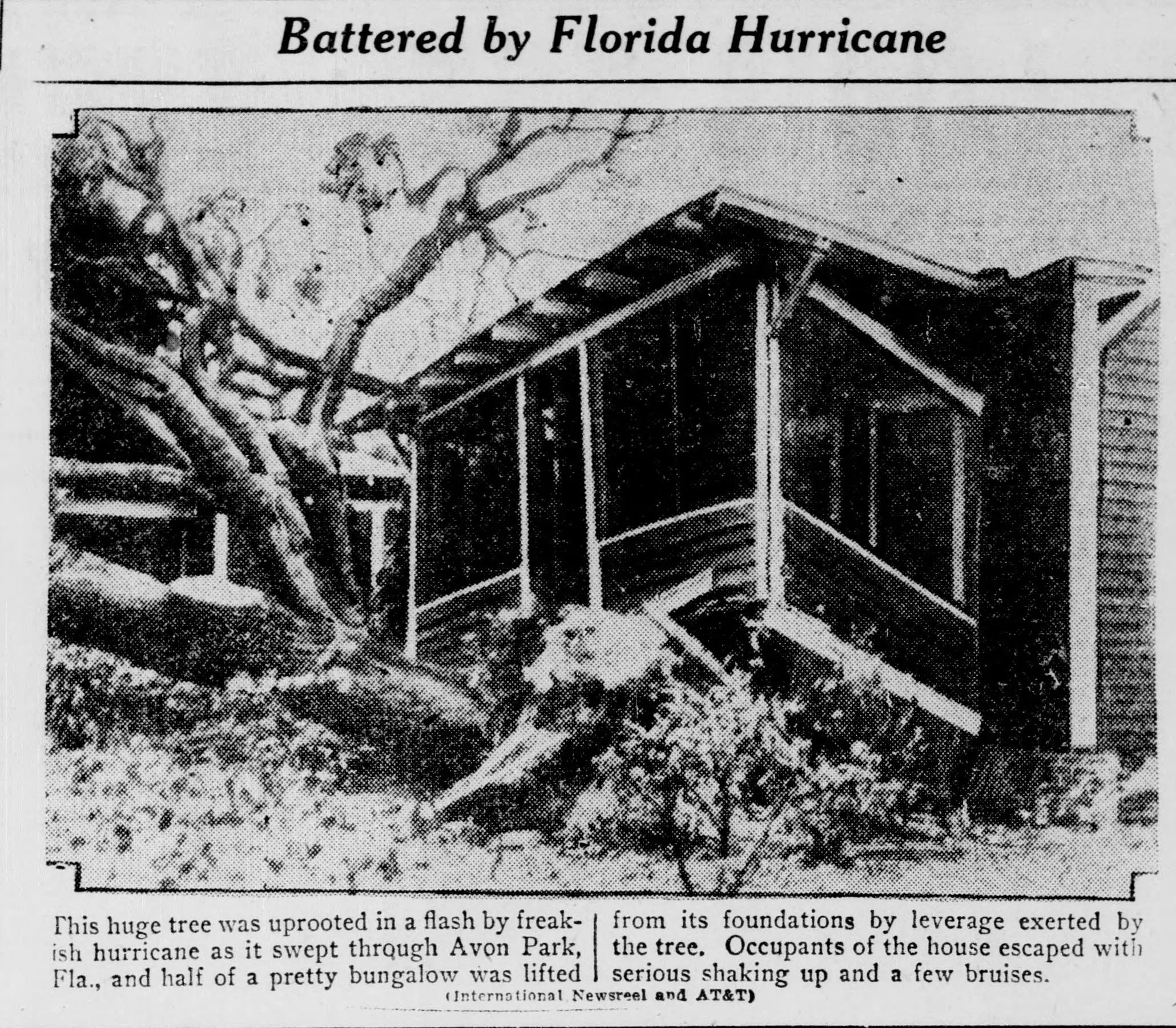
“Battered by Florida Hurricane”: a tree uprooted at Avon Park and the bungalow it lifted off its foundations, September 1928. South Bend News-Times, 26 September 1928, page 15, via Library of Congress, Chronicling America. International Newsreel photograph. Public domain.[southbend-1928-09-26]
Hurricane Donna, September 1960
Donna crossed the Florida Keys on 10 September 1960, passed over Fort Myers that afternoon, and sped north-east “across the main citrus growing areas of the State.” The Weather Bureau’s station table for the storm gives Avon Park’s entry in five words and three figures: gusts of 100 to 125 miles an hour at nine that evening, 6.50 inches of rain, and “Citrus damage. 2 heart attacks on 11th.”[cd-national-summary-1960] At Camp Wingmann on Trout Lake the storm took half the roof off the new director’s house and blew the side walls and windows out of the recreation hall, though its steel frame held.[wingmann-history] Two weeks later Avon Park recorded the highest temperature in Florida for the month, 97 degrees on the 26th.[cd-national-summary-1960]
Later fires
The 1976 history records the fires the newspapers this project can read do not. A furniture store kept by Grover and H. Langford on the ground floor of the Brickell Building on Main Street burned, and Ott and Son moved their department store into the space. One of the two Maxcy packing houses on the Coast Line track burned “and the other destroyed.” And in 1976 the building on Forest Avenue that the postmaster Robert M. Young used as a warehouse “was completely destroyed by fire.”[maxwell-1976] None of the three is dated more closely, and none has been found in a contemporary source.
What the town pulled down
More of old Avon Park went by demolition than by fire or wind, and most of it went after 1960.
- The Masonic Temple, 1961. Built by Perry Haines in 1893 as the Avonian Block, “the Annex” to the Verona with twenty rooms on its third floor for the hotel’s overflow, and home on its ground floor to the Florida Development Company, the Bank of Avon Park and Dr. Lander’s drug store, it was the town’s last building of Crosby’s decade. It was demolished in 1961 for a parking lot and the National Guard Armory.[maxwell-1976]
- The Durrance Block, 1960, razed for the Avon Citrus Bank, its drive-up windows and its parking lot; the bank also bought and razed the Poinsettia Hotel for a staff parking lot, and the old Maxcy packing house north of it to Pleasant Street.[maxwell-1976]
- The Atlantic Coast Line station. The 1976 history says it “was torn down in 1970”;[maxwell-1976] the National Register nomination says it was razed “in the early 1980s.”[nrhp-90000486] The two cannot both be right about the same building, and no third source has been found.
- The Palmer Rooming House on West Main Street, “a landmark of earlier days,” torn down for the Palmer Electric Company; the Highlands Lakes Casino of the 1920s on Lake Lillian, thirty years a Seventh-day Adventist church, demolished in 1979; and the old Middle School buildings, razed as soon as the pupils moved out on 12 November 1979, “with a loud protest from many Avon Park citizens.”[maxwell-1976]
- The old Pinecrest Hotel, 2007. William Heim’s hotel of 1926 on Lake Lotela, finished in 1936 and listed on the National Register in 2000, was gone by March 2007, when “the only visible remains on the site” were palm trees.[wiki-old-pinecrest] The golf club that shared its grounds says “time and termites got the best of the grand old hotel and it was razed in 2007.”[golfpinecrest-history] See The Pinecrest Hotel.
- The Wild Building, 2021. The two-story concrete-block building at 101 West Main Street, at the corner of South Forest Avenue, was put up in 1921 by Max Wild, a Swiss who came to Avon Park in 1895,[newssun-wild-2020] and was demolished in February 2021.[newssun-wild-2021]
Related
- The Avon Park Fire Department
- Construction and Dating of the Delaney Avenue Fire Station
- The Avon Park Hotel burned on 2 February 1927
- The Verona Hotel
- The Avon Park school house burned in 1895
- Head Field
- The churches of Avon Park
- Camp Wingmann
- The Pinecrest Hotel
- Sanborn Fire Insurance Map, Avon Park, November 1920
- The great freezes and recovery
References
- fa-1895-12-18 — The Florida Agriculturist (DeLand, Fla.), reprinting the Bartow Courier-Informant. The Florida Agriculturist, 18 December 1895, page 15: state news paragraphs. 18 December 1895. https://www.loc.gov/resource/sn96027724/1895-12-18/ed-1/?sp=15
- maxwell-1976 — Leoma Bradshaw Maxwell. The First Hundred Years of Avon Park, Florida. 1976. the-first-hundred-years-of-avon-park_leoma-bradshaw-maxwell_1976.md
- sanborn-1920 — Sanborn Map Company, via the Library of Congress. Sanborn Fire Insurance Map, Avon Park, DeSoto County, Florida, November 1920 (4 sheets). 1 November 1920. sanborn-1920-avon-park.md
- nrhp-90000486 — National Park Service. National Register of Historic Places Registration Form: Avon Park Historic District. 22 March 1990. nrhp-avon-park-historic-district-1990.md
- star-1927-02-02 — Associated Press, in the Evening Star. Florida Hotel Burns, Evening Star (Washington, D.C.), 2 February 1927, page 1. 2 February 1927. https://www.loc.gov/resource/sn83045462/1927-02-02/ed-1/?sp=1
- keowee-1927-02-09 — Associated Press, in the Keowee Courier. Fire Demolishes Hotel at Avon Park, Fla., Keowee Courier (Pickens Court House, S.C.), 9 February 1927, page 7. 9 February 1927. https://www.loc.gov/resource/sn84026912/1927-02-09/ed-1/?sp=7
- star-1927-02-23 — Evening Star. Major league training camps and rosters, Evening Star (Washington, D.C.), 23 February 1927, page 32. 23 February 1927. https://www.loc.gov/resource/sn83045462/1927-02-23/ed-1/?sp=32
- byrne-cardinals — Jason Byrne, Florida History Blog, 27 April 2023. Cardinals Played in Avon Park from 1927-1929. 27 April 2023. https://floridahistoryblog.com/cardinals-played-in-avon-park-from-1927-1929/
- star-1929-11-12 — Evening Star. Sports column on spring training sites, Evening Star (Washington, D.C.), 12 November 1929, page 35. 12 November 1929. https://www.loc.gov/resource/sn83045462/1929-11-12/ed-1/?sp=35
- mwr-1894-10 — United States Weather Bureau. Monthly Weather Review, volume 22, number 10, October 1894: the storm of 8-9 October, and Table II, meteorological record of voluntary and other co-operating observers. 31 October 1894. https://archive.org/details/sim_monthly-weather-review_1894-10_22_10
- ncei-homr-avon-park — National Centers for Environmental Information, National Oceanic and Atmospheric Administration. Historical Observing Metadata Repository: station Avon Park 2 W, Florida, cooperative station 080369. 2 September 2026. https://www.ncei.noaa.gov/access/homr/services/station/search?state=FL&name=AVON+PARK
- star-1926-09-19 — Associated Press, in the Evening Star. Hurricane reports, Evening Star (Washington, D.C.), 19 September 1926, page 1. 19 September 1926. https://www.loc.gov/resource/sn83045462/1926-09-19/ed-1/?sp=1
- star-1926-09-20 — Associated Press, in the Evening Star. Trains Carry Aid to Stricken Area, Evening Star (Washington, D.C.), 20 September 1926, page 5. 20 September 1926. https://www.loc.gov/resource/sn83045462/1926-09-20/ed-1/?sp=5
- gaceta-1926-10-26 — La Gaceta. Los Cardenales practicarán en Avon Park, La Gaceta (Tampa, Fla.), 26 October 1926, page 3. 26 October 1926. https://www.loc.gov/resource/sn86002403/1926-10-26/ed-1/?sp=3
- fsu-avon-park-precip — Florida Climate Center, Florida State University. Avon Park monthly precipitation, from the cooperative observer record. 2 September 2026. https://climatecenter.fsu.edu/products-services/data/precipitation/avon-park
- star-1928-09-17 — Associated Press, in the Evening Star. Hurricane reports, Evening Star (Washington, D.C.), 17 September 1928, page 2. 17 September 1928. https://www.loc.gov/resource/sn83045462/1928-09-17/ed-1/?sp=2
- mwr-1928-09 — United States Weather Bureau. Charles L. Mitchell, The West Indian Hurricane of September 10-20, 1928, Monthly Weather Review, volume 56, number 9, September 1928, pages 347-350. 30 September 1928. https://archive.org/details/sim_monthly-weather-review_1928-09_56_9
- noaa-nws-15-1975 — Francis P. Ho, Richard W. Schwerdt and Hugo V. Goodyear, National Weather Service. Some Climatological Characteristics of Hurricanes and Tropical Storms, Gulf and East Coasts of the United States, NOAA Technical Report NWS 15, May 1975, Table 1. 1 May 1975. https://www.govinfo.gov/content/pkg/CZIC-qc851-u65-no-15/html/CZIC-qc851-u65-no-15.htm
- brooksville-1928-09-20 — The Brooksville Journal. Citrus damage survey, The Brooksville Journal (Brooksville, Fla.), 20 September 1928, page 4. 20 September 1928. https://www.loc.gov/resource/sn95047246/1928-09-20/ed-1/?sp=4
- southbend-1928-09-26 — International Newsreel, in the South Bend News-Times. Battered by Florida Hurricane, South Bend News-Times (South Bend, Ind.), 26 September 1928, page 15. 26 September 1928. https://www.loc.gov/resource/sn87055779/1928-09-26/ed-1/?sp=15
- cd-national-summary-1960 — United States Weather Bureau. Climatological Data, National Summary, volume 11, 1960: Tropical Cyclone Data, Hurricane Donna, August 29-September 13, 1960, page 383; Condensed Climatological Summary, September 1960, page 364. 31 December 1960. https://archive.org/details/climatologicalda11unit
- wingmann-history — Camp Wingmann, Inc. Our History, Camp Wingmann, Avon Park, Florida. 31 August 2026. https://www.campwingmann.org/our-history
- golfpinecrest-history — Pinecrest Golf Club. The Legend of Pinecrest Golf Club. 2 September 2026. https://www.golfpinecrest.com/golf-course/course-history
- wiki-old-pinecrest — Wikipedia. Old Pinecrest Hotel. 2 September 2026. https://en.wikipedia.org/wiki/Old_Pinecrest_Hotel
- newssun-wild-2020 — Elaine Levey, Avon Park Depot Museum, in the Highlands News-Sun, September 2020. Wylde versus Wild, or Wild-Whidden Building. 24 September 2020. https://www.midfloridanewspapers.com/highlands_news-sun/wylde-versus-wild-or-wild-whidden-building/article_9b49afea-fe9a-11ea-99f7-07c8a160c4ed.html
- newssun-wild-2021 — Highlands News-Sun, February 2021. Wild Building demolition work underway. 28 February 2021. https://www.midfloridanewspapers.com/highlands_news-sun/news/wild-building-demolition-work-underway/article_b4515e76-7ab3-11eb-8fcc-cb7a46c5386f.html
Where this comes from
- Evidence
- single-source — One source. Treat as reported, not established.
- Review
- unverified — Drafted from sources but not yet checked by a volunteer.
- Rights
- society
Sources
- The Florida Agriculturist (DeLand, Fla.), reprinting the Bartow Courier-Informant, The Florida Agriculturist, 18 December 1895, page 15: state news paragraphs (1895) · newspaper
- Leoma Bradshaw Maxwell, The First Hundred Years of Avon Park, Florida (Held at the Avon Park Historical Society Depot Museum, Avon Park, Florida) (1976) · book
- Sanborn Map Company, via the Library of Congress, Sanborn Fire Insurance Map, Avon Park, DeSoto County, Florida, November 1920 (4 sheets) (1920) · archival
- National Park Service, National Register of Historic Places Registration Form: Avon Park Historic District (1990) · official
- Associated Press, in the Evening Star, Florida Hotel Burns, Evening Star (Washington, D.C.), 2 February 1927, page 1 (1927) · newspaper
- Associated Press, in the Keowee Courier, Fire Demolishes Hotel at Avon Park, Fla., Keowee Courier (Pickens Court House, S.C.), 9 February 1927, page 7 (1927) · newspaper
- Evening Star, Major league training camps and rosters, Evening Star (Washington, D.C.), 23 February 1927, page 32 (1927) · newspaper
- Jason Byrne, Florida History Blog, 27 April 2023, Cardinals Played in Avon Park from 1927-1929 (2023) · secondary
- Evening Star, Sports column on spring training sites, Evening Star (Washington, D.C.), 12 November 1929, page 35 (1929) · newspaper
- United States Weather Bureau, Monthly Weather Review, volume 22, number 10, October 1894: the storm of 8-9 October, and Table II, meteorological record of voluntary and other co-operating observers (1894) · official
- National Centers for Environmental Information, National Oceanic and Atmospheric Administration, Historical Observing Metadata Repository: station Avon Park 2 W, Florida, cooperative station 080369 (2026) · official
- Associated Press, in the Evening Star, Hurricane reports, Evening Star (Washington, D.C.), 19 September 1926, page 1 (1926) · newspaper
- Associated Press, in the Evening Star, Trains Carry Aid to Stricken Area, Evening Star (Washington, D.C.), 20 September 1926, page 5 (1926) · newspaper
- La Gaceta, Los Cardenales practicarán en Avon Park, La Gaceta (Tampa, Fla.), 26 October 1926, page 3 (1926) · newspaper
- Florida Climate Center, Florida State University, Avon Park monthly precipitation, from the cooperative observer record (2026) · secondary
- Associated Press, in the Evening Star, Hurricane reports, Evening Star (Washington, D.C.), 17 September 1928, page 2 (1928) · newspaper
- United States Weather Bureau, Charles L. Mitchell, The West Indian Hurricane of September 10-20, 1928, Monthly Weather Review, volume 56, number 9, September 1928, pages 347-350 (1928) · official
- Francis P. Ho, Richard W. Schwerdt and Hugo V. Goodyear, National Weather Service, Some Climatological Characteristics of Hurricanes and Tropical Storms, Gulf and East Coasts of the United States, NOAA Technical Report NWS 15, May 1975, Table 1 (1975) · official
- The Brooksville Journal, Citrus damage survey, The Brooksville Journal (Brooksville, Fla.), 20 September 1928, page 4 (1928) · newspaper
- International Newsreel, in the South Bend News-Times, Battered by Florida Hurricane, South Bend News-Times (South Bend, Ind.), 26 September 1928, page 15 (1928) · newspaper
- United States Weather Bureau, Climatological Data, National Summary, volume 11, 1960: Tropical Cyclone Data, Hurricane Donna, August 29-September 13, 1960, page 383; Condensed Climatological Summary, September 1960, page 364 (1960) · official
- Camp Wingmann, Inc., Our History, Camp Wingmann, Avon Park, Florida (2026) · secondary
- Pinecrest Golf Club, The Legend of Pinecrest Golf Club (2026) · secondary
- Wikipedia, Old Pinecrest Hotel (2026) · secondary
- Elaine Levey, Avon Park Depot Museum, in the Highlands News-Sun, September 2020, Wylde versus Wild, or Wild-Whidden Building (2020) · newspaper
- Highlands News-Sun, February 2021, Wild Building demolition work underway (2021) · newspaper
Something here wrong, or incomplete? The Society would rather know. Tell a volunteer.
Have a question about this record?