
Hotels and winter visitors of Avon Park
Summary
Avon Park was built to be sold to people from the North, and from the day the Verona opened it had somewhere to put them. The town history’s own summary is that Avon Park “has been a popular winter resort since its first hotel opened in 1889,” that hundreds came each winter to spend several months, and that at first the permanent residents housed them in apartments made over in their own homes.[maxwell-1976] The record that survives outside that book is thin but it is real: an Ohio man who came to Avon Park for his health in 1904 and died there; a Connecticut man who spent the winter of 1905 on his orange grove and wrote home that the climate had cured his dyspepsia; the Arcadia paper’s Avon Park column listing the season’s arrivals at the Hotel Verona from Chicago, Batavia and Rochester in February 1906; a fire-insurance map of 1920 on which three hotels stand; a Washington newspaper of December 1936 carrying, four columns apart, the Hotel Jacaranda’s winter advertisement and the advertisement of a “Sun and Diet Health Resort” whose proprietor had been arrested in Massachusetts three weeks before; a Works Progress Administration project of November 1938 that built the pier, the shelters and the three shuffleboard courts in Donaldson Park; and the Tin Can Tourists’ own convention list, which does not contain the 1939 gathering the town remembers.
This report gathers what is known of the hotels, the camps and the winter people, in the order the town built for them. The Verona, the Jacaranda and the Pinecrest have their own pages and are only summarized here.
The Verona and the first winter guests, 1889-1927
Evidence: corroborated.
The Hotel Verona was Oliver Crosby’s sales office as much as his hotel, and the town history dates the resort trade from its opening in 1889.[maxwell-1976] The earliest winter visitors found in the newspapers came for their health, which is what Florida was sold on. Earl D. Bossier, a twenty-year-old of Perrysburg, Ohio, “died suddenly at Avon Park, Fla., whither he had gone for the benefit of his health,” leaving a wife and a daughter, in December 1904.[pj-1904-12-23] A year later a New Haven paper printed a letter from Harry Leigh, “who is spending the winter on his orange plantation at Avon Park, Fla., near the west coast,” reporting that his health was improving and that “the dyspepsia, with which he was grievously afflicted, has disappeared.”[nhu-1905-12-19]
The Arcadia paper’s Avon Park department, conducted by O. R. Thacher, shows the hotel’s season in full swing under the McCartneys, who had owned the Verona since 1901 and remodeled it in 1906.[maxwell-1976] In the issue of 16 February 1906 it reported “recent arrivals at Hotel Verona” from Batavia and Rochester, New York, a Chicago family of five arrived the previous Friday and Saturday as guests of Mr. and Mrs. W. H. Woodruff, and, for the visitors to send home, “Souvenir Post Cards of Avon Park may be obtained at Sargent’s, the postoffice building.”[dscn-1906-02-16]
The Verona was remodeled a third time in 1919, to D. B. Farnell’s design, and became the Avon Hotel, “the largest commercial hotel on the Ridge”; Henry Lander owned it in 1923, the Golf and Country Club after him, and Mrs. Mary E. Wilcox managed it in 1924.[maxwell-1976] It burned on 2 February 1927; thirty-six guests got out, the loss was estimated at $100,000, and firemen came from Sebring, Frostproof and Wauchula to help the town’s volunteers.[star-1927-02-02] The date is set out in the finding on the fire.
Three hotels in 1920
Evidence: corroborated.
The town had more than one hotel before the boom, and the record of them is a map. The Sanborn Map Company’s fire-insurance survey of November 1920, made for a town of 1,200 people, indexes three: the Hotel Avon on sheet 3, and on sheet 2 a Park Hotel and a Village Inn.[sanborn-1920]
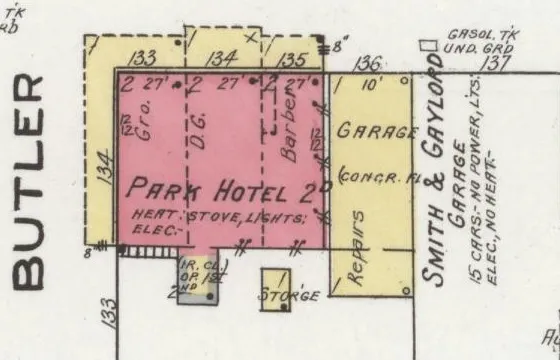
The Park Hotel on the south side of Main Street at Butler Avenue, November 1920. Sanborn Map Company, via Library of Congress, Geography and Map Division. Public domain.[sanborn-1920]
The Park Hotel occupied the upper floor of a two-story brick block on the south side of Main Street at the corner of Butler Avenue, on lots 133 to 135 of block 70, with a grocery, a dry-goods store and a barber’s shop on the ground floor, stove heat and electric light, and the Smith and Gaylord garage next door.[sanborn-1920] The town history describes a hotel of exactly that kind without naming it: the second floor of Walter Whidden’s two-story building on West Main Street, “a hotel with a balcony extending over the sidewalk,” with efficiency apartments and rooms, which Mrs. H. C. Bigbie ran for many years and where a room could be had for three dollars a week in the Depression.[maxwell-1976] The Whidden block was not a building of the Twenties: the county paper’s Avon Park column of 25 February 1915 reported its foundations in and the brick about to be laid by contractors Smith & Pabor.[dsc-1915-02-25] Whether the Park Hotel of the map and the Whidden building’s hotel are the same house is not established.
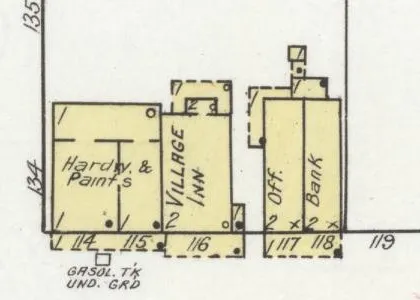
The Village Inn at 116 Main Street, November 1920. Sanborn Map Company, via Library of Congress, Geography and Map Division. Public domain.[sanborn-1920]
The Village Inn was a two-story frame building at 116 Main Street, on the north side between a hardware and paint store and the bank, with a porch to the street.[sanborn-1920] It was already there in 1918, when the state business directory listed “Village Inn, hotel” alongside the “Hotel Avon” in a town of thirty-five names.[gaz-1918] The 1976 town history does not mention it, and nothing found so far says who kept it or when it closed.
The hotels of the boom
Evidence: single-source. Except where a second source is cited, this section rests on the 1976 town history alone.
The boom brought Avon Park four hotels in five years, and the town history is the only account of two of them.
The Poinsettia Hotel began as George Wray’s store building of 1890 on Lakeview Street, which J. C. Burleigh ran as a grocery with his eight children living upstairs and from whose door his wooden railroad set out on 4 July 1895; Mr. Holt kept it as a general store from 1912, with a few caskets stored above the rafters. “In the early Twenties the building was remodeled and became the Poinsettia Hotel,” the book records, owned by John D. Raab, Charlie Lanier and John A. Taylor and managed by Mr. and Mrs. J. A. Jackson.[maxwell-1976] The Raabs, who had put $260,000 into the town and lost it, came back from Grand Rapids in the late Thirties still holding a third of the Poinsettia; the city canceled its back taxes at Lanier’s arrangement, and they lived out their lives there, letting rooms to airmen from the bombing range during the war. Mrs. John A. Taylor bought the hotel, sold it to Mrs. H. C. Bigbie, whose daughter Mrs. Sibyl Padelford ran it until it was sold in 1978, and the Avon Citrus Bank razed it for a car-park.[maxwell-1976]
The Highlands Lakes Hotel and Casino was the resort of the boom: a three-story hotel on the east side of Lake Lillian built in the early Twenties by the Highlands Lakes Development Company, with a lighted pavilion floating in the middle of the lake, an eighteen-hole golf course on the west shore and a casino built out over the water where an orchestra played for dancing nightly; Sinclair Lewis signed its register. “Hardly had the Highlands Lakes Hotel started to prosper when the 1929 crash struck,” and it closed, opening afterwards only for occasions such as the high school’s junior-senior banquet of 1940.[maxwell-1976] Its later life, as a health resort, a barracks, and its conversion into Walker Memorial Hospital, is told on its own page.
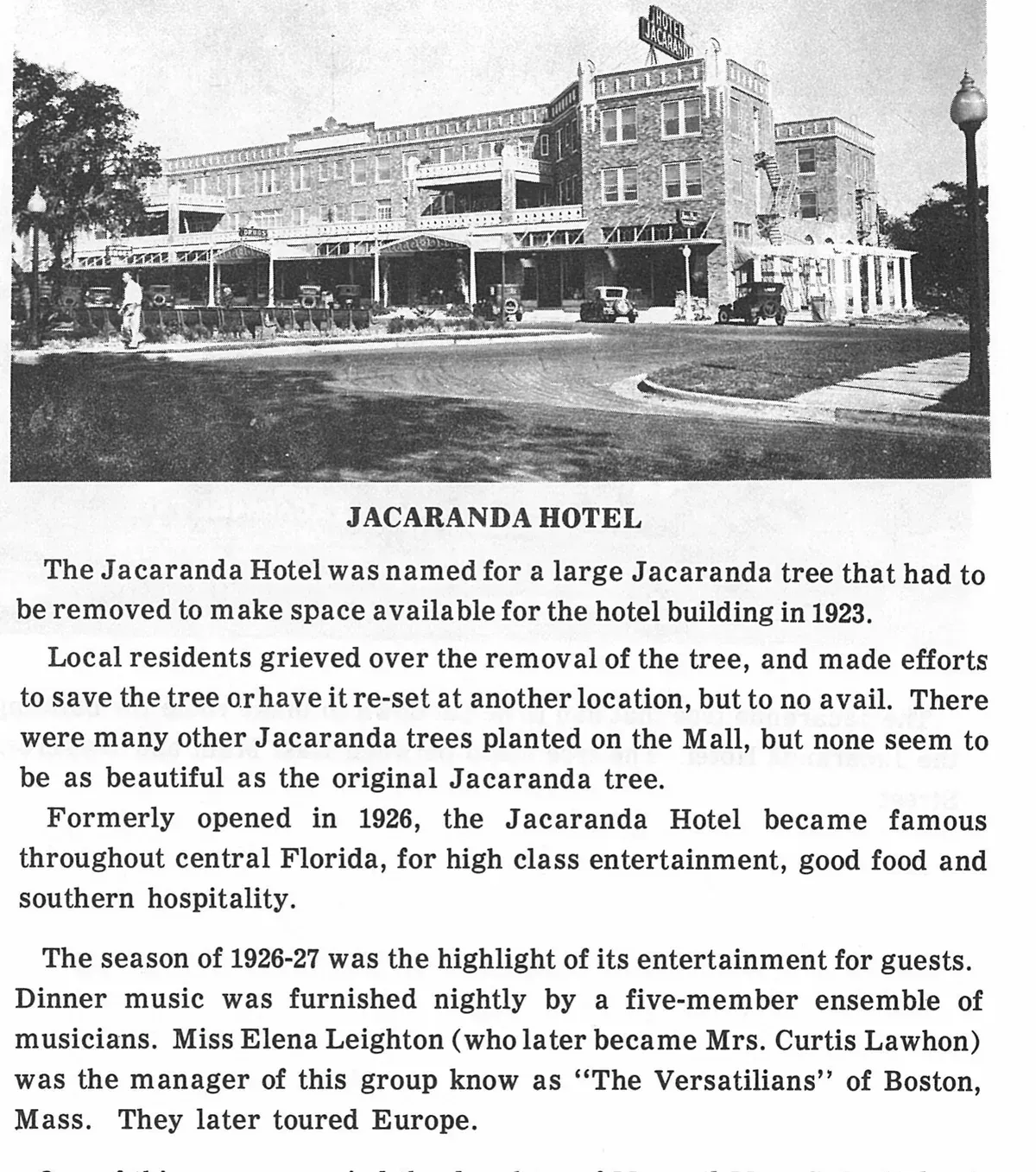
The Jacaranda Hotel, opened in April 1926 during the height of the 1920s building boom. The First Hundred Years of Avon Park, Florida (1976), page 149. Avon Park Historical Society.[maxwell-1976]
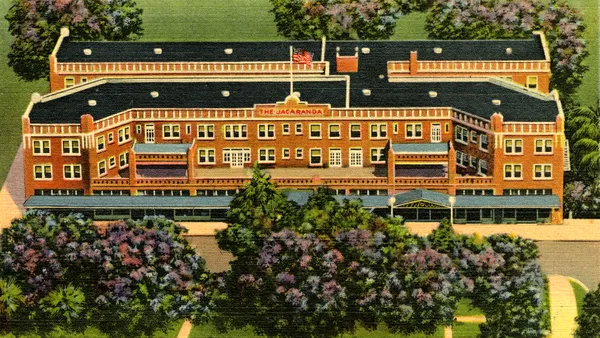 Historic postcard showing early development and streetscape in the Avon Park core around the Jacaranda Hotel in 1926. (State Archives of Florida, Florida Memory) [florida-memory-pc07746]
The Hotel Jacaranda on East Main Street, financed by Raab and Harry Winter and opened for the 1926 season, outlived the bust that ruined its backers. Mel Smith, the sawmill owner and rancher, bought it in the Thirties and C. E. Crabtree became its manager;[maxwell-1976] it was Crabtree’s name that Washington readers saw in December 1936 under “AVON PARK, FLA. HOTEL JACARANDA. Modern hotel, swimming, fishing, golf, etc. American plan, moderate rates. Situated in one of the most scenic sections of Florida. Mild Winter climate. A delightful spot to spend your winters. Illustrated folder on request.”[wt-1936-12-17] The R. R. King family of Highlands, North Carolina, bought it in 1946 and ran it with their King’s Inn in the mountains, a summer resort and a winter one under one management, co-managed by Robert King Jr. (who also managed the Pinecrest for the 1946–1947 season) and his sister Betty King Trowbridge;[maxwell-1976][nrhp-00000266] the Royal Coats family followed them in 1954, Thornton Kennedy of Atlanta bought it in 1962, and by 1976 the E. F. Calloway family were running it as a retirement home with rooms kept for tourists and overnight guests.[maxwell-1976]
The Pinecrest on Lake Lotela was a private golf club when William Heim finished its clubhouse in 1926, and became a hotel only after E. B. Hitchcock of Chicago bought it in January 1936.[nrhp-00000266] Two smaller houses belong to the same decade. Arthur Hatchel, a contractor, built the West Beach Hotel on Lake Lotela at South Highlands Avenue, near the Avon Park Golf Club, partly from lumber he salvaged from the burnt Verona; it was later run as a night club called the Blue Anchor, was bought and remodeled by Edward A. Teppert in the late Forties, and was eventually pulled down for house lots.[maxwell-1976][star-1927-02-02] And on the south side of Lake Isis the Perkins house of 1893, the Stephensons’ “Lillydale Farm,” was run from about 1922 as Dr. Mary’s Health Villa by two women physicians, Dr. Mary E. Coffin and Dr. Ida B. Peffers, both graduates of the Cleveland Homeopathic Medical College, who “mailed out a picture folder and advertised the Villa extensively as a health resort,” before Norton T. Smith bought it and called it the Red Top Inn or Red Top Ranch.[maxwell-1976][king-1905-homoeopathy]
Tents, cabins and trailers
Evidence: single-source, except for the Donaldson Park works of 1938, which are corroborated.
Not everyone who came could afford a hotel, and in the boom not everyone who came could find a room. The city council minute of 26 September 1925 reads, in its entirety, “Agreed to build tents for tourists.”[maxwell-1976] The town history explains it: when the building boom brought families looking for work and no houses to put them in, “the City provided them with tents,” in a tent city between North Prospect and Summit Avenues with one large tent as a community center, where “individual families by the dozens” lived; two of the women who lived there, Mrs. H. L. Haynie and Mrs. L. E. Stewart, went on to work in the Jacaranda’s dining room.[maxwell-1976]
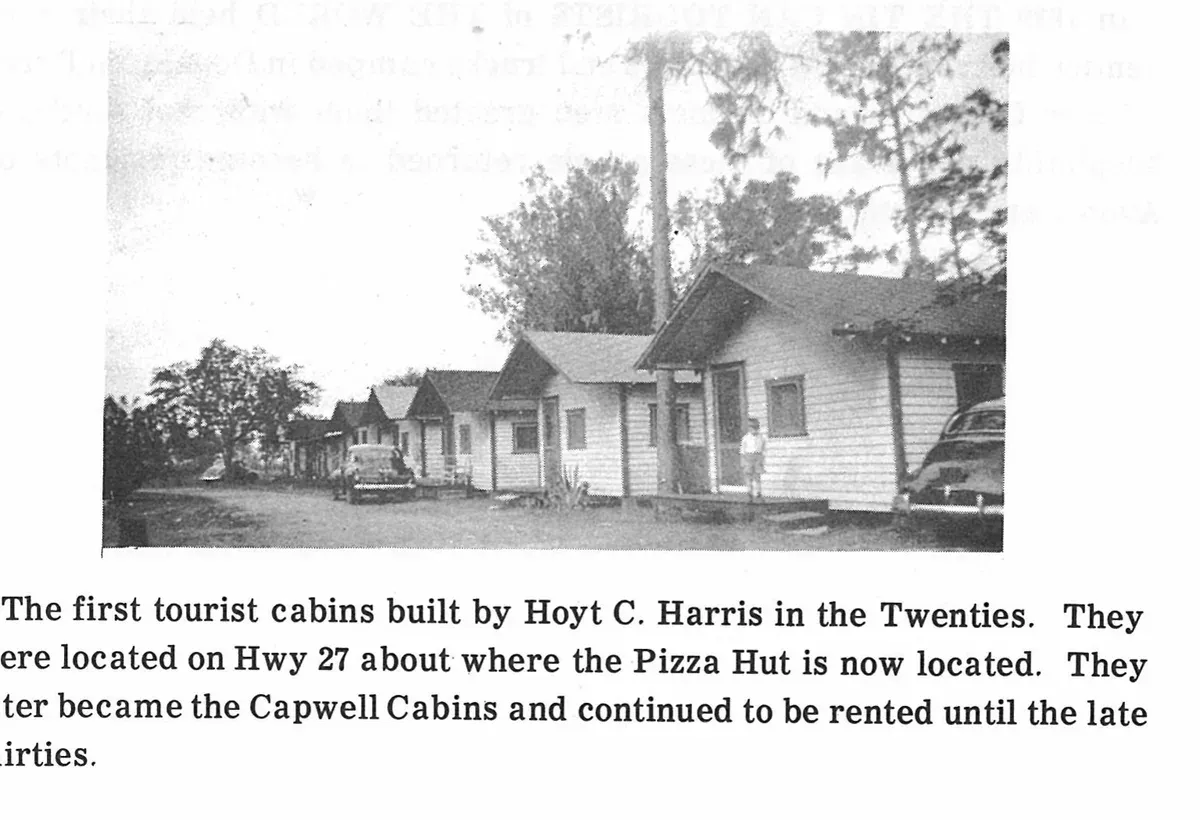
The first tourist cabins, built by Hoyt C. Harris in the Twenties on Highway 27; they became the Capwell Cabins and were rented until the late Thirties. The First Hundred Years of Avon Park, Florida (1976), page 236. Avon Park Historical Society.[maxwell-1976]
The motorists who followed the road south had cabins. Hoyt C. Harris built the first tourist cabins on Highway 27 in the Twenties, on the site the book locates by the Pizza Hut of 1976; they became the Capwell Cabins and were rented until the late Thirties.[maxwell-1976]
The trailers came in the Thirties, and the ground they were given was Donaldson Park on Lake Verona, near where the Verona had stood. On 16 November 1938 the Works Progress Administration’s Florida administrator, Robert J. Dill, authorized nine projects in eight counties, and the Highlands County one was “Avon Park, improve Donaldson Park, build addition to clubhouse, construct pier, three shelters, three shuffleboard courts and other facilities; 20 workers for three months; cost $3,495, WPA allocation, $2,694.”[bj-1938-11-17] So the park already had a clubhouse in 1938, and the shuffleboard courts that the town history says the city built for its winter guests, “the finest shuffle board courts in the State of Florida,” began as three courts built with federal relief labor that winter.[maxwell-1976]
The town history then records the event the town remembers best: “In 1939 THE TIN CAN TOURISTS of THE WORLD held their convention in Avon Park. 180 trailers and trucks camped in Donaldson Park. Mayor Covington and business men greeted them with real southern hospitality and many of these people returned to become residents of Avon Park in future years.”[maxwell-1976]
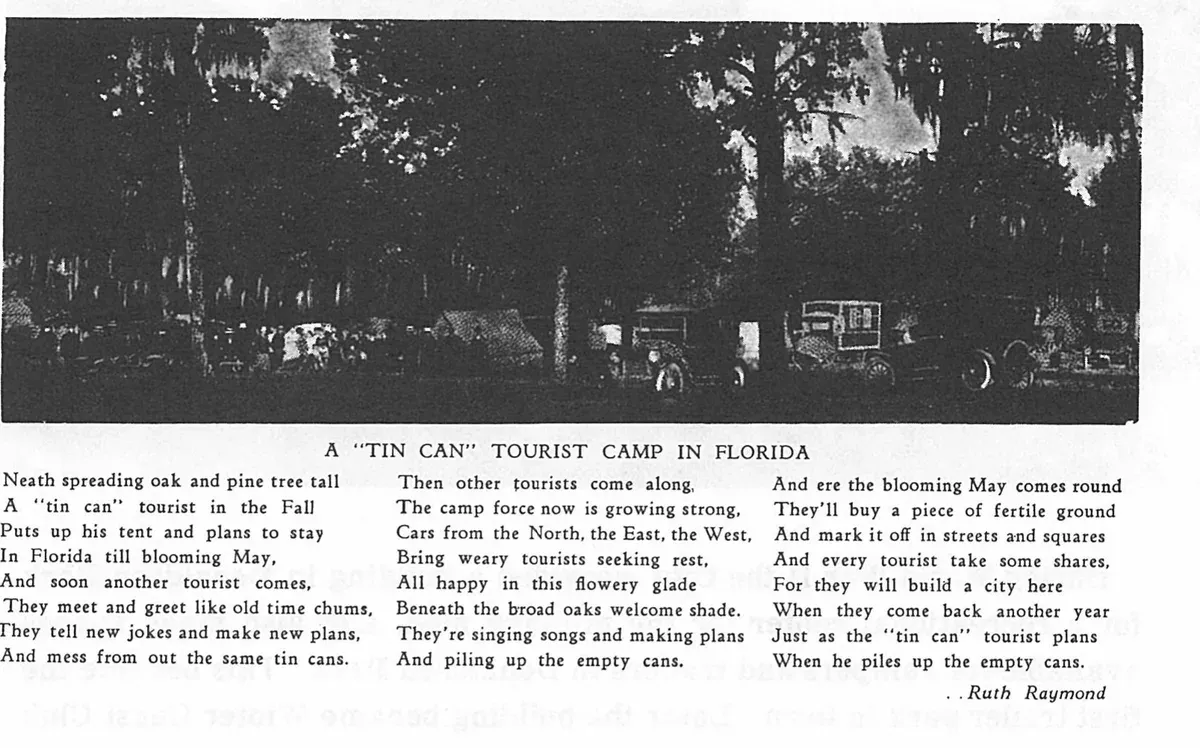
A “tin can” tourist camp in Florida. The First Hundred Years of Avon Park, Florida (1976), page 237. Avon Park Historical Society.[maxwell-1976]
The club’s own records complicate the word “convention.” The Tin Can Tourists of the World keep a list of every known winter convention, and it places the 1938-39 winter convention, and every one from 1940 to 1949, at Tampa; Avon Park does not appear in any year.[tct-tidbits] A Brooksville paper’s calendar of the 1939 season likewise gives “Tin Can Tourist of the World convention at Tampa, January 16-29,”[bs-1939-01-13] and in December 1939 more than four hundred members were reported encamped at Dade City.[gct-1939-12-07] The club held several gatherings a year besides the winter convention,[tct-tidbits] so a camp of 180 rigs at Avon Park in 1939 is entirely possible; but it was not the convention the club itself lists, and no contemporary newspaper account of it has been found.
During the Second World War the city put up a building in Donaldson Park as a recreation center for the airmen and opened the park to campers and trailers, “the first trailer park in town”; after the war the building became the Winter Guest Club house and the trailers were moved elsewhere.[maxwell-1976] By 1976 there were more than a dozen mobile home courts and trailer parks inside the town, “each with a recreational center where the residents meet for community affairs.”[maxwell-1976]
The health resort of 1936
Evidence: corroborated.
The strangest winter of the Depression is the one the town history tells with most embarrassment. “In 1936 Helen G. Randall, a self-proclaimed ‘Doctor,’ supposedly purchased the hotel,” the Highlands Lakes, “and opened a ‘Sun & Diet Health Resort,’ with the support of the Chamber of Commerce and many of the business men in town. Suddenly her plans came to an end and she was proven to be a phony, much to the chagrin of the Chamber of Commerce and everyone who had believed in her grand plan to make Avon Park the ‘ideal health resort of the nation.’”[maxwell-1976]
The newspapers of two other states fill in what the book leaves out, and they spell her name Randle. Under “RESORTS” in a Washington Sunday paper of 20 December 1936 stood an advertisement headed “AVON PARK, FLA.”: “SUN & DIET HEALTH RESORT. LEARN TO LIVE. Rest or play in the proper way. Eat your way to health. Supervised physical culture. Send for new folder and plan your season here.”[star-1936-12-20] Twelve days earlier, in a district court at Wareham, Massachusetts, a judge had held Mrs. Helen Gertrude Randle for the grand jury on a charge of representing herself as a physician and practicing medicine illegally. She had been arrested at Falmouth on 16 November 1936; she “operated a sun and diet health resort last summer in Hendersonville, N.C.”; her “Doctor of Nutrition” was an honorary degree from a New York institute of nutrition; asked where she had lived for the past five years she answered “I traveled,” and gave four mailing addresses, Washington, Asheville, Hendersonville, and Avon Park, Florida.[tn-1936-12-09] In February 1937 “Mrs. Helen G. Randle, of Avon Park, Fla.,” operator of the Sun and Diet Health Resort at Laurel Park, Hendersonville, sued a Foxboro manufacturer for six hundred thousand dollars, alleging he had promised her a half share in a health resort on his Falmouth estate and had induced her to give up the North Carolina one.[tn-1937-02-19] The resort at Avon Park did not open for a second season, and the finding on the affair sets out the sources in full.
Selling the winter
Evidence: corroborated.
The town paid to be advertised. In 1925 the Legislature created a special tax district around Avon Park that could levy up to three mills for publicity and nothing else, and could spend none of it on salaries.[lof-1925-10624] The Jacaranda’s classified advertisement in Washington in December 1936, “Illustrated folder on request,” is the kind of thing it bought, and so are the illustrated folders of the health villa on Lake Isis and the Sun and Diet Health Resort.[wt-1936-12-17][star-1936-12-20][maxwell-1976]
The winter people were, above all, ordinary. The society column of a Washington paper in November 1933 reported that Cora M. Lewis of Clarendon, Virginia, and her nephew “left by motor this week for Avon Park, Fla., where they will spend the Winter,” in company with cousins from Manchester, New Hampshire, who had stopped with her on their way south; the same column had John Shepherd of Avon Park among the guests at a Clarendon birthday party.[star-1933-11-10] By 1941 the Orange Blossom Trail’s promoters were describing the drive “southward to Avon Park, where botanists exhibit collections of Florida flowers and plants,” past the lavender of the jacaranda trees.[star-1941-02-02]
The other winter institution was religious. On 30 December 1937 Dr. John A. Taylor, minister of the First Methodist Church at Sebring and one of the Poinsettia’s owners, deeded forty acres he owned at Avon Park to Asbury College of Wilmore, Kentucky, on condition that the land be used for a holiness camp ground, and with Dr. Henry Clay Morrison, the college’s president, and the Rev. James Green he opened the Avon Park Camp in 1939.[apcamp-about] The town history gives the same founding year and the same two principals, names C. E. Lanier as the third founder, and describes by 1976 a tabernacle seating 750, two trailer courts and a dormitory of a hundred rooms for the hundreds who came to the annual camp meetings.[maxwell-1976] The Episcopal Church’s Camp Wingmann, at Avon Park from 1932, was a summer camp and a different thing.
The Winter Guest Club
Evidence: single-source, except for the Donaldson Park works of 1938.
The winter residents “officially organized” a Winter Guest Club in 1937, and the city provided its clubhouse and built its shuffleboard courts.[maxwell-1976] The courts the WPA built in Donaldson Park the following winter were three,[bj-1938-11-17] and the clubhouse the club occupied after the war was the airmen’s recreation building in the same park.[maxwell-1976] By 1976 about eight hundred winter residents belonged to the club, “and many others who do not join,” many of them now owners of winter homes rather than hotel guests; the clubhouse held carry-in dinners, card parties and tournaments, and the club played shuffleboard against the winter guest clubs of other towns.[maxwell-1976] The town’s promotional page of the same year listed its winter recreation as “Winter Guest Club, Shuffleboard, Bowling, Water Skiing, Tennis Courts, Hand ball Courts, Swimming, Hunting, Fishing and 3 Golf courses.”[maxwell-1976]
The city still keeps shuffleboard courts for its older residents at the Senior Activities Center at 109 East Main Street, whose roof was being repaired after hurricane damage in 2026.[hns-2026-senior-center] Whether that center is the Winter Guest Club’s successor, and when the club stopped meeting under its own name, is not established. The club has its own page, Winter Guest Club.
Related
- Hotel Verona
- Hotel Jacaranda
- Pinecrest Hotel
- Highlands Lakes Hotel and Casino
- Founding of Walker Memorial Hospital and Charles H. Walker
- Winter Guest Club
- The Avon Park Hotel burned on 2 February 1927
- Three hotels on the 1920 Sanborn map
- The WPA built Donaldson Park’s shuffleboard courts in 1938
- The Sun and Diet Health Resort of 1936
- Dr. Mary’s Health Villa on Lake Isis and the Medical Lineage of Mary E. Coffin and Ida B. Peffers
- The West Beach Hotel and the Blue Anchor Night Club on Lake Lotela
- Dr. Mary E. Coffin
- The publicity tax district of 1925
- Lodges and clubs of Avon Park
- The land boom and bust at Avon Park
- Sanborn Fire Insurance Map, Avon Park, November 1920
References
- florida-memory-pc07746 — Unknown. Jacaranda Hotel, Avon Park. 18 September 2026. https://www.floridamemory.com/items/show/165243
- dsc-1915-02-25 — S. F. Tucker (department editor), The De Soto County News, Arcadia, Fla. The De Soto County News, 25 February 1915, page 7: Avon Park Department, S. F. Tucker, Editor. 25 February 1915. https://www.loc.gov/resource/sn95026908/1915-02-25/ed-1/?sp=7
- maxwell-1976 — Leoma Bradshaw Maxwell. The First Hundred Years of Avon Park, Florida. 1976. the-first-hundred-years-of-avon-park_leoma-bradshaw-maxwell_1976.md
- sanborn-1920 — Sanborn Map Company. Sanborn Fire Insurance Map from Avon Park, De Soto County, Florida, November 1920 (four sheets). 1 November 1920. sanborn-1920-avon-park.md
- gaz-1918 — R. L. Polk & Co. Florida State Gazetteer and Business Directory, 1918. 1918. florida-business-directories.md
- pj-1904-12-23 — Perrysburg Journal. Local news item on the death of Earl D. Bossier at Avon Park, Perrysburg Journal (Perrysburg, Ohio), 23 December 1904, page 4. 23 December 1904. https://www.loc.gov/resource/sn87076843/1904-12-23/ed-1/?sp=4
- nhu-1905-12-19 — The New Haven Union. Local news item on Harry Leigh’s winter at Avon Park, The New Haven Union (New Haven, Conn.), 19 December 1905, page 5. 19 December 1905. https://www.loc.gov/resource/sn92051126/1905-12-19/ed-1/?sp=5
- dscn-1906-02-16 — The De Soto County News. Avon Park department, The De Soto County News (Arcadia, Fla.), 16 February 1906, page 4. 16 February 1906. https://www.loc.gov/resource/sn95026908/1906-02-16/ed-1/?sp=4
- lof-1925-10624 — Legislature of the State of Florida. Chapter 10624 (No. 602), Laws of Florida 1925: An Act Creating a Special Tax District for Publicity Purposes in Highlands County, Florida. 1925. http://edocs.dlis.state.fl.us/fldocs/leg/actsflorida/1925/LOF1925V2pt2ch10462-10636.pdf
- star-1927-02-02 — Associated Press, in the Evening Star. Florida Hotel Burns, Evening Star (Washington, D.C.), 2 February 1927, page 1. 2 February 1927. https://www.loc.gov/resource/sn83045462/1927-02-02/ed-1/?sp=1
- nrhp-00000266 — United States Department of the Interior, National Park Service. National Register of Historic Places Registration Form: Pinecrest Hotel, Old, Avon Park, Florida (reference 00000266). 24 March 2000. https://npgallery.nps.gov/GetAsset/d3eaa10c-7fe9-4298-af1c-11123bb9c20b
- star-1933-11-10 — Evening Star. Clarendon social notes, Evening Star (Washington, D.C.), 10 November 1933, page 21. 10 November 1933. https://www.loc.gov/resource/sn83045462/1933-11-10/ed-1/?sp=21
- wt-1936-12-17 — The Washington Times. Hotel Jacaranda advertisement, resort column, The Washington Times (Washington, D.C.), 17 December 1936, page 54. 17 December 1936. https://www.loc.gov/resource/sn84026749/1936-12-17/ed-1/?sp=54
- star-1936-12-20 — Evening Star. Sun and Diet Health Resort advertisement, Resorts column, Evening Star (Washington, D.C.), 20 December 1936, page 29. 20 December 1936. https://www.loc.gov/resource/sn83045462/1936-12-20/ed-1/?sp=29
- tn-1936-12-09 — The Times-News. Mrs. Randle’s Case Goes to Grand Jurors, The Times-News (Hendersonville, N.C.), 9 December 1936, page 3. 9 December 1936. https://www.loc.gov/resource/sn86063811/1936-12-09/ed-1/?sp=3
- tn-1937-02-19 — United Press, in The Times-News. Mrs. Randle Asks Damages, The Times-News (Hendersonville, N.C.), 19 February 1937, page 1. 19 February 1937. https://www.loc.gov/resource/sn86063811/1937-02-19/ed-1/?sp=1
- bj-1938-11-17 — The Brooksville Journal. Nine Projects Are Approved By WPA Head, The Brooksville Journal (Brooksville, Fla.), 17 November 1938, page 7. 17 November 1938. https://www.loc.gov/resource/sn95047246/1938-11-17/ed-1/?sp=7
- bs-1939-01-13 — The Brooksville Sun. Florida winter events calendar, The Brooksville Sun (Brooksville, Fla.), 13 January 1939, page 7. 13 January 1939. https://www.loc.gov/resource/sn98026438/1939-01-13/ed-1/?sp=7
- gct-1939-12-07 — Gadsden County Times. Tin Can Tourists Meet, Gadsden County Times (Quincy, Fla.), 7 December 1939, page 10. 7 December 1939. https://www.loc.gov/resource/sn95047334/1939-12-07/ed-1/?sp=10
- tct-tidbits — Tin Can Tourists. Tin Can Tidbits: all known T.C.T. winter conventions (Florida). 2 September 2026. https://tincantourists.com/tin-can-tidbits/
- star-1941-02-02 — Evening Star. Orange Blossom Trail travel feature, Evening Star (Washington, D.C.), 2 February 1941, page 33. 2 February 1941. https://www.loc.gov/resource/sn83045462/1941-02-02/ed-1/?sp=33
- apcamp-about — Avon Park Camp Association. About the Avon Park Camp. 2 September 2026. https://www.avonparkcamp.com/about
- hns-2026-senior-center — Highlands News-Sun. Avon Park is making progress on renovations to Senior Activities Center & Shuffleboard. 2026. https://www.midfloridanewspapers.com/highlands_news-sun/avon-park-is-making-progress-on-renovations-to-senior-activities-center-shuffleboard/article_79c66163-32ed-4386-9f67-c127248ecbe2.html
- king-1905-homoeopathy — William Harvey King, M.D. History of Homoeopathy and Its Institutions in America, Volume III. 1905. https://archive.org/details/historyofhomoeop03king
Related
- Entity: Hotel Jacaranda
- Entity: Pinecrest Hotel and Country Club
- Entity: Robert King Jr.
- Finding: The Two King Families of Avon Park: William King and Robert King Jr.
- Entity: Highlands Lakes Hotel
- Entity: Hotel Verona
- Finding: West Beach Hotel and Blue Anchor
- Finding: Dr. Mary’s Health Villa and Lake Isis Resorts
Where this comes from
- Evidence
- single-source — One source. Treat as reported, not established.
- Review
- unverified — Drafted from sources but not yet checked by a volunteer.
- Rights
- society
Sources
- Unknown, Jacaranda Hotel, Avon Park (2026) · archival
- S. F. Tucker (department editor), The De Soto County News, Arcadia, Fla., The De Soto County News, 25 February 1915, page 7: Avon Park Department, S. F. Tucker, Editor (1915) · newspaper
- Leoma Bradshaw Maxwell, The First Hundred Years of Avon Park, Florida (Held at the Avon Park Historical Society Depot Museum, Avon Park, Florida) (1976) · book
- Sanborn Map Company, Sanborn Fire Insurance Map from Avon Park, De Soto County, Florida, November 1920 (four sheets) (1920) · archival
- R. L. Polk & Co., Florida State Gazetteer and Business Directory, 1918 (1918) · book
- Perrysburg Journal, Local news item on the death of Earl D. Bossier at Avon Park, Perrysburg Journal (Perrysburg, Ohio), 23 December 1904, page 4 (1904) · newspaper
- The New Haven Union, Local news item on Harry Leigh's winter at Avon Park, The New Haven Union (New Haven, Conn.), 19 December 1905, page 5 (1905) · newspaper
- The De Soto County News, Avon Park department, The De Soto County News (Arcadia, Fla.), 16 February 1906, page 4 (1906) · newspaper
- Legislature of the State of Florida, Chapter 10624 (No. 602), Laws of Florida 1925: An Act Creating a Special Tax District for Publicity Purposes in Highlands County, Florida (1925) · official
- Associated Press, in the Evening Star, Florida Hotel Burns, Evening Star (Washington, D.C.), 2 February 1927, page 1 (1927) · newspaper
- United States Department of the Interior, National Park Service, National Register of Historic Places Registration Form: Pinecrest Hotel, Old, Avon Park, Florida (reference 00000266) (2000) · official
- Evening Star, Clarendon social notes, Evening Star (Washington, D.C.), 10 November 1933, page 21 (1933) · newspaper
- The Washington Times, Hotel Jacaranda advertisement, resort column, The Washington Times (Washington, D.C.), 17 December 1936, page 54 (1936) · newspaper
- Evening Star, Sun and Diet Health Resort advertisement, Resorts column, Evening Star (Washington, D.C.), 20 December 1936, page 29 (1936) · newspaper
- The Times-News, Mrs. Randle's Case Goes to Grand Jurors, The Times-News (Hendersonville, N.C.), 9 December 1936, page 3 (1936) · newspaper
- United Press, in The Times-News, Mrs. Randle Asks Damages, The Times-News (Hendersonville, N.C.), 19 February 1937, page 1 (1937) · newspaper
- The Brooksville Journal, Nine Projects Are Approved By WPA Head, The Brooksville Journal (Brooksville, Fla.), 17 November 1938, page 7 (1938) · newspaper
- The Brooksville Sun, Florida winter events calendar, The Brooksville Sun (Brooksville, Fla.), 13 January 1939, page 7 (1939) · newspaper
- Gadsden County Times, Tin Can Tourists Meet, Gadsden County Times (Quincy, Fla.), 7 December 1939, page 10 (1939) · newspaper
- Tin Can Tourists, Tin Can Tidbits: all known T.C.T. winter conventions (Florida) (2026) · secondary
- Evening Star, Orange Blossom Trail travel feature, Evening Star (Washington, D.C.), 2 February 1941, page 33 (1941) · newspaper
- Avon Park Camp Association, About the Avon Park Camp (2026) · secondary
- Highlands News-Sun, Avon Park is making progress on renovations to Senior Activities Center & Shuffleboard (2026) · newspaper
- William Harvey King, M.D., History of Homoeopathy and Its Institutions in America, Volume III (1905) · book
Something here wrong, or incomplete? The Society would rather know. Tell a volunteer.
Have a question about this record?