
This is a draft. It is published so it can be read and corrected, not because it is finished.
Indigenous Presence on the Lake Wales Ridge Before European Contact
Summary
People lived on the Lake Wales Ridge for thousands of years before any European saw it, and the archaeological evidence for that is real and professionally documented. What is missing is not the evidence but our access to it, and any account of Avon Park that begins in 1885 is starting the story several thousand years late.
Three things can be said with reasonable confidence. Highlands County lies within the recognized territory of the Belle Glade archaeological culture, which occupied the Lake Okeechobee basin and the Kissimmee River valley from roughly 1000 BC to about AD 1700.[wiki-belle-glade] Occupation of the ridge itself intensified during the Middle to Late Archaic, roughly eight thousand to twenty-five hundred years ago, as the ridge’s lakes and seep springs began holding water year round.[fwc-ridge-history] And at the time Europeans arrived, the interior around the upper Kissimmee watershed was the country of the Jororo and the closely related Mayaca — not the Seminole, who are a later people entirely.[worth-missions][wiki-mayaca]
Why the ridge
The Lake Wales Ridge is a sand ridge roughly 110 to 115 miles long and four to fifteen miles wide, formed from ancient beach and dune systems laid down when higher seas covered the rest of the peninsula and left the ridge standing as a chain of islands. Its crest is about three hundred feet above sea level, and it has stood above water for hundreds of thousands of years.[fwc-ridge-history]
For people, that geology meant one thing above all: dry ground. In a region of seasonally flooded flatwoods, prairie and marsh, the ridge was somewhere you could camp, walk, and live year round without being driven out by water. It also sits on the divide between two drainages, the Kissimmee to the east and the Peace to the west, which made it a natural corridor as well as a refuge.[fwc-ridge-history]
What drew people to particular spots on it was water. State wildlife accounts describe Indigenous use of the ridge increasing in the Middle to Late Archaic, once climate change let the ridge-margin lakes and seep springs fill and hold, and describe late prehistoric Belle Glade sites clustering around exactly those lakes and springs. The people who lived there did not farm. They hunted deer, gray squirrel, alligator and gopher tortoise, and took fish and aquatic turtles from the lakes.[fwc-ridge-history]
The landscape they knew was not the landscape of today. A sediment core from Lake Tulane, inside Avon Park itself, records roughly fifty to sixty thousand years of Florida vegetation, swinging repeatedly between pine-dominated wetter phases and oak, ragweed and rosemary-scrub drier phases in step with cold events in the North Atlantic.[grimm-tulane] Whatever the first people to reach the ridge found, it was in the middle of one of those swings — and the lakes themselves were already there, older than any human presence in Florida by tens of thousands of years.
What has actually been found
The Blueberry site (Florida Master Site File number 8HG678) is documented as a Belle Glade village in Highlands County on the Lake Wales Ridge.[butler-lawres-blueberry] Evidence: single-source. David S. B. Butler and Nathan R. Lawres report at least three earthen mounds, a linear embankment, and a sheet midden accompanied by 272 Phase II lithic specimens, consisting predominantly of resharpening and thinning flakes derived from nonlocal chert.[butler-lawres-blueberry] Butler and Lawres report radiocarbon assays dating the primary Belle Glade occupation to calibrated AD 1160–1660, while Sylvia Scudder’s soil study identifies an older fiber-tempered Late Archaic component and reports a calibrated date of AD 1410–1455 from the Belle Glade midden.[butler-lawres-blueberry][scudder-blueberry] A detailed analysis of the lithics, stratigraphy, and chronology is given in the Blueberry site finding.
Goodnow Mound, on Lake Josephine in Highlands County, was excavated in January 1947 by John W. Griffin, later the state archaeologist, and Hale G. Smith, and reported in 1948 by the Florida Park Service — the earliest professional excavation report on a named Highlands County site.[griffin-smith-goodnow] It is a contact-period burial mound, not a prehistoric one: Griffin and Smith recovered thousands of European glass trade beads, two pairs of iron scissors, iron axes and a knife blade, five hawk’s bells, sherds of a Spanish olive jar, and silver ornaments including beads hammered from European coins, all interred with the burials alongside Belle Glade Plain pottery.[griffin-smith-goodnow] They dated the mound to the Spanish contact period, roughly 1530 to 1700.[griffin-smith-goodnow] The prehistoric date of about AD 1200 that circulates for this site belongs to the Skipper Site, a separate mound on the same lake reported in the second half of the same volume.[griffin-smith-goodnow] The excavation, the trade goods and the dating are set out in the Goodnow Mound finding.
Avon Park Air Force Range, a federal landholding of roughly 106,000 acres straddling Polk and Highlands counties, is by a wide margin the best-surveyed archaeological landscape in the area, because federal law requires it to be. At least six professional cultural resource studies have been carried out there since 1985, beginning with a survey by Piper Archaeological Research for the Department of Energy and including a 1997 inventory and assessment by Geo-Marine for the Army Corps of Engineers.[austin-1987-kissimmee][geomarine-1997-apafr][tdar-apafr-collection] The 1985 survey found sites spanning the entire period of human occupation of the Kissimmee valley, from the Archaic onward.[austin-1987-kissimmee]
A cluster of site numbers appears in the titles and catalogue records of those reports, but their descriptions are not accessible here, and their locations are deliberately not given.[tdar-apafr-collection]
Regionally, Highlands County sits on the edge of one of the best-studied ceremonial landscapes in Florida. Fisheating Creek, which rises in the county’s prairies and flatwoods before flowing east through Glades County, drains a corridor containing dozens of recorded archaeological sites associated with the Belle Glade ceremonial complex at Fort Center.[fisheating-creek] Fort Center itself is outside the county, but it shows what kind of society the Belle Glade world supported.
Paleoindian evidence. No Paleoindian site or diagnostic artifact has been recorded on the Lake Wales Ridge or anywhere in Highlands County. The two statewide projectile point datasets that map Florida’s Paleoindian record — the Florida Fluted Point Survey and David K. Thulman’s Florida paleopoint dataset of 735 points across thirty-five river basins — hold no point from the county, the ridge, or the Kissimmee drainage.[dunbar-2005-pidba][thulman-2011-pidba] The statewide synthesis of the Florida Master Site File reaches the same result: Paleoindian settlement was confined to the karst river country of northern and west-central Florida, where surface water and tool-grade chert both occurred, and the only documented Paleoindian site in the southern half of the peninsula is the Cutler Fossil site in Miami-Dade County.[faught-pevny-2019] Statements in range management plans that occupation there began in the late Paleoindian period are generalizations from statewide prehistory rather than records of anything found on the ground. The oldest verified occupation on the ridge is Early Archaic, about 7000 BC. See Finding: empirical absence of Paleoindian sites on the Lake Wales Ridge and Avon Park Air Force Range.
Mound destruction. In the summer of 1899 local men opened a burial mound east of Avon Park and removed beads, utensils and a large quantity of human remains, as reported by the Avon Park correspondent of the Arcadia News and reprinted in The Florida Agriculturist of 5 July 1899.[fa-1899-07-05] See Finding: a burial mound east of Avon Park was opened in 1899.
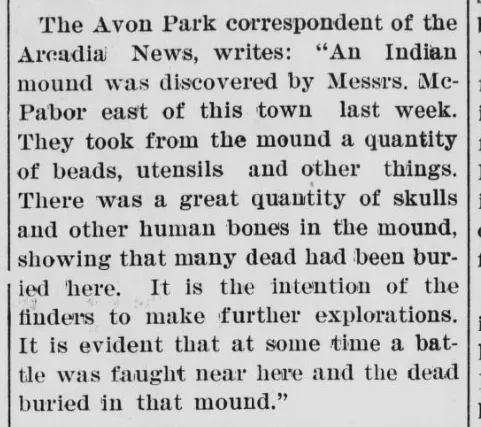
The Florida Agriculturist, 5 July 1899, page 5: Indian mound opened east of Avon Park by Messrs. Mc- Pabor. Image provided by the University of Florida / Library of Congress, Chronicling America. Public domain.[fa-1899-07-05]
Who was here at contact
The interior of central Florida was the country of the Jororo and, immediately north of them along the upper St. Johns, the Mayaca. The two were linked by language, and Spanish records sometimes treat the whole interior as a single “Province of Mayaca and Jororo.”[wiki-jororo][wiki-mayaca] Both are described as loosely organized, non-agricultural communities; the Jororo’s territory is described as extending across the upper Kissimmee River watershed, which reaches the northern edge of Highlands County.[worth-missions]
Four Franciscan missions operated in this territory in the 1690s, roughly thirty miles apart: San Salvador de Mayaca, San Joseph de Jororo, La Concepción de Atoyquime, and Atissimi.[worth-missions] They did not last. In late October 1696 the friar at Atoyquime and a native sacristan were killed after harsh punishment of Indigenous people at the mission, and the revolt that followed effectively ended the Jororo missions; all three Jororo-province mission dates end in 1697.[wiki-jororo][worth-missions]
What followed was catastrophe. Florida’s Indigenous population fell from roughly 350,000 at contact to fewer than a thousand by the 1750s. Epidemic disease did much of it — about half of the Timucua Christian converts died between 1613 and 1617 — and English slave raiding from Carolina, carried out with Yamasee and Creek allies from the 1680s onward, did much of the rest. Governor James Moore’s 1704 campaign left Apalachee province nearly depopulated, its people killed, enslaved, or driven west.[mfh-demise] By 1708 Carolina raids had pushed many Mayaca toward St. Augustine or south toward Lake Okeechobee, and by 1743 only a remnant was recorded near the lake.[wiki-mayaca] When Spain ceded Florida to Britain in 1763, the survivors left for Cuba.[mfh-demise]
This is the point local history most often gets wrong. The Seminole are not the descendants of these people and are not a continuation of them. The Seminole formed in the eighteenth century, largely from Lower Creek migrants out of Georgia and Alabama, and moved into a Florida whose original inhabitants had already been destroyed. The Mayaca, the Jororo, and the Belle Glade people of the Kissimmee valley are a separate and earlier story, and it ends before the Seminole story begins.
Why the local record is silent
Avon Park’s own historical writing does not mention any of this. The Historical Society’s article on the town’s lakes discusses Lake Tulane’s scientific importance and the recreational history of Lake Verona and Lake Viola, and never connects either to human presence before settlement.[aphs-lakes] General local histories begin at 1884 to 1886 with Oliver Marvin Crosby. None of the National Register listings in Highlands County is designated as an archaeological site; all are buildings, districts, a depot, and a cemetery.[nrhp-highlands]
Some of that silence is a real absence of evidence within the city limits. Most of it is an access problem. The Florida Master Site File, the state’s authoritative register of recorded sites, is not a public online database. The federal survey reports for Avon Park Air Force Range sit in a repository that restricts their files. The two most on-point books — John Hann’s Indians of Central and South Florida, 1513–1763 and Jerald Milanich’s work on precolumbian Florida — are in print and in libraries, not on the open web.[hann-central-south-fl] The record is not thin. Access to it is limited.
References
- fwc-ridge-history — Florida Fish and Wildlife Conservation Commission. Lake Wales Ridge: History. 30 August 2026. https://myfwc.com/recreation/lead/lake-wales-ridge/history/
- butler-lawres-blueberry — David S. B. Butler and Nathan R. Lawres. Modeling Belle Glade Lithic Use Behaviors: A Case Study from Highlands County (The Florida Anthropologist 67, 2014). 2014. https://www.westga.edu/share/documents/pubs/093035_1783.pdf
- scudder-blueberry — Sylvia J. Scudder. Deep Sand: Soil and Landscape Relationships at the Blueberry Site (8HG678), Highlands County, Florida. 2003. https://doi.org/10.58782/flmnh.dqwv9506
- griffin-smith-goodnow — John W. Griffin and Hale G. Smith, Florida Park Service. The Goodnow Mound, Highlands County, Florida: Containing a Report on the Skipper Site, Highlands County (Contributions to the Archaeology of Florida, No. 1). 1948. https://beadresearch.org/wp-content/uploads/Repeating_Material/Trade_Bead_Bibliography_PDFs/101-200/TB_157.pdf
- austin-1987-kissimmee — Robert J. Austin. Prehistoric and Early Historic Settlement in the Kissimmee River Valley: An Archaeological Survey of the Avon Park Air Force Base (The Florida Anthropologist 40:4). 1987. https://core.tdar.org/document/111901
- geomarine-1997-apafr — Geo-Marine, Inc., for the U.S. Army Corps of Engineers, Fort Worth District. Avon Park Air Force Range: Cultural Resources Inventory and Assessment. 1997. https://core.tdar.org/document/391123
- dunbar-2005-pidba — James S. Dunbar (Florida Bureau of Archaeological Research). Florida Fluted Point Survey (Paleoindian Database of the Americas). 2005. https://pidba.org/florida.htm
- thulman-2011-pidba — David K. Thulman. Florida Paleopoint Data (Paleoindian Database of the Americas). 2011. https://pidba.org/florida.htm
- faught-pevny-2019 — Michael K. Faught and Charlotte D. Pevny. Pre-Clovis to the Early Archaic: Human Presence, Expansion, and Settlement in Florida over Four Millennia. 1 March 2019. https://www.flheritage.com/
- tdar-apafr-collection — the Digital Archaeological Record (tDAR). Avon Park Air Force Range archaeology archive. 30 August 2026. https://core.tdar.org/collection/17689/avon-park-air-force-range-archaeology-archive-documents-images-and-other-data
- worth-missions — John E. Worth, University of West Florida. Spanish Florida Missions. 30 August 2026. https://pages.uwf.edu/jworth/jw_spanfla_missions.html
- mfh-demise — Museum of Florida History, Florida Department of State. Demise of the Indigenous Population and the Mission Period. 30 August 2026. https://museumoffloridahistory.com/explore/exhibits/permanent-exhibits/la-florida/forever-changed-phase-2/the-first-spanish-period/demise-of-the-indigenous-population-and-the-mission-period/
- wiki-mayaca — Wikipedia, citing Milanich and Hann. Mayaca people. 30 August 2026. https://en.wikipedia.org/wiki/Mayaca_people
- wiki-jororo — Wikipedia, citing Hann. Jororo. 30 August 2026. https://en.wikipedia.org/wiki/Jororo
- grimm-tulane — E. C. Grimm and others. A 50,000-Year Record of Climate Oscillations from Florida and Its Temporal Correlation with the Heinrich Events (Science 261). 1993. https://www.science.org/doi/10.1126/science.261.5118.198
- aphs-lakes — Avon Park Historical Society. The Lakes That Shaped Avon Park. 30 August 2026. https://avonparkhistoricalsociety.com/article/149_The-Lakes-That-Shaped-Avon-Park
- nrhp-highlands — Wikipedia. National Register of Historic Places listings in Highlands County, Florida. 30 August 2026. https://en.wikipedia.org/wiki/National_Register_of_Historic_Places_listings_in_Highlands_County,_Florida
- wiki-belle-glade — Wikipedia. Belle Glade culture. 30 August 2026. https://en.wikipedia.org/wiki/Belle_Glade_culture
- fisheating-creek — Florida Wildlife Corridor Foundation. Fisheating Creek Ecosystem. 30 August 2026. https://web.archive.org/web/20251216225456/https://floridawildlifecorridor.org/missing-links-2/fisheating-creek-ecosystem/
- hann-central-south-fl — John H. Hann. Indians of Central and South Florida, 1513-1763 (University Press of Florida, 2003) - identified through a published review; the book itself was not read. 2003. https://networks.h-net.org/node/3119/reviews/5617/scarry-hann-indians-central-and-south-florida-1513-1763
- fa-1899-07-05 — Arcadia News, via The Florida Agriculturist (DeLand, Fla.). The Florida Agriculturist, 5 July 1899, page 5: an Indian mound opened east of Avon Park, from the Avon Park correspondent of the Arcadia News. 5 July 1899. https://www.loc.gov/resource/sn96027724/1899-07-05/ed-1/?sp=5&r=0.15,0.241,0.53,0.322,0
Related
- Lake Wales Ridge
- Belle Glade culture
- The Mayaca and the Jororo
- Finding: Avon Park’s own history writing is silent on Indigenous presence
- Finding: Linguistic etymology of the Seminole place name Istokpoga
- Finding: “Hicoria” is a botanical coinage, not an Indigenous place name
- Finding: the local archaeological record is gated, not absent
Where this comes from
- Evidence
- single-source — One source. Treat as reported, not established.
- Review
- unverified — Drafted from sources but not yet checked by a volunteer.
- Rights
- society
Sources
- Florida Fish and Wildlife Conservation Commission, Lake Wales Ridge: History (2026)
- David S. B. Butler and Nathan R. Lawres, Modeling Belle Glade Lithic Use Behaviors: A Case Study from Highlands County (The Florida Anthropologist 67, 2014) (2014) · secondary
- Sylvia J. Scudder, Deep Sand: Soil and Landscape Relationships at the Blueberry Site (8HG678), Highlands County, Florida (2003) · secondary
- John W. Griffin and Hale G. Smith, Florida Park Service, The Goodnow Mound, Highlands County, Florida: Containing a Report on the Skipper Site, Highlands County (Contributions to the Archaeology of Florida, No. 1) (1948) · official
- Robert J. Austin, Prehistoric and Early Historic Settlement in the Kissimmee River Valley: An Archaeological Survey of the Avon Park Air Force Base (The Florida Anthropologist 40:4) (1987)
- Geo-Marine, Inc., for the U.S. Army Corps of Engineers, Fort Worth District, Avon Park Air Force Range: Cultural Resources Inventory and Assessment (1997)
- James S. Dunbar (Florida Bureau of Archaeological Research), Florida Fluted Point Survey (Paleoindian Database of the Americas) (2005) · official
- David K. Thulman, Florida Paleopoint Data (Paleoindian Database of the Americas) (2011) · secondary
- Michael K. Faught and Charlotte D. Pevny, Pre-Clovis to the Early Archaic: Human Presence, Expansion, and Settlement in Florida over Four Millennia (2019) · secondary
- the Digital Archaeological Record (tDAR), Avon Park Air Force Range archaeology archive (2026)
- John E. Worth, University of West Florida, Spanish Florida Missions (2026)
- Museum of Florida History, Florida Department of State, Demise of the Indigenous Population and the Mission Period (2026)
- Wikipedia, citing Milanich and Hann, Mayaca people (2026)
- Wikipedia, citing Hann, Jororo (2026)
- E. C. Grimm and others, A 50,000-Year Record of Climate Oscillations from Florida and Its Temporal Correlation with the Heinrich Events (Science 261) (1993)
- Avon Park Historical Society, The Lakes That Shaped Avon Park (2026)
- Wikipedia, National Register of Historic Places listings in Highlands County, Florida (2026)
- Wikipedia, Belle Glade culture (2026)
- Florida Wildlife Corridor Foundation, Fisheating Creek Ecosystem (2026)
- John H. Hann, Indians of Central and South Florida, 1513-1763 (University Press of Florida, 2003) - identified through a published review; the book itself was not read (2003)
- Arcadia News, via The Florida Agriculturist (DeLand, Fla.), The Florida Agriculturist, 5 July 1899, page 5: an Indian mound opened east of Avon Park, from the Avon Park correspondent of the Arcadia News (1899)
Something here wrong, or incomplete? The Society would rather know. Tell a volunteer.
Have a question about this record?